Escalation Protocol Design for High-Risk Resident Alerts in LTC Facilities
Fixing LTC alert failures means redesigning the routing pathway, not improving detection.
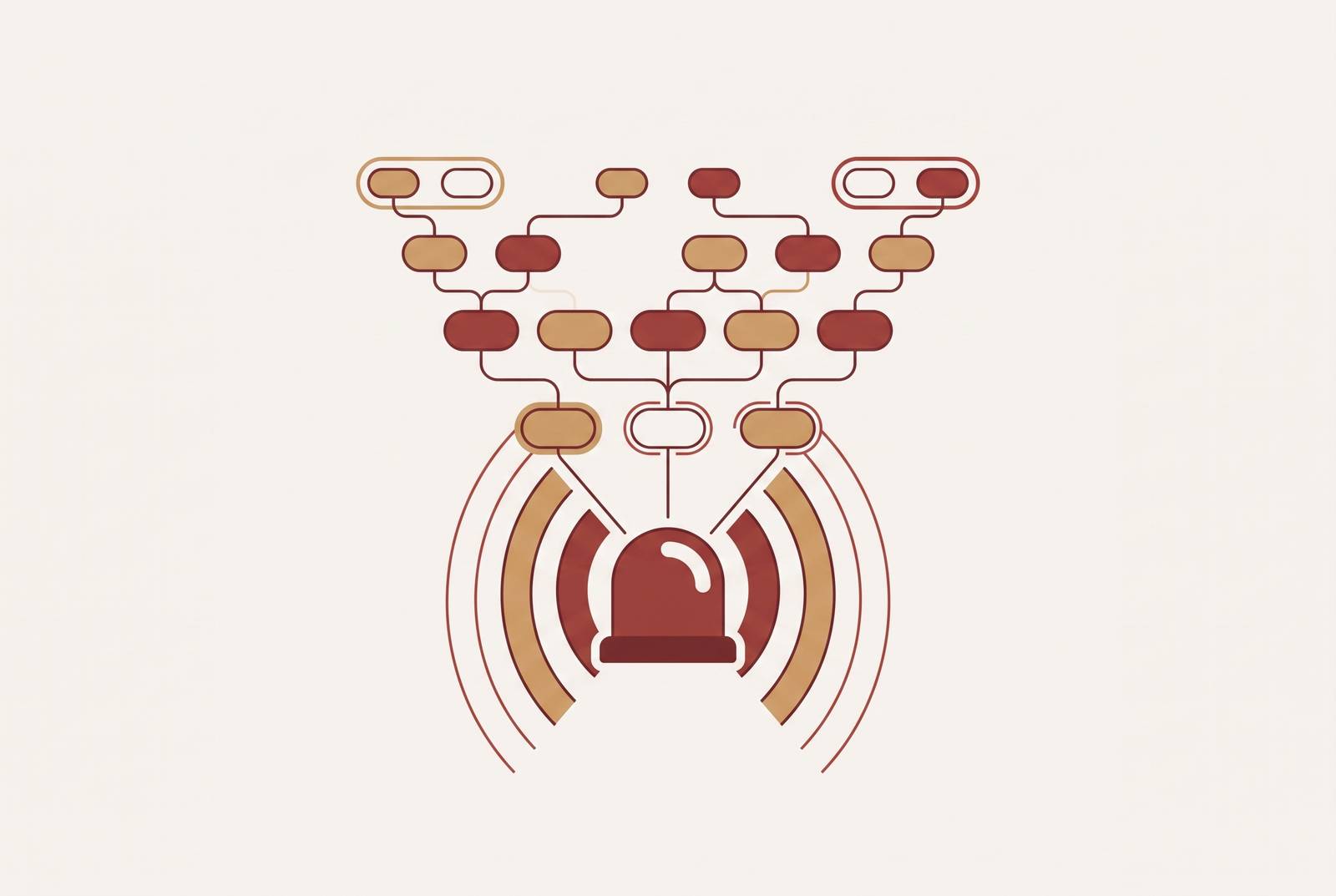
Long-term care facilities do not lack resident risk data. The data is already there, but nothing moves it through the organizational layers fast enough to trigger intervention before harm occurs. The failure point is routing and action, not detection, and every design choice in an escalation protocol must follow from that distinction.
Why LTC alert systems fail at the routing stage, not the detection stage
Long-term care facilities already generate substantial resident risk data through MDS assessments, clinical notes, vital-sign monitors, and infection-surveillance modules. The problem is that this data rarely moves fast enough through staffing hierarchies to produce a clinical intervention before a condition worsens. Three intersecting failures drive the gap. Structured assessment schedules miss deterioration that occurs between windows. Alert systems are so noisy that staff disengage from them. And clinical notes contain early warning signals that remain locked in unstructured text, invisible to any automated routing logic.
The MDS illustrates the blind spot precisely. Data is collected during defined structured periods, and what happens between those periods often cannot be captured on the MDS and may not impact quality measures unless a significant change in status triggers an unscheduled assessment. That means early-deterioration signals appearing in nursing shift notes and care-plan entries sit outside the formal assessment record at exactly the moment they are most actionable. More than 80% of alerts in clinical systems were either false alarms or notifications requiring no medical intervention, which compounds the problem: the channels that might carry a real signal are already saturated with noise that has conditioned staff to disengage.
The practical implication is not that facilities lack information. It is that no structured pathway exists to route the right signal to the right person with enough context to act on it. An escalation protocol is that pathway, and its absence is what turns abundant resident data into a documentation archive rather than a clinical safety mechanism.
How the 2026 CMS risk-based survey shift raises the stakes for escalation documentation
Escalation protocols are not merely a safety mechanism. In the current regulatory environment they are a compliance instrument whose time-stamped, role-specific records constitute the paper trail surveyors now scrutinize when a fall, pressure ulcer, or behavioral incident occurs. On July 16, 2026, CMS announced a new risk-based survey approach for nursing home inspections beginning September 8, 2026, redirecting limited survey resources toward complaint investigations, overdue recertification surveys, and facilities presenting greater resident risk. The policy does not reduce the importance of documentation. It concentrates survey attention on the facilities where an incomplete record carries the most exposure.
The shift in Special Focus Facility selection makes the documentation stakes concrete. CMS moved selection focus toward the prevalence of resident falls, and when candidates have similar compliance histories, CMS recommends selecting the facility with the higher resident-fall prevalence. Fall-related escalation documentation now functions as a direct determinant of survey selection, which means the record of who was notified, when, and what action followed is not an administrative formality. It is the evidence that separates a facility with a functioning safety system from one whose falls suggest systemic failure.
The MDS 3.0 Quality Measures User's Manual v18.0, effective January 1, 2026, extends the same logic to psychotropic medication. Diagnosis exclusions for schizophrenia, Tourette's syndrome, and Huntington's disease coded on the MDS must now also be supported by Medicare or Medicaid claims data, or they will no longer qualify as exclusions. That tightens the long-stay antipsychotic measure and increases survey focus on psychotropic documentation, which makes behavioral-incident escalation records more consequential. Nursing home surveyors have cited resident-on-resident violence more than 700 times since the beginning of 2024, and each citation raises the same question: what did the facility know, who was told, and what was done.
The Long Term Care Community Coalition also notes that conditions in a nursing home can quickly change due to staffing changes, management turnover, or owners' financial priorities. A facility's past survey history is not a reliable proxy for current safety. An escalation protocol that generates auditable records is one of the few internal mechanisms that remains credible when survey criteria shift, precisely because it documents present-tense clinical response rather than relying on historical reputation.
Which clinical signals belong at the top of a tiered alert framework
A tiered escalation framework should be anchored to a small set of clinical variables that are simultaneously predictive of unplanned hospitalization and reportable on CMS quality measures. These are the signals that matter most for both resident outcomes and regulatory standing, and they deserve the first tier of any alert hierarchy because they carry the highest consequence when missed. The anchor set is not arbitrary. It follows from what the data shows about which factors actually predict deterioration.
Machine learning applied to routine LTCF assessments can identify a compact set of predictors capable of forecasting six-month unplanned hospitalization. That caveat matters: the findings establish feasibility and signal value, not a finished predictive instrument. Facilities should treat the research as evidence for which variables belong in a monitoring framework, not as a turnkey model ready for deployment.
For infection-specific risk, a 2025 study using facility-year observations from 2019 to 2024 found that machine learning models outperformed traditional logistic regression in predicting UTI rates, with Random Forest identifying rural location and number of staffed beds as influential predictors. If an escalation framework only scores individual residents on clinical variables, it will miss facility conditions that systematically raise risk. The same triage logic must govern alert prioritization. An escalation system cannot alert on everything, and the decision about what it does alert on should be defensible in terms of both clinical consequence and regulatory exposure.
How alert fatigue erodes escalation behavior and what the research shows fixes it
Alert fatigue is not a minor inconvenience. It is a measurable cause of escalation failure, and the design choices that create it are known and avoidable. The causal chain from noise to missed intervention is not hypothetical. It survives statistical controls for the other factors that might explain it.
The same study found the remedy, and it is a structural one. Nurses with access to standardised escalation protocols reported significantly higher escalation behavior scores, meaning the protocol structure itself is protective against fatigue-driven inaction. The finding reframes what a protocol is for. It does not just route information. It preserves the responding clinician's capacity to act by removing ambiguity about what requires action and who owns it. A 2026 Springer study identified a broader phenomenon, behavioral nudge fatigue, extending beyond alarm fatigue, and suggested that addressing it through human-centered system design and greater involvement of nurses in alert governance may support both nurse well-being and patient safety.
The structural fix follows directly from this evidence. Alert systems should use role-specific thresholds, not a single alarm sent to every nurse. CNAs receive proximity alerts for immediate, bedside-level concerns. Charge nurses receive clinical deterioration flags that require assessment and decision-making. Nursing managers receive only true escalation events that exceed a defined threshold and require a documented response decision. This tiering reduces the volume of alerts any single person receives while ensuring that each alert that does arrive is matched to the authority and responsibility of the person receiving it.
The four structural components every escalation protocol must define
An escalation protocol that closes the detection-to-action gap must define, in advance, four things: trigger criteria, tiered response pathways, role-specific accountability, and feedback loops. Without all four, any one element will fail when it matters most. The four components function as a system, and each is specified below.
Trigger criteria
Trigger criteria define which note types and clinical observations activate an alert. Shift notes, skin assessments, behavioral observations, and hydration and nutrition entries are the note categories most likely to carry early-deterioration signals invisible to structured dashboards. Thresholds should distinguish between single-event alerts, such as a fall or a new skin wound, and trend-based alerts, such as three consecutive shifts with documented refusal to eat. Trend-based triggers require pattern detection across notes, not just point-in-time flagging, and they are where unstructured documentation becomes essential to escalation logic.
Tiered response pathways
Tier structure maps severity to responder. Oregon DHSOHA's interim LTCF infection control guidance illustrates how entry screening, outbreak posting, and transmission-based precaution triggers each carry distinct requirements. That is a model for how clinical alert tiers can mirror regulatory notification tiers: the escalation pathway should respect the external reporting structure the facility already operates under.
Role-specific accountability
Each tier must name who is responsible for acting within what timeframe. Documented, time-stamped role-specific records are the auditable evidence surveyors examine when a fall or behavioral incident is cited, and without named accountability the paper trail has gaps that become F-tag exposure. The same cross-functional clarity applies to resident-risk escalation, not just IT or safety events. Escalation is a clinical incident response problem, and the accountability structure should match that gravity.
Feedback loops
A closed-loop protocol requires that the person who received an alert document what action was taken and when. Without that documentation, the escalation chain is open-ended and produces no learning signal for protocol refinement. Feedback data, meaning which alerts were acted on, which were dismissed, and which were escalated further, is the raw material for threshold calibration over time. It is also the mechanism for reducing alert fatigue by retiring triggers that consistently produce no clinical intervention. A feedback loop is what turns an escalation protocol from a static policy document into a self-correcting operational system.
Why unstructured clinical notes are the most underused input in LTC escalation systems
The earliest clinical deterioration signals in long-term care appear in unstructured narrative notes. A nurse's notation of unusual restlessness, new confusion, or refusal to eat often precedes by days what would be captured in a structured assessment field, making those notes the highest-value and most neglected input for escalation trigger logic. The trigger criteria component of a protocol cannot function as intended unless it includes these notes in scope, because the trend-based triggers that matter most for early intervention depend on exactly this kind of free-text observation.
Electronic health records store information both as structured data, such as laboratory results and medications, and unstructured narrative text, such as physician notes and imaging reports. The challenge is operational, not conceptual. Manual annotation is the current de facto standard for converting it into usable signal, but it is labor-intensive and subject to human annotator variability.
Large language models represent the current frontier in this space. The implementation question is not which technique to adopt but how to scope the problem. Escalation protocol designers must define which note types activate which triggers: shift notes for behavioral change, skin assessment entries for wound trajectory, nutrition and hydration notes for intake decline. That upfront scoping decision is what makes note-based escalation feasible rather than aspirational.
How chronic understaffing shapes what an escalation protocol must compensate for
An escalation protocol designed without accounting for chronic nurse staffing shortfalls will consistently break down at the point it is most needed, because the human links in the escalation chain are operating under the same resource constraints that make missed signals likely in the first place. LTCCC's Q1 2026 staffing report, released August 31, 2026, found that chronic understaffing continues across nearly nine in ten U.S. nursing homes. The vast majority of facilities must therefore design escalation pathways that function reliably when the charge nurse is covering multiple units or the nursing manager is off-site.
Staffing changes and management turnover can quickly degrade conditions in a nursing home in ways that publicly reported quality metrics do not yet reflect. An escalation protocol that does not depend on optimal staffing is a resilience mechanism, not just a clinical tool. A tier-two alert that nominally requires a charge nurse response within 15 minutes becomes a documentation liability if the charge nurse is routinely unavailable at that interval. The protocol must not promise a response cadence the facility cannot staff.
A second design implication concerns cognitive load. That matters particularly when staffing is thin and nurse bandwidth is constrained. Escalation protocol design cannot fix the staffing crisis, but it can compensate for its most dangerous downstream effect: the cognitive overload that causes a documented pattern to go unnoticed.
Making the escalation framework work without creating new documentation burdens for nursing staff
The escalation framework described in this article is only viable if it draws on documentation nurses are already producing. Any requirement to enter data into a parallel system, complete additional forms, or change charting workflow will reduce compliance and undermine the signal quality the protocol depends on. The framework's value proposition must be extraction and routing, not data creation.
Nurses already produce the observations that feed a well-designed escalation system: shift notes, skin assessment entries, behavioral observations. Tools that read existing EHR documentation rather than requiring new structured entries preserve the clinical workflow that makes nursing staff willing to chart thoroughly in the first place. The audit trail must derive from the same notes that triggered the alert. Otherwise the feedback data measures form compliance, not clinical reality.
A clinical intelligence layer that processes unstructured notes, ranks residents by risk, and routes the right signal to the right role can recover meaningful nursing manager time. That time can be redirected toward the clinical interventions the escalation framework is designed to enable. The practical test for any escalation tool is the question that should govern procurement and design alike: does it require nurses to do anything differently, or does it make the intelligence already in their charting visible and actionable to the people who need to act on it?
Sources
- LTCCC Alert: CMS’s New Risk-Based Survey Policy for Nursing Homes Puts Vulnerable Residents at Risk - NursingHome411
- LTCCC Alerts - NursingHome411
- Interim Summary of Long-Term Care Facility Infection Control ...
- Digital alert fatigue and escalation behaviours in nurse-led remote postoperative care: a cross-sectional study
- Machine-learning prediction of 6-month unplanned hospitalization among long-term care residents: A multicenter study with external validation in Anhui, China - PubMed
- Digital alert fatigue and escalation behaviours in nurse-led remote postoperative care: a cross-sectional study - PMC