F-Tag Gap Detection Tools for Skilled Nursing Facilities — Platform Comparison
Three 2026 CMS actions will judge SNF compliance continuously, not at survey time.

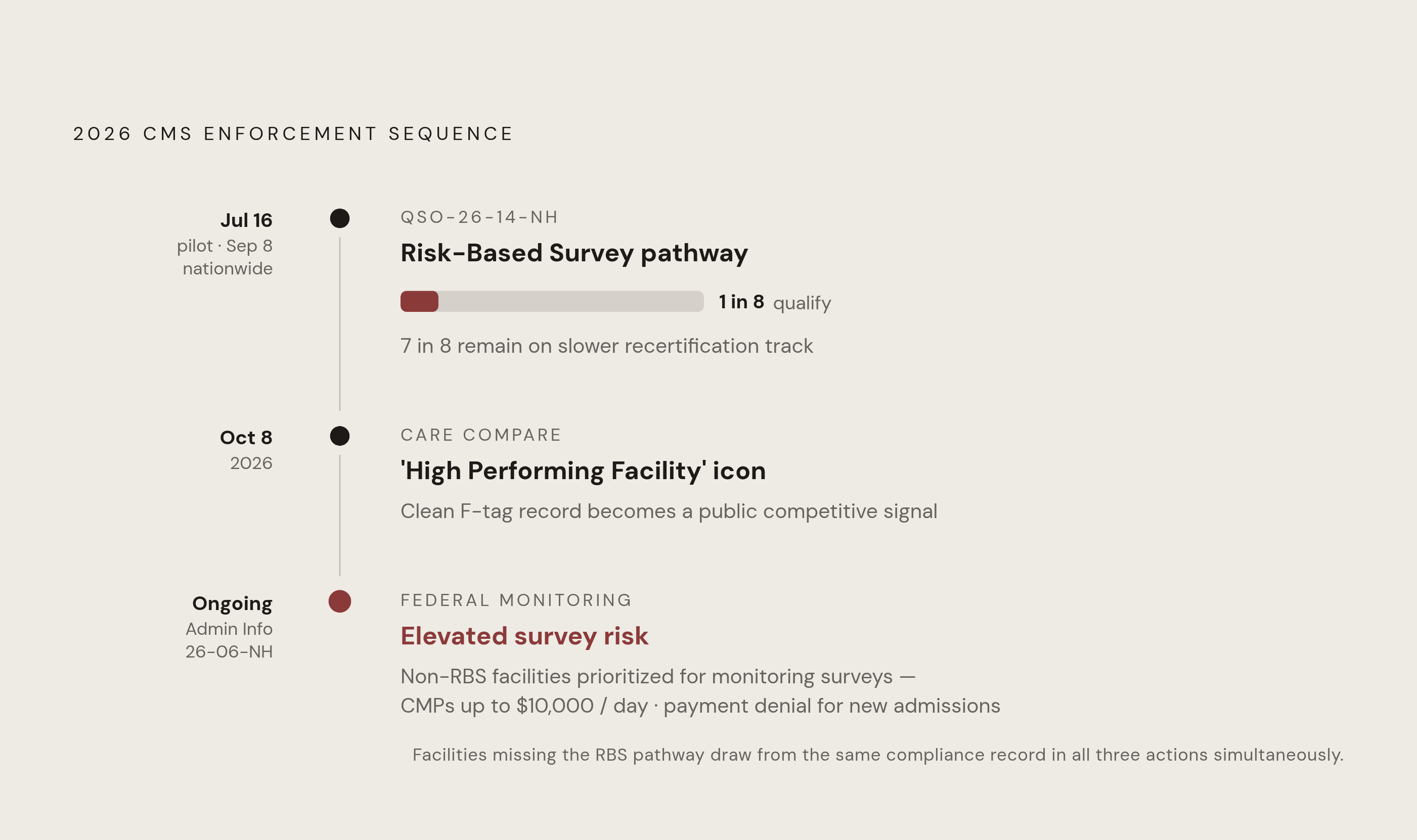
F-tag compliance was once a periodic paperwork exercise, but now it is a continuous enforcement mechanism, and it determines survey frequency, payment, and public reputation all at once. The F-tag list itself keeps moving: CMS issued a revision, originally released in November 2024, that took effect April 28, 2025, and the regulatory floor facilities are measured against has not stopped shifting since. Three CMS actions arrive in 2026, and they compound one another because all three draw from the same record: the documentation a facility produces every day. The Risk-Based Survey system, established under QSO-26-14-NH and effective July 16, 2026, with nationwide implementation beginning September 8, 2026, offers a faster, lighter recertification path to facilities that can demonstrate continuous compliance. CMS estimates only about one in eight nursing homes will qualify when the pathway opens, leaving the remaining seven in eight on the slower, more exposed recertification track.
Starting October 8, 2026, CMS will mark qualifying facilities on Nursing Home Care Compare with a "High Performing Facility" icon, under the terms of QSO-26-14-NH. Families can see that icon directly when they compare homes, so a clean F-tag record becomes a competitive signal, not just an internal metric. CMS Admin Info 26-06-NH adds a third layer: Federal Monitoring Survey selection can now prioritize providers based on data showing a risk of noncompliance, a history of noncompliance, allegations of noncompliance, CMS location-specific concerns, or media attention. A facility that misses the RBS pathway is drawing from that same compliance data, so it faces a higher chance of being flagged for a monitoring survey as well.
The financial exposure behind all of this is specific. Under 42 CFR §488.408, CMS may impose Civil Money Penalties of up to $10,000 per day, adjusted annually for inflation, for higher-tier F-tag deficiencies. A single condition-level deficiency can also trigger denial of payment for new admissions, which cuts directly into a facility's revenue regardless of its census. Together, these three 2026 actions mean a facility's compliance posture is no longer judged at a point in time. It is judged continuously, against a documentation record that CMS is now mining in more ways than it was even a year earlier.
The Documentation Problem Inside the EHR
Most F-tag exposure does not begin with a failure in care. The large majority of data inside an EHR is unstructured: clinical notes, shift summaries, and patient narratives written in a nurse's own words. That narrative text often holds the only record of something clinically significant, a subtle change in a resident's condition, a judgment call during a shift, but it cannot be systematically reviewed at scale in its raw form.
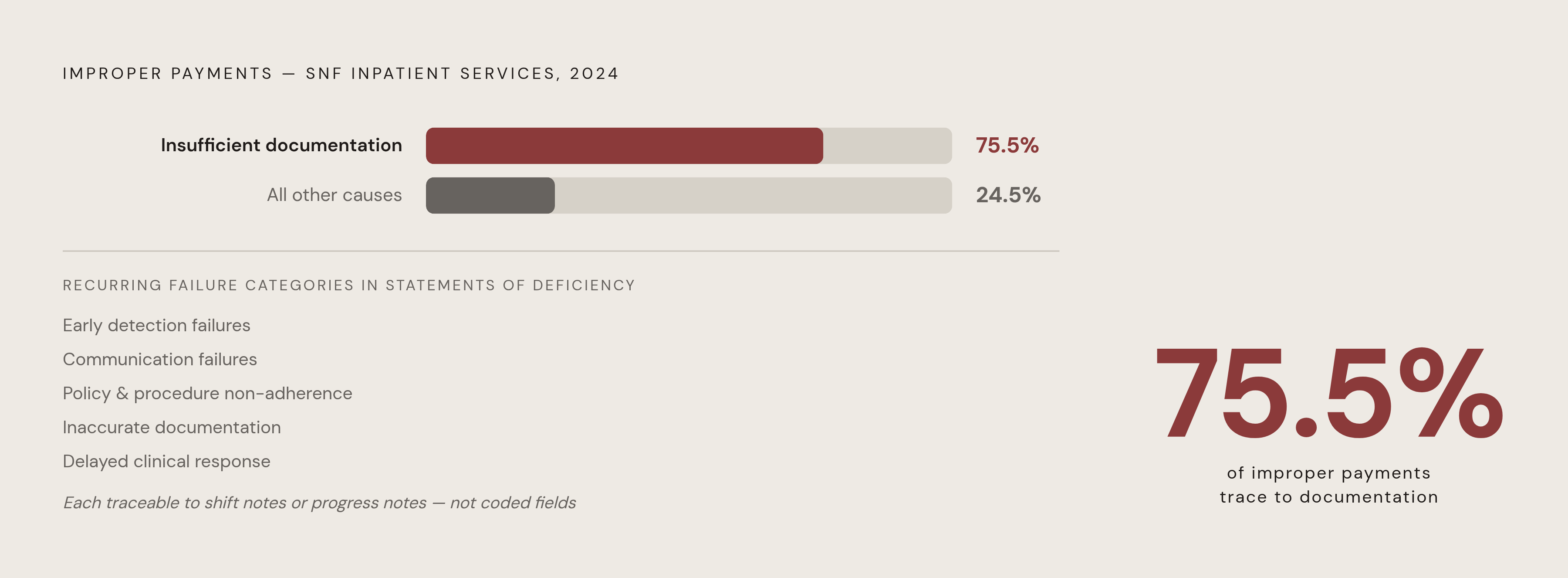
CMS's own compliance data shows just how much of SNF audit exposure traces back to this gap: insufficient documentation accounted for 75.5% of improper payment rates for SNF inpatient services during the 2024 reporting period. Content analysis of Statements of Deficiency across nursing homes finds the same handful of failure categories repeatedly: early detection failures, communication failures, failures to follow policy and procedure, inaccurate documentation, and delays in initiating a clinical response. Every one of those categories leaves a trace somewhere in a shift note or progress note, even in cases where the coded fields in the chart show nothing out of order.
MDS Validation Audits make this gap concrete. That requirement exposes the gap between what a nurse wrote in a narrative note and what the corresponding MDS field actually records. June 2026 CMS data shows where this exposure concentrates: F689 (accident hazards and falls), F695 (nutrition and hydration), F880 (infection control), F641 (accuracy of assessments), and F605 (freedom from chemical restraints) are among the tags carrying the most citation exposure. F0689 citations carry particular weight: nearly one in three involved actual harm or immediate jeopardy, the highest proportion of serious findings among the top-cited tags.
NLP and the Compliance Signal
Natural language processing is what makes it possible to check unstructured clinical documentation against regulatory requirements at scale, and it does this without asking nursing staff to enter a single additional field. Applied to compliance work, NLP scans unstructured records to find care gaps, near misses, and quality deviations that coded fields miss entirely, because no one ever translated the narrative into a structured flag.
The research basis for this approach is established. A 2026 systematic review found that integrating structured and unstructured data using NLP embeddings and large language models consistently outperforms traditional regression modeling, though fully integrated systems in post-acute care remain scarce. The practical mechanics back this up: language models predicting SNF discharges from unstructured H&P text have achieved strong predictive performance, with a technique called ELC substantially reducing input length compared to raw H&P text. That matters for compliance applications because it shows modern NLP can work from compressed, clinically meaningful representations of nursing notes rather than requiring a system to process entire raw charts line by line.
What the three platform categories do
Before a facility compares individual products, it needs to know which layer of the compliance stack its own gaps live in. The market divides into three functionally distinct categories, and a facility that buys one platform assuming it covers all three will still have gaps a surveyor finds.
Layer 1 consists of clinical EHRs. The EHR functions as the data source for everything downstream, not as the compliance engine itself.
Layer 2 consists of document-compliance layers, which address the non-clinical F-tag evidence gap that EHRs leave unstructured: staff training records under §483.95, resident-rights notices under §483.10, contractor conflict-of-interest disclosures, license expirations, and plan-of-correction artifacts. The evaluative question that should guide any purchase is which platforms within each layer read documentation that already exists, rather than requiring a new data-entry step from staff who are already at capacity.
Clinical risk and QAPI platforms: which tools surface gaps from existing documentation
Within the clinical risk and QAPI layer, platforms that read documentation nurses have already written surface compliance gaps fastest.
Ascenix reads unstructured clinical notes nurses already enter into their EHRs and converts that existing documentation into automated compliance reports, ranked resident risk scores, and gap alerts across every incident category driving regulatory exposure: falls, medication errors, hydration, skin wounds, and behavioral changes. The platform is live in 50 homes, and facilities using it have recovered up to 20% of nursing manager time. It covers the F-tag domains carrying the highest citation volumes and harm rates: falls (F689), pressure ulcers (F686), hydration and nutrition (F692), and medication management. Its design also lines up directly with the RBS qualification requirement: continuous, data-supported compliance documentation in place of a pre-survey scramble.
Other platforms in this layer address adjacent needs. skyComply focuses on legal, regulatory, and compliance risk across senior care organizations, turning survey findings into structured correction workflows and tracking each deficiency through closure, while supporting CMS and state findings, plans of correction, assigned actions, evidence collection, and portfolio risk monitoring. EPICompliance Pro SNF is built specifically around skilled nursing compliance, with workflows spanning quality, facility oversight, staffing, policies, vendor management, billing integrity, incident tracking, investigations, corrective actions, QAPI, and survey preparation. QAPI360 is built around Quality Assurance and Performance Improvement programs, and its AI tools can draft analyses and annual program evaluations for you. SNF AI positions itself as an AI-powered operating platform for skilled nursing facilities, using machine vision that continuously scans for the patterns that lead to F-tags, deficiencies, and survey citations.
Document-compliance layers: closing the non-clinical evidence gap
A facility can have strong clinical risk monitoring in place and still accumulate document-driven citations, because staff training records, resident-rights notices, and contractor credentials often live in binders and attachment fields that no system is systematically checking. Infection prevention and control (F880/§483.80), freedom from accident hazards (F689/§483.25), quality of care (F684/§483.25), food safety (F812/§483.60), and care planning (F656/§483.21) are consistently among the most-cited F-tag deficiencies on SNF standard surveys. These categories of documentation run on fixed cadences, so software built to enforce complete-by-design documentation can wipe out this category of citation.
FileFlo positions itself as the document-compliance layer for SNFs that already run an EHR. If you are evaluating a clinical platform, check in the same pass whether its document-compliance layer is current.
Incident-specific documentation tools: closing the F0689 gap at the point of care
F0689 is the tag where documentation failures most reliably produce citations at the actual-harm level, and the deficiency pattern repeats across facilities in a way that points to a structural gap in how incident records get created, not to isolated staff failures. When a surveyor reviews an incident under F0689, the review looks for the time and circumstances of the incident, immediate interventions, witness information, resident response, follow-up actions, and root cause analysis. A note that reads "resident was found on the floor" does not meet that standard.
Common deficiency patterns recur across incident records: missing environmental assessments at the time of the incident, incomplete post-incident follow-up, inconsistent documentation between shifts, delayed documentation, and no documented risk reassessment after a fall. A clinical risk platform that reads unstructured notes and flags incomplete incident documentation catches this gap at a portfolio level, across every resident and every shift. Facilities running both cover the F0689 exposure from both ends: one closes the gap in the record as it's written, the other catches what still slips through afterward.
The documentation burden on nursing staff and platform selection
Any platform that requires nurses to enter data in a second system, in a different format, or at a different time than their existing charting will generate incomplete data, and it will fail to close the gaps it was purchased to close. Nurses already give up a substantial share of every shift to documentation: registered nurses spend an estimated 25 to 35 percent of every shift on charting, time taken directly away from patient care.
The workforce dimension makes this constraint harder to ignore. The KLAS Arch Collaborative's 2025 report describes nurses as "shock absorbers" for the regulatory requirements layered onto documentation, and it finds that a significant share of nurses surveyed intend to leave their current role by 2029, citing documentation burden among the contributing factors. A 2026 Black Book Research survey of RN manager respondents found that 86% say documentation requirements regularly cut into the RN time available for direct patient care, and most want AI to start with low-risk, high-volume tasks before it takes on any autonomous clinical judgment support.
The question worth asking of any compliance tool is where the tool gets its data. Ascenix's design follows that same logic: it reads unstructured notes nurses have already written rather than requiring duplicate entry, and the up to 20% recovery in nursing manager time comes from eliminating manual review and reporting work, not from layering a new tool onto an already full shift.
Evaluating a platform against a facility's F-tag exposure profile
The right platform for a given facility is the one that closes the gaps appearing most often in that facility's own Statement of Deficiencies and resident population, not the platform with the longest feature list. Repeated citations in the same tag area point to a systemic gap, not an isolated incident, and that should drive where a facility spends its platform budget.
Cited tags map onto specific platform layers. Clinical tags, falls (F689), pressure ulcers (F686), infection control (F880), quality of care (F684), and hydration (F692), call for a platform that monitors clinical documentation continuously. Document-driven tags, staff training (§483.95), resident-rights notices (§483.10), and MDS accuracy (F641), call for a document-compliance layer that enforces fixed cadences and produces audit-ready records on demand. The annual facility assessment pulls resident population, staffing requirements, and risk profile into a single foundational document, and a platform that tracks resident risk scores feeds that assessment directly, eliminating manual compilation.
Checking the data source behind each vendor's platform reveals compliance gaps that a feature list alone will not show. CMS estimates only about one in eight nursing homes will qualify when the pathway opens, and a facility outside that one-in-eight should identify whether its gap sits in clinical monitoring, document evidence, or both before choosing where to invest.
Continuous gap detection across the compliance stack
A facility running continuous F-tag gap detection does not experience a survey as an audit. The document-compliance layer keeps the survey binder current at all times: staff training records, resident-rights acknowledgements, contractor credentials, and plan-of-correction artifacts stay organized and retrievable without a scramble in the days before a surveyor arrives. Point-of-care documentation tools close the remaining gap at the moment an incident occurs, capturing environmental conditions, immediate interventions, and follow-up actions while they are still fresh.
These three layers map directly onto the three 2026 CMS actions driving this shift. Continuous clinical data supports RBS qualification. A clean, current document record supports the Care Compare "High Performing Facility" designation arriving October 8, 2026. So a consistently well-documented compliance posture reduces the risk indicators that trigger monitoring survey prioritization under Admin Info 26-06-NH. Under the Risk-Based Survey model and its continuous compliance scoring, a facility qualifies for the faster recertification pathway only if its documentation stays current, complete, and auditable at any moment CMS looks. A platform built for long-term care can turn the notes nurses write during an ordinary shift into that audit trail automatically, and it adds no new task to their day.
The starting point for any facility is an honest audit of where its own compliance gaps originate: clinical documentation, document evidence, or incident-level records. Each layer calls for a different kind of tool, and the facilities that close these gaps fastest are the ones that pick platforms reading from data nurses have already produced, rather than platforms that ask already-stretched staff to produce more.