MDS Quality Measures Used in Five-Star Rating Calculations for Nursing Homes
Nursing homes' star ratings depend on how CMS scores 15 quality measures from resident data.

MDS quality measures shape nursing homes’ Five-Star ratings, but better clinical rates do not translate directly into more stars. Intentional improvement depends on understanding which measures count, how CMS scores them, and whether the documentation supports the result. The strongest strategy joins accurate MDS coding with continuous clinical monitoring and consistent care, so that the rating improves because the underlying performance improves.
How the Five-Star system is structured and where QM ratings fit
The Five-Star system has three domains, which are Health Inspections, Staffing, and Quality Measures. Each produces its own star rating, but the overall rating is not an average of the three. Instead, it starts with the health inspection rating, after which Staffing and Quality Measures can each add or subtract one star. A strong QM rating can therefore lift the overall result, while a weak one can lower it.
CMS’s Technical Users’ Guide states that the July 2025 revision bases the health inspection domain on the two most recent standard surveys, with the most recent weighted at 75%. The guide also introduces a trophy icon at the September 2026 refresh for highly performing homes, reflecting fewer citations, higher staffing, and other quality indicators. That designation supplements the traditional rating. In this system, QM gives clinical teams the most direct way to affect ratings through daily care and documentation.
The 15 quality measures that make up the QM rating and what each one tracks
The QM rating has 15 measures, 9 for long-stay and 6 for short-stay residents, that use data from MDS assessments and claims. The long-stay MDS measures track increased need for help with daily activities, worsened ability to walk independently, pressure ulcers, an indwelling catheter, and urinary tract infections. They also track residents experiencing one or more falls with major injury and residents receiving antipsychotic medication. The antipsychotic measure’s January 2026 redesign supplements MDS data with claims and encounter data.
The two long-stay claims-based measures track how many hospitalizations and outpatient emergency department visits there are per resident days. They contribute to the long-stay score, but their focus differs from the assessment-based measures. They capture hospital and emergency department use rather than a condition or functional change recorded through MDS.
The three short-stay MDS measures track discharge function, new or worsening pressure ulcers or pressure injuries, and antipsychotic medication received for the first time after admission. Discharge function measures the percentage of residents at or above an expected ability to care for themselves and move around at discharge. It replaced the prior functional improvement measure in January 2025. The three short-stay claims-based measures track whether residents have a re-hospitalization after nursing home admission, have outpatient emergency department visits, or make a successful return to home and community. Successful return uses a two-year data period, while most MDS measures use the four most recent quarters.
How MDS data is converted into points and then into a star rating
A clinical rate earns points according to its position in the national performance distribution. CMS groups facilities into deciles or quintiles for each measure and awards more points for better performance. The direction of improvement depends on the measure. For emergency department visits, a lower rate is better, while for discharge function, a higher score is better. The clinical rate and the points it earns are therefore related, but they are not the same result.
Most MDS-based measures use data from four quarters in a resident-weighted calculation. Each quarter’s applicable risk-adjusted rate is multiplied by its eligible resident count, and those results are summed and divided by the total eligible residents. A quarter with more eligible residents consequently contributes more than one with fewer. The points from these measures make up a Long-Stay QM Score and a Short-Stay QM Score. CMS adjusts the short-stay score so that the two groups count equally in the Total QM Score despite their different numbers of measures.
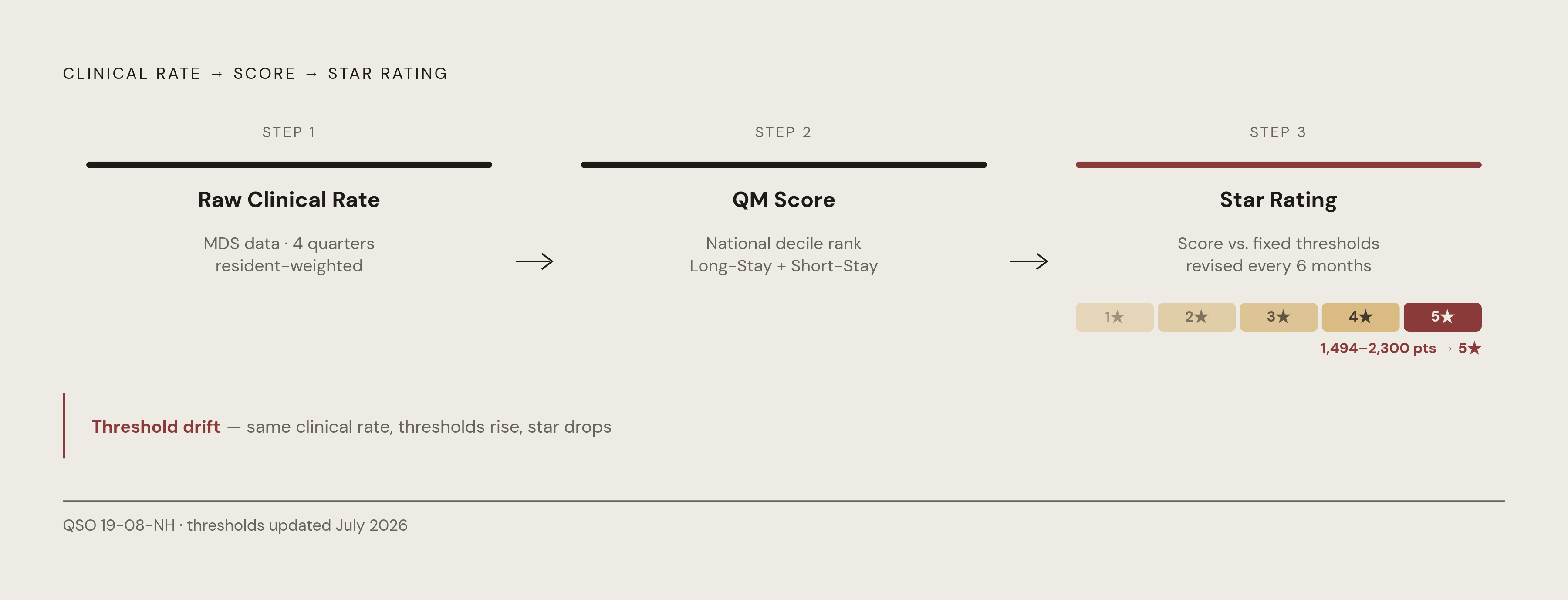
The January 2025 baseline had a separate band of total scores for each rating from 1-star through 5-star. CMS’s Technical Users’ Guide says the revised band for 5-star in July 2026 is 1,494–2,300 points. Earning measure points is thus one step, and crossing a star threshold is another. A facility’s result depends on both.
Why the QM thresholds rise automatically and what flat performance actually costs
QSO 19-08-NH permits CMS to increase QM rating thresholds every six months by an amount equal to half the average national improvement in QM scores. As performance across the country improves, a facility may need more points to keep the same rating.
CMS’s Technical Users’ Guide says the July 2026 adjustment was based on the average improvement from January 2025 through April 2026. The resulting increases required more total QM points for 5-star and 4-star ratings than the January 2025 thresholds. A facility in the 5-star band in early 2025 could consequently fall into the 4-star band by mid-2026 without a change in its clinical rates. Repeated adjustments can widen that gap, although the policy does not establish a fixed future increase. Losing a star because a threshold rises can have the same effects on referrals and managed-care contracts as losing one because care gets worse.
Which five measures are risk-adjusted, and why that changes how Section GG data should be treated
Five MDS-based measures are risk-adjusted to account for factors at the resident level. They are long-stay loss of independent walking, pressure ulcers, and catheter use, together with short-stay discharge function and new or worsening pressure ulcers. All claims-based measures are also risk-adjusted. The purpose is to account for resident characteristics when comparing facilities, rather than treating every resident population as equivalent.
CMS’s Technical Users’ Guide states that the July 2025 update added Section GG functional ability variables as risk adjustors to four claims-based measures. CMS also revised their thresholds to maintain the same distribution. Functional coding at admission thus helps set the baseline for how well residents are expected to do, which is used to judge later outcomes. An assessment that understates acuity can raise that baseline and make a facility look worse in a risk-adjusted comparison. Section GG is not merely a reimbursement task, and admission workflows need accurate functional documentation because its effects extend into later QM calculations, including those tied to discharge.
Where MDS coding errors create regulatory exposure beyond the QM score itself
Schizophrenia coding errors can trigger a sanction that overrides the rating earned through measure points. Facilities identified through CMS’s schizophrenia coding audit have their overall QM rating and long-stay QM rating downgraded to one star for six months. Strong performance on other measures does not cancel that penalty. Documentation accuracy is therefore a compliance requirement as well as a way to protect points.
CMS’s Technical Users’ Guide also describes an April 2026 antipsychotic measure correction involving residents with schizophrenia who had not been appropriately excluded from the January 2026 data. That correction is distinct from the sanction for a facility’s inaccurate coding. Both show how the way residents are classified affects whether they are in the right group for measurement. Errors can affect individual scores and national distributions.
CMS’s data validation process began in early 2026 and checks MDS elements used in the Quality Reporting Program and value-based purchasing program. Roughly one in ten certified nursing homes were selected in the early rounds. Facilities that are selected must reply within five business days and send the required documentation within 45 days or their payment will be cut. OIG also found that many falls with major injury among Medicare residents go unreported. Such omissions weaken QM reliability and leave facilities open to survey findings.
How the antipsychotic hybrid measure signals where MDS-only reporting is heading
CMS’s Technical Users’ Guide says that the long-stay antipsychotic measure for January 2026 uses Medicare and Medicaid claims data and Medicare Advantage encounter data along with MDS data. Medication exposure is no longer confined to what appears within the 7-day MDS look-back window. Claims show what was prescribed throughout the nursing home stay, including exposure that assessments at set intervals can miss. The redesign changes the evidence used to represent the care episode.
Exclusion diagnoses, including schizophrenia, now require claims validation of MDS coding. A coded exclusion must therefore align with the wider record, making reconciliation between data sources part of documentation accuracy. CMS has stated that it may apply similar cross-validation approaches to other QMs, but the schedule remains unconfirmed. The implication is narrower than a claim that all MDS-only reporting will disappear. Workflows that capture medication events only within the assessment window have a blind spot, and reconciliation across the full episode addresses it.
Why QM ratings update quarterly but clinical decisions cannot wait that long
Quarterly QM updates summarize care over much longer periods. Most MDS-based measures use four quarters of data, while claims-based measures use a full year or two years. Earlier adverse events can therefore affect the score long after the care episode ends. Recent improvement takes time to displace that history.
The same rolling average also delays the visibility of deterioration. It buffers a single-quarter anomaly, but that smoothing can conceal an emerging clinical pattern. Managers relying only on Care Compare or quarterly preview reports are responding to a lagged signal. By the time a measure falls into a lower decile, the underlying problem may already span two or three quarters.
A 2024 PBJ research simulation provides an adjacent illustration of what summaries can miss. It found that adding a day-to-day staffing variation measure could change the staffing rating for 21% of nursing homes. This staffing simulation illustrates the limits of periodic summaries. Clinical teams need near-real-time monitoring of falls, pressure injuries, antipsychotic initiations, and functional decline before those events accumulate into a published score.
What continuous, note-based monitoring looks like in practice for the measures that matter most
Early signals already exist in the clinical record between MDS assessments. Nursing narratives tell of falls, wound assessments show how skin has changed, and progress notes show how behavior has changed. Therapy and ADL notes can show functional decline before it becomes structured data in the next assessment. The barrier is extracting and connecting that information while it can still inform care.
For falls with major injury, incident and nursing documentation can precede MDS coding by days. Wound notes provide pressure ulcer staging information before an OBRA assessment. Medication administration records and physician notes show when antipsychotic use starts, while therapy entries help show how function has changed. These records also provide the evidence auditors use to assess whether coded MDS items are supported.
Monitoring must draw on nursing, therapy, dietary, and social services because all of them affect the outcomes being measured. A system that reads only nursing notes will miss signals in other records. Tools capable of reading existing EHR documentation can surface those signals without duplicate entry or new workflows. Their practical value is bringing evidence forward while teams still have time to respond, rather than merely explaining a score after publication.
What a credible QM improvement strategy looks like across the measures, and where the strongest objection to it sits
A sound strategy starts with coding that the record supports, including exclusion diagnoses, risk-adjustment variables, and Section GG entries. Continuous monitoring then picks up events that affect the measures between quarterly refreshes. Care teams must deal with the conditions that lead to falls, pressure injuries, functional decline, and unsuccessful discharge. Because thresholds can rise, improvement should aim above the current 5-star threshold.
The strongest objection questions whether Five-Star QM ratings measure how good the care is. A relative score built from selected measures, documentation, and reporting windows is not interchangeable with the full quality of a resident’s care. That limitation matters even when every item is coded accurately. A stronger rating alone cannot establish that every part of care has improved.
QM ratings still matter because they shape how the public sees a home on Care Compare, whether it qualifies for managed-care contracts, and how many referrals it gets. Work on ratings should help reduce falls, prevent pressure injuries, and improve how medications are managed. Chasing points without changing care is ethically incomplete and fragile against audit. The most durable improvement makes the rating and the care move together.