Monitoring Plans After a Plan of Correction — Structure and Duration Standards
Weak monitoring language leaves facilities unable to prove corrections hold at revisit.
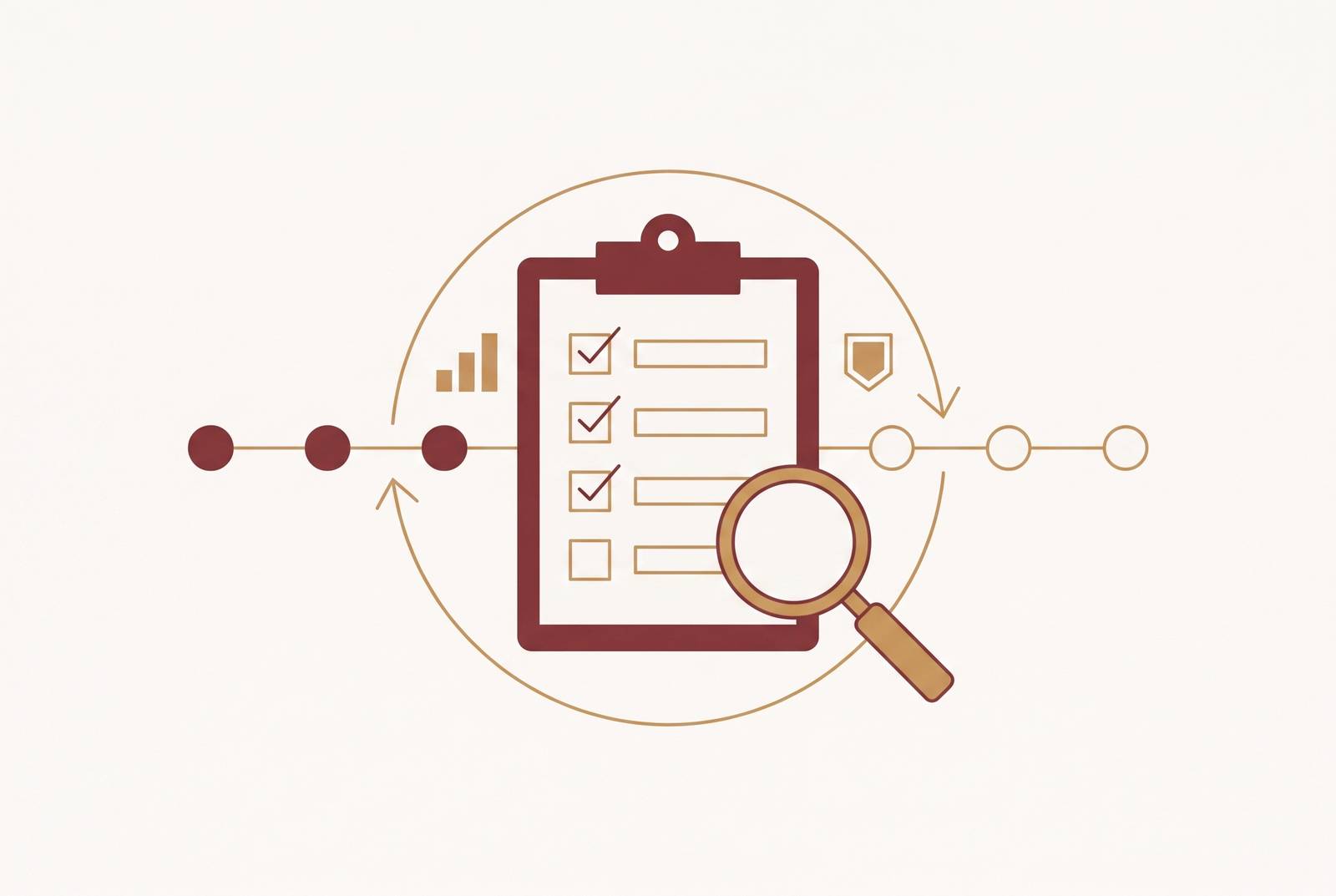
A monitoring plan embedded in a Plan of Correction must do more than support acceptance. It must define how the facility will detect recurrence, document results, and act over a period suited to the citation. Sustainable compliance depends on those structural and duration commitments being specific enough to evaluate and practical enough to maintain after the correction date.
Why the monitoring plan inside a POC is the part that most often fails
Acceptance does not show that residents are still protected. A facility may have corrected the cited noncompliance but still have no monitoring process to catch it if it returns. At revisit, that gap becomes a problem of evidence as well as care. A completed corrective action shows what happened once, while monitoring that works shows whether the correction holds.
Training may be complete and a policy revised, but neither establishes who will audit practice or what happens when performance slips. Without those connections, the POC documents a response rather than a system for preventing recurrence.
What the 10-day submission window requires the facility to commit to
CMS-2567 guidance establishes a submission window of 10 calendar days from receipt, including weekends and holidays. An insufficient plan must be revised and resubmitted within an already compressed compliance timeline. The deadline therefore requires the facility to decide how it will monitor care as it fills out the form. What the facility writes becomes a commitment that regulators can evaluate against subsequent practice and evidence.
An authorized representative, typically the administrator or director of nursing, must sign the first page. A missing signature can cause rejection and resubmission without resetting the enforcement clock. CMS moved electronic POC submission into iQIES, the Internet Quality Improvement and Evaluation System, in July 2025. Paper submission to the state survey agency was a temporary cutover backup, while CMS expects nursing homes previously using ePOC to use iQIES going forward.
The commitment must satisfy the reviewing agency. After acceptance, an on-site revisit is required for substandard quality of care, actual harm, or unresolved immediate jeopardy, while documentary evidence may substitute for lower-level findings. With either route, the evidence must match the written plan. Meeting the filing deadline cannot compensate for monitoring language that leaves the reviewer unable to determine what compliance looks like.
The five required elements of an acceptable POC and why monitoring is the weakest link
CMS-2567 guidance requires the response to each citation to cover five elements. These are corrective action for the residents identified in the findings, identification of others potentially affected, systemic changes to prevent recurrence, monitoring of ongoing compliance, and responsibility with a specific completion date. Each element answers a different question about the facility’s response. A strong account of resident-level correction does not compensate for an incomplete account of ongoing oversight.
The diagnostic distinction is between changing practice and testing it. Revised policies, training, and changes in care delivery describe the intervention, while audits and quality assurance activities establish whether that intervention works. Monitoring is underdeveloped when it names no auditor, frequency, documentation location, escalation trigger, or end date.
QSO-26-03-NH, revised April 3, 2026, addresses an OIG recommendation to clarify acceptable plans of correction after findings of noncompliance with participation requirements. The plan must connect the correction to evidence that the facility can maintain it, rather than treating completion of the initial work as the endpoint.
What a monitoring plan must specify to satisfy surveyors under the updated SOM
The memo revised Chapters 5 and 7 of the State Operations Manual, effective April 30, 2026, to tighten acceptable POC standards. A defensible monitoring element answers six practical questions. It identifies the specific practice or condition being audited, the responsible auditor role, the frequency, the duration, the documentation location, and the threshold for escalation. Together, those details turn a general promise into a process a surveyor can evaluate.
Precision begins with the object and method of the audit. “Nursing staff” does not identify an accountable role, and “regularly” does not establish an interval. A defined duration or end date establishes how long heightened monitoring will continue. The documentation pathway identifies the tool, log, or system in which results can be found, while the escalation threshold makes clear when observation must produce action.
An infection control citation under F-880 illustrates the difference. “Hand hygiene will be monitored” leaves nearly every operational question unanswered. A specific plan assigns the Infection Control Nurse a stated minimum number of covert hand hygiene observations per week for 12 weeks, with results documented and reported to QAPI. It also defines the compliance threshold below which a department receives an immediate department-level in-service. The plan’s actual minimum, threshold, and recording location must be stated explicitly for staff and surveyors.
How severity level determines the duration and intensity of required monitoring
The same monitoring period cannot meet the needs of both a D-level infection control finding and an F-600 abuse or neglect citation. The distinction concerns intensity as well as elapsed time. Higher-severity and abuse-related findings call for more demanding oversight because the monitoring must address the risk represented by the citation.
At the lower tier, non-IJ findings warrant an extended period of heightened monitoring with monthly QAPI reporting. Abuse and high-severity citations call for monitoring that lasts longer, from months to a year, with clear requirements for review each week. These expectations provide a severity-based framework for setting each citation’s end date. The 12-week infection control example does not establish the appropriate duration for an abuse finding.
Revisit timing adds another constraint to that framework. Immediate jeopardy and G-level and above citations usually lead to a re-survey within a short window of business days. Lower-severity findings may not generate a standalone re-survey and may instead be verified at the next standard survey. Monitoring therefore has to provide evidence early that the correction is holding and keep going after an early revisit.
What the enforcement consequences of an inadequate monitoring plan look like in 2026
An inadequate monitoring structure can leave recurrence undetected or correction unsupported at revisit, exposing the facility to enforcement remedies. The memo aligns Chapter 7 with the FY 2025 SNF Prospective Payment System final rule, which expands CMS’s ability to impose per-instance and per-day civil money penalties to promote sustained correction. Those revisions apply to enforcement cycles beginning on or after March 31, 2026. Beginning June 24, 2026, per-instance penalties are displayed on Nursing Home Care Compare, so the penalties are public as well as financial.
A facility not in substantial compliance three months after the survey’s last day faces denied payment for all new admissions. Continued noncompliance six months after the survey exposes it to provider agreement termination. These consequences arise from unresolved compliance failures, but weak monitoring can prevent the facility from detecting or demonstrating correction.
Federal comparative surveys can also identify additional deficiencies that affect compliance status and enforcement exposure. If such a survey identifies substandard quality of care, loss of the Nurse Aide Training and Competence Evaluation Program occurs. State acceptance does not insulate the facility from those findings.
How federal monitoring surveys evaluate the POC and its monitoring structure after acceptance
Admin Info 26-06-NH, dated May 15, 2026, describes three types of federal monitoring for FY 2026. Their main aim is to check how well the state survey agency does its work. Resource and Support Surveys place federal surveyors with state teams during standard, complaint, or revisit surveys to assess performance in real time. Health Comparative surveys provide an independent federal survey in the same facility within 60 calendar days of the state survey exit date, following all investigative protocols.
EP/LSC Desk Audits examine the documentary basis for compliance decisions. Federal surveyors review the CMS-2567, the accepted POC, and evidence of compliance obtained by the state agency if it conducted a desk review. The POC review evaluates adherence to 42 CFR 488.402(d). This gives the monitoring language a second audience beyond the agency that accepted it.
Although federal monitoring evaluates the state agency, comparative findings can confirm state-cited deficiencies or identify additional ones that directly affect the facility. An accepted plan remains open to scrutiny against evidence of restored and maintainable compliance. For FY 2026, CMS reduced the basis for calculating required federal monitoring surveys by approximately one-tenth because of the federal government shutdown from October 1 through November 12, 2025, while maintaining the statutory minimum of five SNFs per state.
Why QAPI is the structural backbone of a monitoring plan that holds up over time
QAPI gives time-limited corrective monitoring an ongoing organizational home. CMS requires nursing homes to have an ongoing program to monitor care and services, analyze what they find, and make improvements in a systematic way. That requirement extends beyond holding meetings. A facility that meets quarterly but takes no action between meetings has not established the continuous activity that monitoring requires.
Integration depends on what happens to audit results. Findings described as “results reported to QAPI” must feed into agendas, trending data, and documented performance improvement projects. A plan that spells out this pathway shows how each audit’s findings feed into the facility’s wider work to improve quality. It also distinguishes the end of heightened corrective monitoring from the end of attention to the underlying risk.
Meeting documentation is not the intended product. QAPI provides the structure through which a detected decline prompts analysis and action between meetings. Without that link, even an audit done on a careful schedule can leave a record but no change in care.
How clinical documentation in EHRs can drive the monitoring that POC plans describe but rarely operationalize
QAPI needs information at the intervals the POC promises. Much of that information already exists in nurses’ EHR documentation, including observations, condition changes, incident patterns, and evidence of care-plan adherence. The operational gap is access to that information. Compliance-relevant detail can remain buried in unstructured notes until someone extracts it manually.
Structured fields alone do not capture every sign of risk. Progress notes and food intake records can show risks to residents and help staff monitor them beyond what separate audits find. Extracting signals about falls, skin condition changes, hydration gaps, behavioral shifts, and medication patterns can populate monitoring reports without requiring nurses to chart the same information again.
Real-time risk stratification can also allow review intensity to track resident condition as documentation is entered. High-risk residents, including those named in survey findings, can be reviewed more often without nurses having to add documentation. This supports rather than replaces the plan’s committed audit frequencies. The operational test remains whether the facility can detect what its monitoring plan promises to detect, rather than whether a manual chart review happens to coincide with the schedule.
Building a monitoring plan that survives the correction date and the next survey
The practical approach is to build backward from the evidence a revisit or subsequent survey will require. A facility should begin with severity and citation category to establish the duration and intensity of heightened monitoring. It should then specify the auditor role, audit method, frequency, duration or discontinuation trigger, documentation location, and escalation threshold. Each commitment needs an operational counterpart that staff can carry out.
The next step is to define how results enter QAPI. The plan should describe how data will be trended and what pattern would trigger a performance improvement project, rather than naming QAPI as a destination without a process. The clinical documentation already being recorded should support that work wherever it holds the information needed for monitoring. Avoiding parallel data entry makes the promised audit frequency more sustainable.
An internal review at the halfway point provides a deliberate checkpoint. If trends show that the correction is holding, the facility has evidence for subsequent review. If they show otherwise, the facility has an opportunity to intervene before a revisit or comparative survey identifies the gap. The monitoring plan then functions as the facility’s own early-warning system, catching the recurrence that a surveyor should not be the first to find.