Reducing Duplicate Documentation Burden for LTC Nursing Managers — Platform Options
Platform choice should prioritize where nurses stop re-entering the same information.
Duplicate documentation in long-term care nursing is a workflow problem. Choosing a platform should therefore start with where information stops moving and nurses have to enter it again. Capture tools, coding assistants, document management, and predictive analytics each fill a different gap. Each should make use of documentation already in the record without giving nurses more to enter.
Why duplicate documentation persists in long-term care nursing despite EHR adoption
Clinical, administrative, and billing systems often hold the same information about a resident without sharing it across the places where staff enter it. Nurses have to fill those gaps by entering the same facts in separate records and redundant flowsheets. Consent forms, incident reports, physician orders, and external-provider inputs frequently sit outside the core EHR, while physicians, nurse practitioners, therapists, and nurses document in separate locations. An electronic record does not, by itself, create a shared documentation workflow.
That fragmentation also separates observation from charting. End-of-shift documentation becomes the predictable result of a system that leaves nurses to reconstruct care after providing it. Precision becomes harder as cognitive resources are depleted. Small details fade first, including a change in behavior, a slow decline in mobility, or a slight change in breathing. The resulting note may record that care occurred while losing the specificity needed to explain the resident’s condition and response.
What the documentation gap costs a facility in compliance, reimbursement, and care quality
Under PDPM, MDS coding accuracy determines case-mix classification and reimbursement. A mismatch between the MDS and the clinical record therefore creates financial exposure as well as a compliance problem. CMS’s 2025 update to F641 surveyor guidance explicitly includes review of MDS coding accuracy. The OIG’s 2025 audit of Pinnacle Multicare Nursing and Rehabilitation Center found coding errors that caused Medicare overpayments under PDPM. Documentation quality is consequently more than an internal charting standard.
Incomplete or delayed notes also weaken continuity between caregivers. Vague language that passes a review within the facility can fail a review by Medicare Administrative Contractors, Recovery Audit Contractors, and Unified Program Integrity Contractors. Facilities need to be ready for a survey before a review is scheduled. CMS QSO-26-03-NH, issued in April 2026, requires more recertification surveys during off-hours and minimum durations for recertification and complaint surveys. The Nursing Home Risk-Based Survey offers a lighter survey footprint for facilities that qualify, giving them more reason to judge tools by how well they help staff stay ready than by how well they support occasional chart cleanups.
The regulatory push toward deregulation and what it actually changes for documentation workload
The deregulation effort under way in 2026 targets administrative redundancy while retaining the clinical documentation standards behind survey findings and PDPM reimbursement. AAPACN’s requests include standardized surveyor training, national MDS standardization, and fewer redundant validation reviews. Those changes concern consistency rather than reduced clinical detail. They do not resolve the gap between an observation, its narrative record, and the structured fields that depend on it. For platform selection, the distinction is straightforward. Even if CMS finalizes deregulation, accurate, real-time, defensible documentation remains necessary, although particular forms or reporting steps may change.
How unstructured clinical notes become the hidden foundation — and the hidden bottleneck — of LTC documentation
Most EHR data in LTC settings is unstructured narrative text. Those notes often contain clinically meaningful information that appears nowhere in the structured record. Yet systems that cannot interpret it leave staff to translate its contents manually into MDS items, care plans, billing codes, incident reports, and risk assessments.
Natural language processing can read those notes and turn what nurses observe into structured clinical intelligence. It can help with MDS coding, find care-plan mismatches, and flag risk signals without asking nurses to write a second version. Its usefulness still depends on the original note. A behavioral change lost during delayed charting is also unavailable to a model reading that chart.
Point-of-care capture tools: reducing re-entry by closing the gap between observation and record
Mobile or voice-enabled documentation lets nurses record observations at or immediately after the interaction, when the details are still available. This removes the later reconstruction step from charting. Ambient AI scribes extend that approach by transcribing spoken observations, structuring the note, and mapping its contents to EHR fields. The category fits the single-entry principle only when that captured information reaches the record already used by the care team.
voize positions its bedside speech workflow around that connection. Its documentation describes structuring observations, interventions, and residents’ responses into the correct EHR fields, with weekly quality checks for care-assessment and care-plan discrepancies associated with F656 and F684 citations. For evaluators, limited and heterogeneous peer-reviewed evidence for AI scribes makes the distinction between vendor-reported gains and independently measured results important. The decisive workflow question remains whether the tool eliminates re-entry or moves it into a parallel record that staff must maintain.
MDS and PDPM coding assistants: turning narrative documentation into reimbursement-accurate structured data
MDS and PDPM coding assistants address the translation from narrative evidence to structured coding. A nurse documents functional status, and an MDS coordinator otherwise rereads that note to code the same information into MDS items. The assistant reads the narrative to support that second step. Under PDPM, the consequences are component-specific. For example, leaving out how often a restorative nursing program takes place and how long it lasts directly affects the Nursing component score, while errors in MDS coding also put the facility at risk under F641.
NurseMagic® Enterprise describes structuring SOAP, Narrative, and Shift notes and prompting clinicians for required compliance details, with claimed alignment to PDPM and MDS requirements. Flowtrics says it offers real-time suggestions, finds gaps in documentation, and helps with diagnosis-code support that meets MDS requirements. These claims need to be tested in the coordinator’s workflow. Useful differentiation includes how specifically coding support addresses PT, OT, SLP, Nursing, and Non-Therapy Ancillary components. The strongest distinction is timing. Flagging missing evidence before submission helps staff fix it at the source, while retrospective denial management starts after reimbursement has already been denied.
Workflow integration and digital document management: eliminating the paper-to-digital re-entry loop
Consent forms, incident reports, physician orders, and external-provider inputs may require staff to locate paperwork, obtain signatures, and transcribe information into the EHR. Capture and coding tools do not necessarily resolve this. Digital document management addresses the document lifecycle itself, including storage, retrieval, sharing, and electronic signatures. Its role is narrower than a general effort to remove paper.
GlobalDWS worked with Meighen Health on workflows in which external-provider inputs required manual entry and workload pressure pushed documentation to the end of shifts or after hours. However, digitization alone does not establish single-entry flow. An electronic signature can remove a signature bottleneck while leaving transcription untouched. For a nursing manager evaluating this category, the essential distinction is whether the platform populates structured fields in the core EHR or produces a standalone digital document that someone must still re-enter.
Predictive analytics layers: using documentation that already exists to surface risk before it becomes a survey finding
Predictive analytics reads existing documentation to identify resident risk trends, care-plan gaps, and compliance exposures. It does not require a new narrative from nurses. Models can use prior hospitalizations, chronic conditions, and vital signs to identify heightened hospitalization risk, while analysis of existing EHR notes adds clinical signals recorded in free text. A prioritized view across the resident census can then direct managerial follow-up instead of requiring an undifferentiated review of every chart.
Continuous monitoring can also support readiness across falls, medication errors, hydration, skin wounds, and behavioral changes. StackAI describes a complementary “survey binder” workflow that assembles existing evidence into structured folders with a searchable index and short summaries. That is evidence organization, not new clinical capture. Its role illustrates how existing documentation can serve both operational review and retrieval under survey pressure. For predictive tools, however, the sharpest discriminator is whether they analyze unstructured notes or only structured fields, because a structured-only system misses behavioral and functional observations recorded solely in narrative text.
How the four categories interact — and why most facilities need more than one
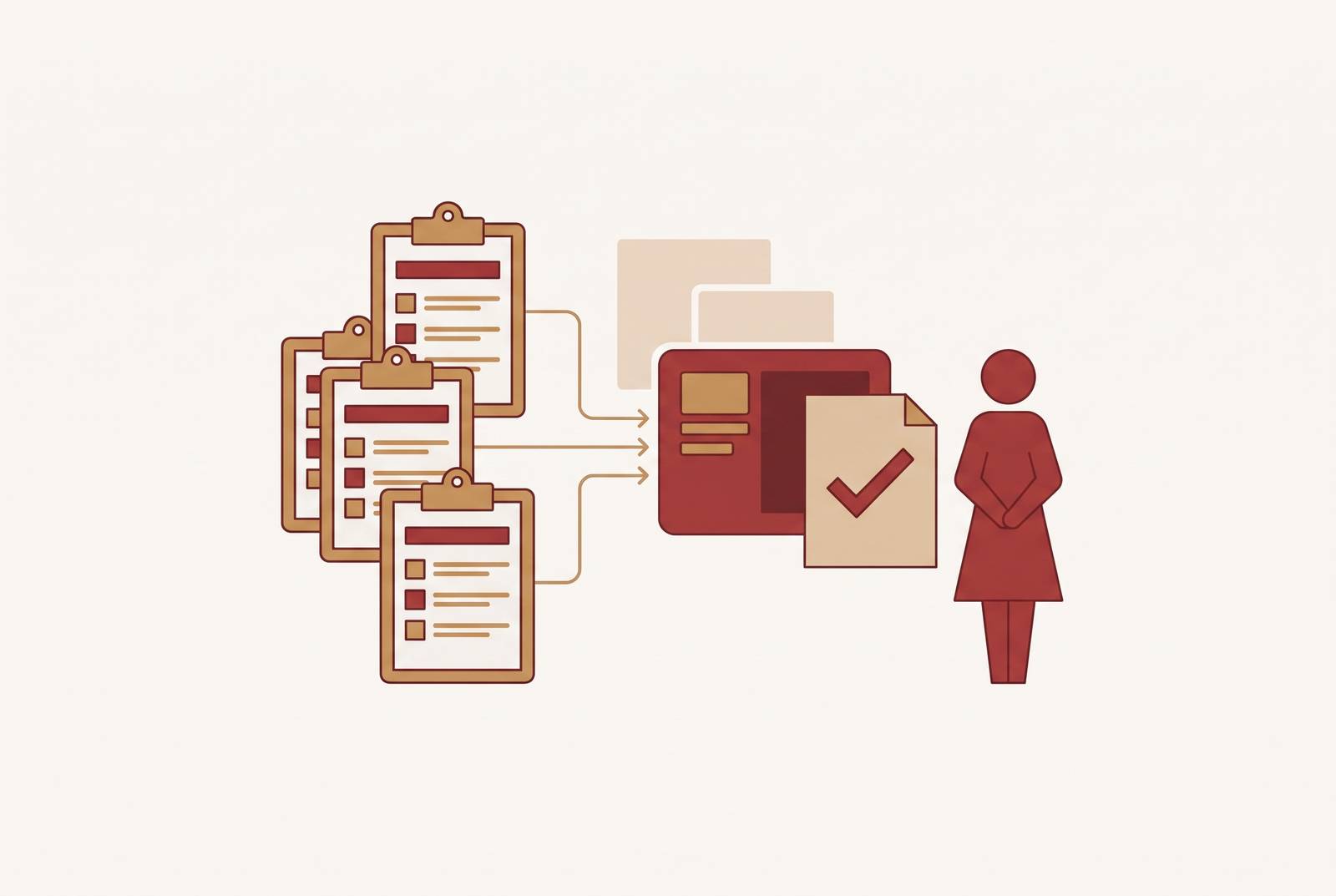
The four categories operate at different points in the same documentation lifecycle. Capture tools improve the original note, coding assistants support its translation into MDS items, document management brings external inputs into the record, and analytics turns recorded information into prioritized intelligence. They are not interchangeable answers to one task. Their dependencies also affect results. Better capture can improve the inputs available to coding and predictive tools, while analytics applied to incomplete notes remains limited by what was recorded.
For nursing managers, investment sequencing should begin with the gap creating the most immediate regulatory or financial exposure. Rebuilding the account of care at the end of a shift calls for capture, denials tied to MDS coding call for coding support, and transcribing outside documents calls for document management. The diagnosis comes before the platform choice. With capture alone, staff may still have to review improved notes by hand, while analytics without enough detail in the notes can miss small signs needed to assess risk. For a manager pursuing both compliance and efficiency, the minimum viable stack is a point-of-care tool that writes into the existing EHR paired with a layer that continuously reads those notes and surfaces ranked risk and compliance gaps.
What to evaluate before selecting any platform: the questions that surface re-entry risk in disguise
Vendor demonstrations should show what work staff still have to do after information is captured. A typed note in a separate application may look more efficient than a handwritten form while preserving the same reconciliation burden. Appearance is not evidence of eliminated re-entry. The practical evaluation therefore follows information from its first entry through its use in the primary record. Four questions make that test concrete.
Does this tool write directly into the EHR fields already in use, or does it maintain its own data store that staff must later reconcile with the primary record? This separates write-back from digital storage. A workflow can remove paper without removing duplicate entry, particularly when a document must still be transcribed after signing.
Does it read unstructured narrative notes, or only structured fields, and if only structured fields, which clinical signals will it miss? Behavioral changes, functional observations, and subtle trends lose their value to downstream analysis when the tool cannot read the place where they were recorded.
Does it flag gaps before documentation is finalized, or only after a denial or citation has already occurred? The answer should make clear whether the workflow supports clinicians and MDS coordinators before submission or creates a separate retrospective review process.
Does it require nurses to learn a new documentation workflow, or does it layer intelligence onto the workflow they already follow? Each added step takes time from the nursing staff available to do the work. CMS’s interim final rule effective February 2, 2026, repealed the minimum staffing requirements established by the 2024 rule, so those repealed requirements are not a current justification for purchase. The no-new-burden test remains valid on workflow grounds. Beyond spending only to avoid penalties, facilities can aim for accurate documentation kept up throughout care that helps them qualify for the Nursing Home Risk-Based Survey and its lighter survey footprint.