Surveyor Interviews With Nursing Staff and What They Reveal
Surveyors cite gaps between charts, observations, and staff accounts, not care quality itself.
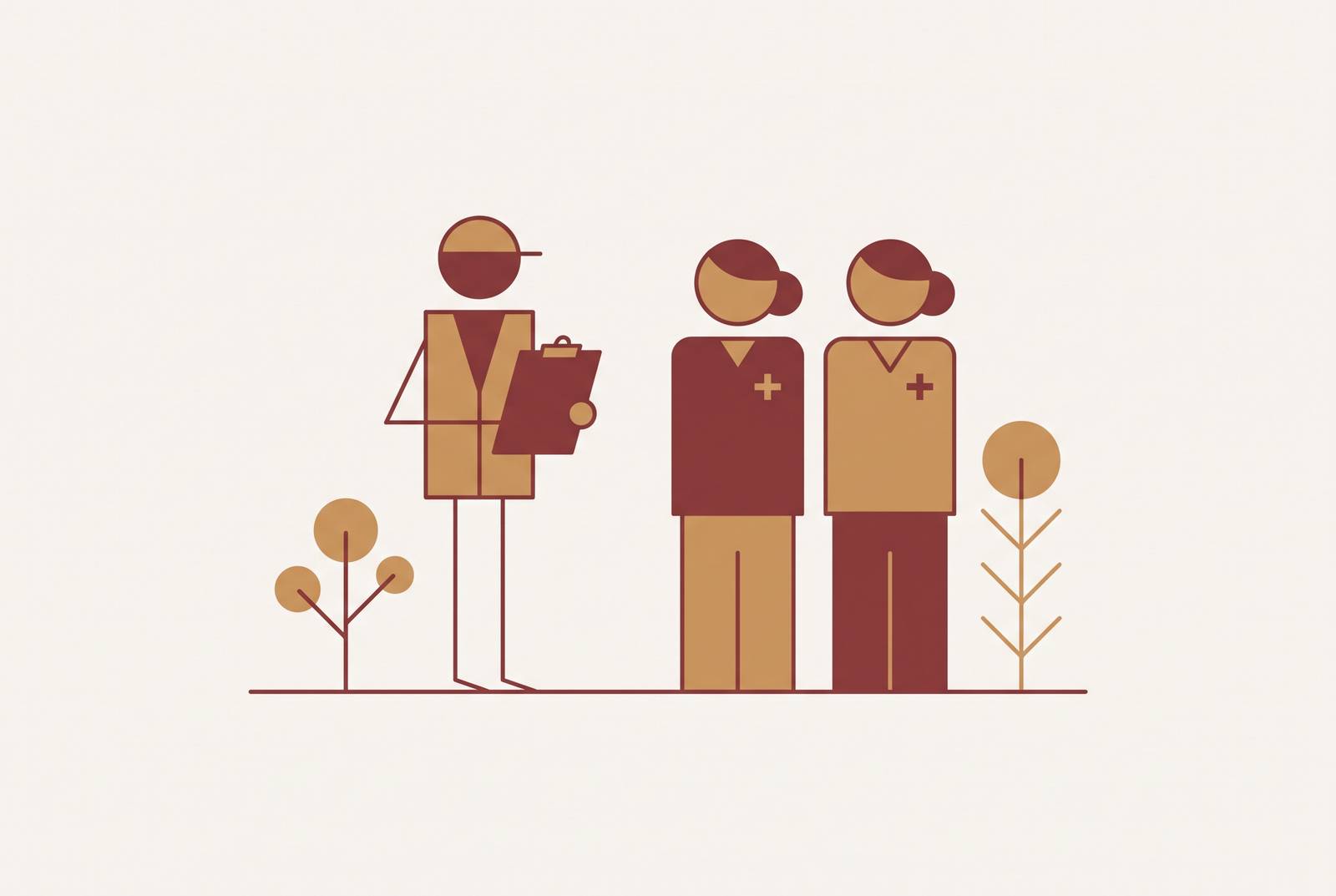
Surveyor interviews with nursing staff are built to catch one thing: a gap between what the chart says, what a nurse can explain, and what the surveyor has already seen on the floor. That gap, not the underlying quality of care, is what most often turns into a citation. Understanding what these interviews actually probe, and why the gaps appear in the first place, is the most useful preparation a facility can do.
The staff interview's role in the survey's triangulation mechanism
A federal nursing home survey runs on three separate streams of evidence: the written record, direct observation of care, and what staff say when asked about it. The staff interview is the moment all three are forced to line up, and any place where they don't is where a deficiency gets written. CMS structures the process this way on purpose. Surveyors observe care, conduct interviews, and then review records, with record review typically coming after the interviews and observations are already done. The interview is the test the paperwork has to pass, not a formality that happens alongside the paperwork check.
Surveyors don't walk in cold. They carry computer-based LTCSP software on tablets or laptops, pre-loaded with a facility's prior survey results, its Quality Measures, staffing data, and complaint history. By the time they ask a nurse a question, they already have a hypothesis about where the facility is weak, and the interview is how they test it against what's actually happening on the unit. The pool of people they can pull into that process is wide: CNAs, licensed nurses, the Infection Preventionist, dietary staff, social services, the Medical Director, the Director of Nursing, and the Administrator are all fair game. A single weak answer, at any level of the organization, can open a line of inquiry that wasn't on the surveyor's original list.
What surveyors probe when they question nursing staff
Surveyors are checking whether a staff member's account of one specific resident's care matches both the chart and whatever the surveyor has already watched happen on the floor. The LTCSP assigns "care areas" to each resident in the sample, things like falls, pressure injuries, unnecessary medications, catheters, dialysis, and behavioral health, and the questions follow those assignments directly. A CNA caring for a resident flagged for falls will be asked to describe that resident's fall prevention plan, not fall prevention in general.
What separates a passing answer from a flagged one is rationale. A surveyor isn't satisfied by confirmation that a task got done. Saying "we reposition him every two hours" tells a surveyor a schedule exists; it says nothing about why that interval is right for that resident, and surveyors are trained to ask the follow-up question that exposes the difference. Fall documentation gets particular scrutiny now: an OIG finding cited in research showed that nursing homes failed to report a large share of falls involving major injury and hospitalization among Medicare-enrolled residents on the assessments required to capture them, and surveyors probe this directly in interviews rather than taking the incident log at face value. Skin and wound care, hydration, medication administration, and behavioral changes each carry their own paper trail, one a surveyor can pull up mid-interview and check against the MAR, the physician's orders, and the care plan in real time. When a staff member describes a protocol the chart doesn't show, or the chart shows an intervention nobody on the floor can name, that divergence is the citation. The underlying care event is almost beside the point.
Why documentation gaps, not care failures, drive most citations
A survey doesn't evaluate care directly. It evaluates what the record can prove about the care, and that distinction is where most facilities get hurt. A facility can be delivering genuinely appropriate care and still draw a deficiency when the chart fails to document that story. Michelle Stuercke, chief clinical officer for Transitional Care Management, frames the standard surveyors apply this way: medical records have to "tell the resident's story," showing how care decisions track the resident's condition, goals, and changing needs, updated every time something shifts, and that's the bar. A chart that's accurate but static, a snapshot rather than a narrative, fails it.
The adjudicated cases show what that failure costs. In Generations Oakton Pavilion (CR6834), a resident had a documented pattern of repeated falls over several weeks, and the facility needed to show evidence of effective, resident-specific interventions and actual supervision in response, and it couldn't. The ALJ upheld a per-day civil monetary penalty and a denial of payment for new admissions because the chart failed to show an individualized response to a pattern it had already recorded.
A separate Pennsylvania case shows a more severe version of the same dynamic, though the mechanism is different in kind. The Third Circuit upheld convictions and roughly $15.35 million in restitution against two operators for falsifying staffing records during Department of Health surveys. The evidence showed the facilities kept accepting new admissions even as nurses were warning that staffing levels weren't sufficient to support them. Falsifying a record during a survey is not a documentation gap; it's a deliberate act, and the two failure modes shouldn't be conflated. But both cases point to the same underlying rule. When a surveyor asks a staff member about a resident and then pulls the chart, the two accounts have to match, and the chart has to show how a care decision evolved over time, not just confirm that it existed at one point.
The 2026 survey environment and documentation mismatches
The regulatory environment heading into 2026 gives facilities less room to manage these mismatches after the fact. CMS announced nationwide rollout of the Risk-Based Survey, or RBS, starting September 8, 2026, under QSO-26-14-NH. Higher-performing facilities qualify for a lighter survey footprint, while survey resources shift toward complaint investigations and facilities carrying more resident risk. A facility's charting habits determine how closely it gets surveyed, because the eligibility test for that lighter footprint runs directly on the facility's own documentation and quality data. Eligibility is also fragile: a staffing rating below three stars is the most common reason a facility gets disqualified from the lighter track, on top of the five-star overall rating requirement. CMS piloted RBS starting in 2023 across more than 100 facilities in 22 states. That pilot produced findings comparable to the traditional survey process while needing roughly half the onsite time, and CMS is now scaling it up.
Surveys now also start at times facilities can't plan around. CMS requires at least 8% of a state's recertification surveys to start off-hours, meaning weekends, federal holidays, before 8 a.m., or after 6 p.m., and survey teams have to stay in the building for at least five consecutive hours on the first day. The two-day requirement carries its own consequence: a Friday entrance means a Saturday Day 2, not a Monday return. Payroll-Based Journal staffing data now feeds directly into surveyor investigations too, giving surveyors an independent staffing record to check against what staff say and what the posted schedule claims, a discrepancy there creates the same triangulation problem as a clinical documentation gap. The updated guidance also adds more detail to the interview and observation process itself, with specific attention to Director of Nursing requirements, so the interview is getting more structured, not less. CMS has additionally updated F641 guidance to explicitly include MDS coding accuracy review, and a mismatch between the MDS and the clinical record now carries both compliance risk and reimbursement consequences under PDPM.
The charting conditions behind the documentation gap
None of this traces back to carelessness on the part of nursing staff. It traces back to when, how, and under what conditions clinical documentation actually gets written in a skilled nursing facility. Care happens continuously across a shift, in real time, with full attention. Documentation tends to happen in compressed windows, often at the end of that same shift, when fatigue is highest and the fine details of what happened six hours earlier are hardest to reconstruct accurately.
The AAPACN/LTC 100 survey of nearly 500 skilled nursing facility nurses, conducted in November 2025, found that rising documentation and compliance demands are a leading source of strain across the profession. Nurses pointed specifically to duplicated documentation across Medicaid, PDPM, and managed care requirements, work layered on top of standard regulatory charting. About a fifth of the nurses surveyed said insufficient staffing made their jobs harder, and rising regulatory burden contributed directly to burnout. These aren't separate problems sitting next to the documentation gap. They cause it. A nurse charting at the end of a twelve-hour shift covering multiple residents is writing from memory, not from contemporaneous observation, and memory compresses events, generalizes details, and drops exactly the specifics a surveyor will ask about days or weeks later. What results is a note confirming a task happened without capturing the clinical reasoning behind it, the resident's response to it, or its connection to the care plan, which is precisely what an interview exposes as missing.
Electronic health records don't help as much as they could here: they're built to capture structured fields efficiently, but free-text clinical notes often get handled in ways that add to a nurse's cognitive load rather than reduce it, because the interface wasn't designed around the way nurses actually document.
What the unstructured notes hold
The clinical reasoning and risk signals surveyors look for in interviews are usually already sitting in a facility's own notes. This information lives in free text that nobody reads systematically before a survey happens. Unstructured data makes up the large majority of everything in an electronic health record, and it often holds information that doesn't exist anywhere else in a resident's file: a physician's observation, a patient history detail, a diagnostic impression, the specific reasoning behind a care decision that a structured field has no room for.
The gap a surveyor finds between what a nurse charted and what they're asked about in an interview is frequently not a gap in the care, or even in the documentation itself. It's a gap in the facility's ability to find and organize what it already wrote down. Free-text notes trace the progression of a resident's condition across visits, a gradual rise in skin fragility, a sequence of behavioral shifts, a string of fall-adjacent observations spread across different shifts and different nurses, which is exactly the kind of longitudinal evidence surveyors look for when judging whether a facility caught a risk early or only after it became a problem. The difficulty is that free text varies enormously in style and terminology from one clinician to the next, which makes it hard to pull together by hand. One nurse captures a pattern in three precise sentences; another nurse spreads the same pattern across four separate notes written over three days, in language that doesn't obviously connect to the first nurse's entry. A facility in that position has already written the story a surveyor wants, and cannot find it.
What staff need to be able to say
Being ready for a staff interview comes down to one alignment: every nurse who might get asked about a resident should be able to describe the same care rationale the chart documents, in their own words, without having been handed a script. Surveyors are trained to notice when a staff member's answer reflects genuine recall of a specific resident's risk factors and interventions, which reads differently from recited protocol language a staff member has simply memorized.
CNAs get interviewed most often, and they're asked about the residents they actually care for. The answer that holds up reflects awareness of the care plan itself, not just confirmation that a task happened. "I turn him every two hours" states a schedule. Being able to say why that resident's care plan specifies that particular interval, and what risk it's addressing, shows the CNA knows the resident, not just the routine. Licensed nurses face a different kind of question: why a medication was held, why a wound care protocol changed, why an incident was escalated or wasn't. Each of those answers needs both the nurse's own knowledge and a chart entry that backs it up. The Medical Director and Director of Nursing get asked about systemic patterns instead of individual residents, QAPI minutes, incident trends, staffing decisions, and here the documentary record, logs, meeting minutes, corrective action plans, has to match what they describe out loud.
CMS's own survey guide tells surveyors to expect staff to answer "honestly and specifically about their own residents." Meeting that bar requires staff to know a resident's current care plan, not the version from the last assessment cycle. The most common reason a staff member can't answer specifically is that the care plan hasn't caught up to a recent change in that resident's condition, so the chart and the care being delivered have quietly drifted apart.
Continuous monitoring of the chart as more reliable preparation than pre-survey review
Surveys arrive unannounced, and the structural changes taking effect in 2026 make them arrive at less predictable hours than before. The only preparation that reliably closes the gap surveyors are trained to find is a continuous process that keeps the chart, the care plan, and staff knowledge aligned at all times, not a review exercise triggered by the fear of an approaching survey window.
The LTCSP draws roughly seventy percent of its sample from MDS pre-selected residents chosen offsite, before the survey team ever walks in. Facilities can't predict which residents will be reviewed, so every resident's chart has to hold up to the same scrutiny as the one a surveyor would most want to examine. Predictive risk monitoring, applying both structured and unstructured chart data to catch a resident's changing condition before a care gap forms, is what connects good clinical care to a defensible written record: the care plan gets updated because the monitoring caught the change, not because a surveyor found it first. Falls make the case clearly. The OIG finding that a large share of falls involving major injury went unreported on required assessments reflects a workflow where recognizing an incident and documenting it are disconnected from each other. A facility that monitors fall-adjacent signals as they accumulate in clinical notes can recognize and document that pattern before it turns into a deficiency. The same logic holds for skin integrity, behavioral change, hydration, and medication, in every case, the clinical signal appears in nursing notes before it appears in structured data or becomes visible to a surveyor standing on the unit.
A facility that reads its own unstructured notes systematically, surfacing risk signals, flagging where documentation has fallen behind, connecting care plan updates to the changes that prompted them, is running the same quality review a surveyor will eventually run. The facility has usually already written the story the surveyor is looking for. What remains is whether it can find that story before the surveyor does.