F-Tag Severity and Scope Grid Explained for SNF Operators
The scope-and-severity grid determines how badly CMS penalizes nursing home violations.

An F-tag is the number CMS attaches to a specific federal requirement a nursing home has to meet, and it's the label a surveyor writes down the moment that requirement isn't satisfied. These tags aren't assigned on the fly during an inspection. They run across a fixed range, F540 through F949, and each one ties back to a particular section or subsection of 42 CFR Part 483, the federal regulation governing skilled nursing facilities. Two documents work together to define what each tag means and how it gets applied. The first is 42 CFR Part 483 itself, which states in plain regulatory language what a facility must do. The second is Appendix PP of the State Operations Manual, the field manual surveyors carry that assigns the tag number to the rule and lays out how compliance gets judged in practice. When a surveyor identifies a problem during an inspection, the finding doesn't come out as a narrative description of what went wrong. It comes out as a tag number, a scope-and-severity letter, and the supporting evidence, all of it recorded on CMS Form 2567, a document that is both public and searchable. That structure, tag plus letter plus evidence, is what the rest of this piece unpacks, starting with where the letter actually comes from.
How the A-to-L grid is constructed
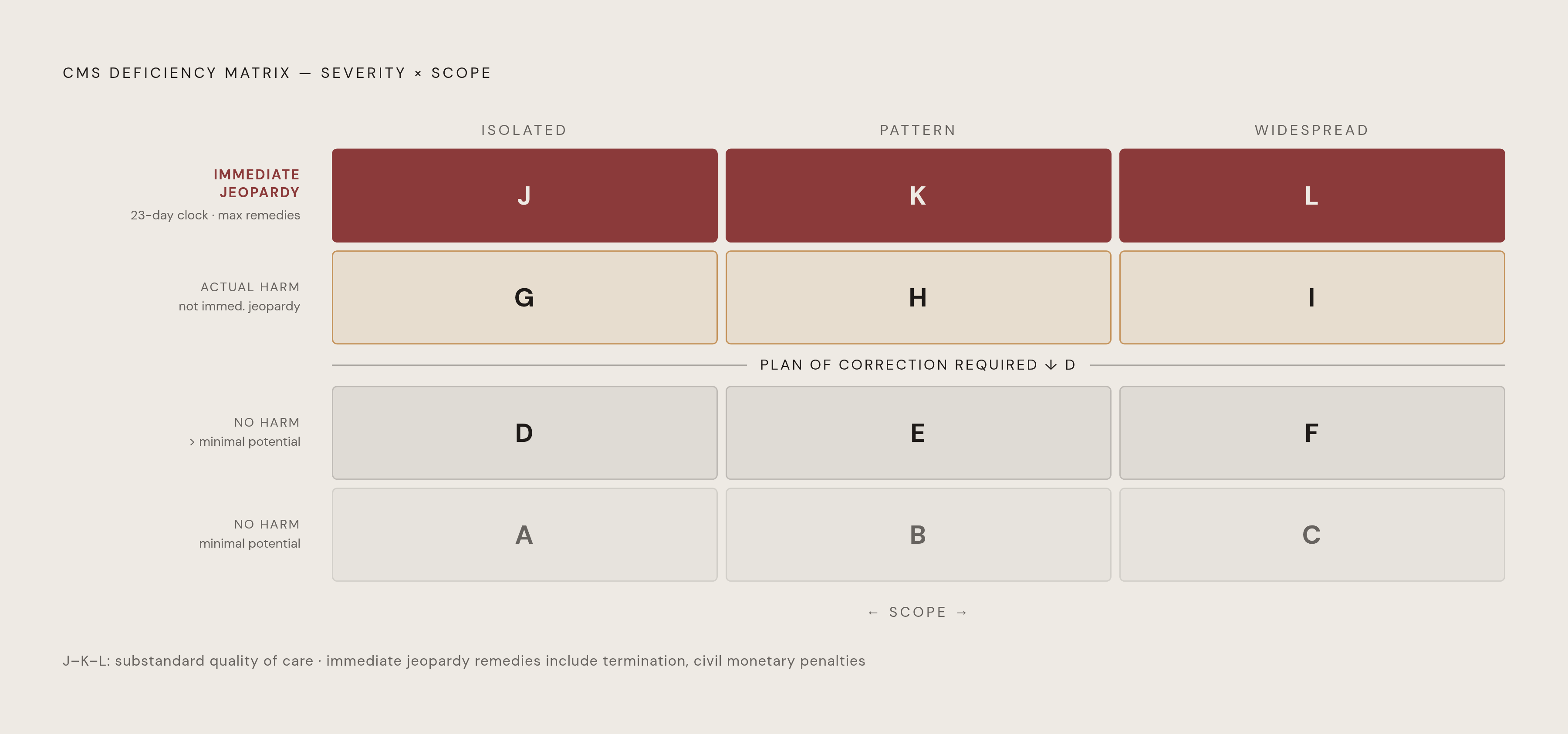
Every deficiency a surveyor cites gets scored on two separate judgments, scope and severity, and the point where those two judgments cross is what produces the letter that follows the facility around afterward. Severity climbs through four levels. Only the potential for minimal harm, with no actual harm, defines Level 1, corresponding to letters A, B, and C. Level 2 covers no actual harm but potential for more than minimal harm, short of immediate jeopardy, corresponding to D, E, and F. Level 3 covers actual harm that stops short of immediate jeopardy, where the deficient practice produced a negative outcome that compromised a resident's ability to reach their highest practicable well-being, corresponding to G, H, and I. Level 4 is immediate jeopardy: the deficient practice caused, or is likely to cause, serious injury, serious harm, serious impairment, or death, and it demands immediate corrective action. That level corresponds to J, K, and L.
Scope runs along three levels. Isolated means one resident or a very limited number of residents are affected, one or a very limited number of staff are involved, or the situation occurred only occasionally or in a very limited number of locations. A pattern means more than a limited number of residents or staff are involved, so the problem appears across several locations, or the same resident experiences repeated occurrences of the same practice. Widespread means the situation is pervasive throughout the facility, or reflects a systemic failure that affected, or had the potential to affect, a large portion or all of the facility's residents.
Four severity rows crossed against three scope columns produce the full grid, lettered A through L, with A the least serious finding a facility can receive and L the most serious.
| | Isolated | Pattern | Widespread | |---|---|---|---| | No harm, minimal potential | A | B | C | | No harm, more than minimal potential | D | E | F | | Actual harm, not immediate jeopardy | G | H | I | | Immediate jeopardy | J | K | L |
The single most important thing to understand about this grid is that the same broken rule, the same F-tag, the same underlying failure in care, can land anywhere from A to L depending entirely on how much harm resulted and how far it reached. So a missed turning schedule that never produced a wound scores nowhere near the same letter as one that produced a stage 3 pressure injury in three residents across two units. The tag number tells a surveyor which regulation was broken. The letter tells CMS how badly, and for how many people, and that distinction is what every other consequence in this piece flows from. One procedural rule governs cases where a single tag turns up examples at different harm levels: surveyors are instructed to select the highest harm level present and apply the scope associated with that specific level, rather than averaging or softening the finding to reflect a mix of minor and severe examples.
The grid's authority and the 2026 SOM revisions
The grid is not an informal scoring convention surveyors picked up over time. It lives in the CMS State Operations Manual, Chapter 7, Section 7400.3.1, titled the Matrix for Scope and Severity, and that section is what CMS uses to instruct surveyors on how to determine deficiency level. Because the grid sits inside the State Operations Manual rather than inside the statute itself, CMS can and does revise it, and the manual has, in fact, changed recently in ways that matter to operators.
CMS issued QSO-26-03-NH, which revised Chapter 7. The memo was originally issued January 30, 2026, revised April 3, 2026, took effect March 30 and April 30, 2026 depending on the provision, and was formally codified in Transmittal 244 on June 26, 2026. Among its changes, the revision refined the definitions of immediate jeopardy priority examples found in Chapter 5 and updated the guidance surveyors use in Chapter 7 for identifying and removing immediate jeopardy, so surveyors can spot and respond to the most serious risks to residents more consistently. Enforcement policy for civil money penalties moved alongside it: CMS can now apply per-instance or per-day fines, a change reflected in the CMP Analytic Tool starting March 31, 2026, and some of those penalties now appear publicly on Nursing Home Care Compare starting June 24, 2026.
CMS also rolled out the Risk-Based Survey process nationwide starting September 8, 2026. Under that process, facilities with a strong, consistent compliance track record can undergo a more focused standard recertification survey. CMS has estimated that only a small minority of nursing homes will initially qualify, based on overall quality ratings, staffing performance, the accuracy of their data reporting, and their survey history. The RBS rollout matters here less for its mechanics than for what it signals: CMS is actively building infrastructure to differentiate facilities by compliance track record, rewarding consistent performers with a lighter survey footprint and, by implication, treating the facilities that keep landing on the higher end of the grid as a different category of regulatory risk. An operator reading the grid as fixed, settled background knowledge is reading a document CMS has already revised twice within a single year.
Plan-of-correction requirements and immediate-jeopardy timelines by grid letter
The letter a deficiency receives sets a threshold, and that threshold is D. Deficiencies scored A, B, or C carry no plan-of-correction requirement. Anything D or above requires the facility to submit one, laying out how it will fix the problem and prevent it from recurring.
Immediate jeopardy findings, the J, K, and L letters, carry the shortest timelines and the heaviest remedies CMS has available. A facility cited with immediate jeopardy has 23 days to resolve it. That is a hard operational clock, not a guideline, and it runs regardless of the facility's size, ownership structure, or history. Beyond that single deficiency, every nursing home carries a broader compliance clock: a facility must return to substantial compliance within 6 months of being cited, or CMS is required to terminate its Medicare contract. The remedies available to CMS along the way include civil monetary penalties, denial of payment for new admissions, and, at the far end, termination from Medicare and Medicaid.
Revisits compound this exposure. A facility that needs more than one revisit to demonstrate substantial compliance has, in CMS's framing, generally failed to make systemic changes to its quality of care, or failed to properly monitor and reassess care through its own quality assessment and assurance process. That pattern, cited once, found again on revisit, cited again, is what CMS treats as a yo-yo of noncompliance, and it is penalized heavily inside the scoring system that feeds the next section. A single bad survey is a data point. Repeated revisits turn that data point into a track record, and the scoring system downstream is built to catch exactly that.
Deficiency letters, the Five-Star health inspection rating, and the SFF pipeline
Every deficiency letter a facility receives carries a specific point value, and those points don't disappear once the plan of correction is accepted. They aggregate across surveys and produce the health inspection rating that anchors a facility's overall Five-Star score on Care Compare. The point weights, drawn from the SFF Scoring Methodology, run as follows: A, B, and C carry 0 points. D carries 2 points. E carries 4 points. F carries 6 points, but that rises to 10 points if the finding also qualifies as substandard quality of care. G, H, and I carry escalating point values above that, each with its own substandard quality of care premium layered on top.
That last distinction matters on its own. Substandard quality of care is an overlay on the existing grid. The shaded cells, G through L plus E and F, qualify as substandard quality of care specifically when the underlying requirement that wasn't met falls under 42 CFR 483.13, 483.15, or 483.25. When that overlay applies, the point value jumps to the higher, parenthetical figure built into the scoring table, not the base value the letter would otherwise carry.
CMS doesn't score a single survey in isolation. It totals points across the two most recent standard surveys, adds in three years of complaint surveys and focused infection-control surveys, weights the whole set by how recent each finding is, and then ranks the facility against others in its own state. The health inspection rating measures a facility's standing against other facilities in the same state. Recency weighting also means a serious citation from last quarter does far more damage to the score than an identical letter from three years ago, so if a fresh J-level finding turns up on a complaint survey between standard inspections, it still counts in full, no matter how clean the facility's last standard survey looked.
All of this cumulative scoring feeds directly into a special oversight program for the lowest-ranked facilities. CMS ranks facilities within each state by their SFF deficiency score and presents five candidates per available SFF slot to the state for consideration, with each state allotted a minimum of five and a maximum of thirty slots. Landing on that list means intensified oversight and repeated scrutiny going forward, a designation that follows a facility publicly and shapes how surveyors, referral sources, and families perceive it. The arithmetic behind all of this points to one operational truth: a single immediate jeopardy finding at scope K or L, carrying the weight that letter combination assigns and the substandard quality of care premium it almost certainly triggers, can inflict more damage on a facility's standing than years of accumulated low-level D and E citations combined.
The financial consequences tied to where a citation lands on the grid
Where a citation lands on the grid doesn't just set a regulatory and reputational clock running. It also determines the civil money penalty CMS imposes, if any, and its size. For facilities operating on the thin margins common across the skilled nursing sector, even a penalty that looks modest on paper can inflict damage out of proportion to its face value.
The scale of penalty activity nationwide gives a sense of how concentrated this exposure is. CMS imposed substantial fines on nursing homes in 2024, with total penalties reaching $566 million nationwide according to LTCCC data. That figure reflects penalty activity concentrated heavily in a subset of facilities, the ones whose citations clustered toward the higher letters and higher scope on the grid.
Peer-reviewed research published in Innovation in Aging quantified what that financial pressure looks like at the facility level. The study found that penalties equivalent to less than a single day of a facility's operating expenses were already associated with a meaningful decrease in net-income margin, and that decline grew larger as the penalty grew, with penalties equivalent to three or more days of expenses associated with the largest margin reductions of all, scaling alongside exactly where on the A-to-L grid the underlying deficiency landed.
Sources
- SFF SCORING METHODOLOGY
- Bureau of Community and Health Systems NURSING ...
- State Operations Manual Appendix PP - Guidance to Surveyors for
- State Operations Manual Chapter 7 - Survey and Enforcement Process for Skilled
- Page 1 of 3 DEPARTMENT OF HEALTH & HUMAN SERVICES
- QSO-26-03-NH Revised State Operations Manual Chapter ...