Accreditation Canada QMENTUM Standards for Long-Term Care Programs
Continuous quality cycles replace one-off inspections in Canadian long-term care accreditation.
Accreditation Canada's Qmentum framework for long-term care is not a checklist facilities memorize before a visit. It's a four-year, standing cycle of measurement built on CAN/HSO 21001:2023 Long-Term Care Services, the governing standard published in January 2023 and revised in May 2025. The program that applies to LTC homes is Qmentum Global for Long-Term Care, distinct from the general Qmentum framework used across other health sectors, and it runs on a two-body structure: HSO (Health Standards Organization) writes and maintains the standard, while Accreditation Canada applies it, alongside standards from other bodies, and issues the accreditation itself. Over 70% of Canadian long-term care homes now work within this system, part of a broader Accreditation Canada portfolio covering more than 9,300 health and social service locations across the country.
How the four-year accreditation cycle works in practice
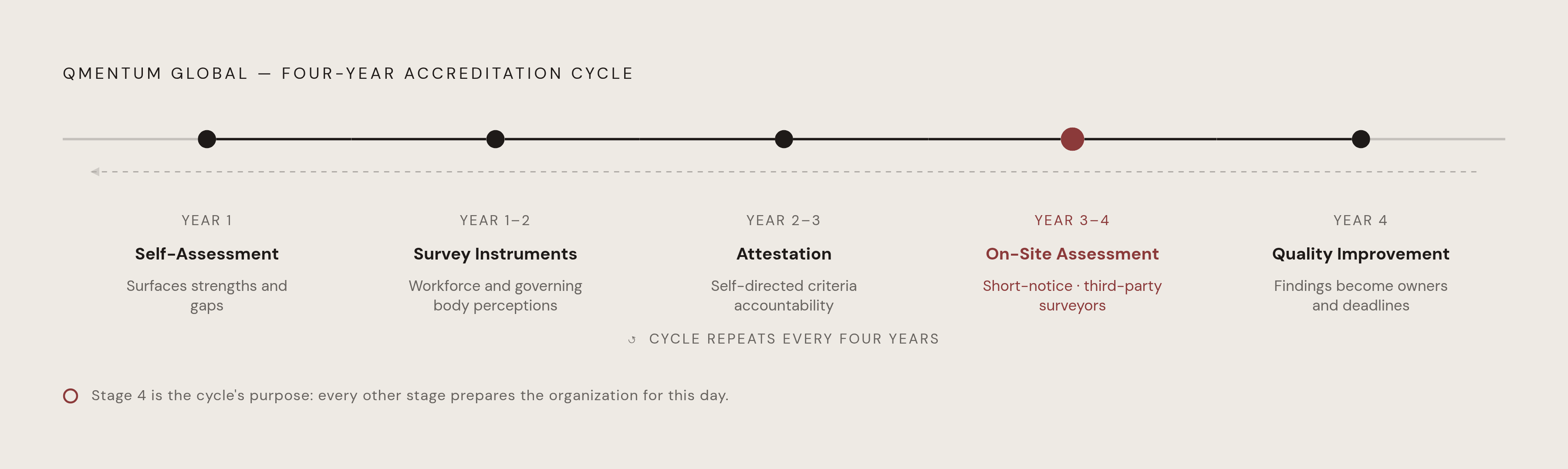
Qmentum is short for quality plus momentum, and that compound name is the whole point. The framework treats accreditation as a continuous cycle. Accreditation Canada calls this "a journey," language that sounds soft until you see what it replaced: the old "big bang" model, where facilities spent months polishing files and staging hallways for one scheduled inspection, then went quiet until the next one came around.
Qmentum Global kills that approach on purpose. It builds in attestations and short-notice visits, so a home has to operate as though a surveyor could walk in on any given Tuesday. Plan-do-study-act (PDSA), a quality improvement method borrowed from industrial process control, gets applied here to everyday care operations across four years instead of four days.
That cycle breaks into five stages, and each one does a different job. Self-Assessment comes first, customizable to the organization, meant to surface strengths and gaps before anyone from outside gets involved. Survey Instruments follow: the HSO Global Workforce Survey and the HSO Governing Body Assessment, both of which capture how staff actually perceive safety culture and working conditions in practice. Attestation is a self-directed accountability step, where the organization checks itself against attestable criteria ahead of the on-site visit. The On-Site Assessment arrives on short notice, run by third-party surveyors conducting observation, staff interviews, and document review on-site. The Quality Improvement Action Plan, a digital tool, closes the loop by converting everything the assessment turned up into a working list of action items with owners and deadlines attached.
The structure of the standards themselves: sections, clauses, criteria, and guidelines
The HSO standards run on a four-level hierarchy, and that structure tells a facility exactly where to look when something goes wrong. A section title sets the topic area. Under it sits a clause, a thematic statement introducing a group of criteria. The criteria are the evidence-based requirements themselves, each spelling out intent, the action expected, and who owns it. Guidelines sit beneath the criteria and offer context and implementation detail because criteria alone leave undefined what "compliant" looks like on the floor at 2 a.m., and guidelines supply that definition. on a Sunday.
None of this sits still. The standards get revised regularly, built with input from residents, workforce members, leaders, and other Canadians, which is part of why the 2023 version of CAN/HSO 21001 already saw a revision by May 2025.
Core standards apply broadly across program types. Service-specific standards, including Long-Term Care Services, apply specifically to the LTC context. Health PEI's experience shows how this plays out for a real health system: the organization was evaluated against six core, mandatory standards, a concrete case of the general and specific layers stacking on top of each other rather than existing as two separate checklists.
Required Safety Practices: the compliance floor every LTC home must meet
The biggest structural shift in Qmentum Global for long-term care is the move from Required Organizational Practices (ROPs) to Required Safety Practices (RSPs). The count dropped from 38 ROPs to 24 RSPs, and anyone who reads that drop as a loosening of standards has it backwards. It cuts administrative overhead from the old model and puts the remaining weight behind the practices with the most direct bearing on resident safety.
Each RSP carries several criteria, and each criterion is designed as a discrete, auditable check a surveyor can verify against evidence on the ground, not against a written policy sitting in a binder. Plenty of Canadian organizations are still operating under the legacy ROP categories, which covered safety culture, communication, medication use, infection control, risk assessment, and worklife conditions. The older framework's categories carry forward into the RSP structure, with practices in areas like hand hygiene and fall prevention mapping directly onto the updated requirements.
People-centred care and workforce empowerment as standards pillars, not just values statements
People-centred care, as embedded in the Qmentum framework, emphasizes placing residents at the centre of care decisions and fostering collaboration among everyone involved in their care. That's a mouthful of a definition, but the standards don't leave it as a poster on the breakroom wall. The standards embed people-centred care as a measured requirement, so the concept gets assessed, not just praised.
The model reaches past the resident, too. Families, caregivers, and the surrounding community get folded explicitly into what "people-centred" means under this standard, pushing accountability outward past the walls of the building.
Workforce empowerment counts as a measured input. The HSO Global Workforce Survey sits inside the accreditation cycle as an active instrument, and it captures staff perception of work-life quality and safety culture as data points that inform the overall assessment.
Resident risk areas the standards target and the documentation demands they create
The RSP and legacy ROP frameworks converge on a handful of risk categories with obvious weight in daily life inside a long-term care home: falls and fall injury, medication safety, infection prevention, skin and wound integrity, hydration, and behavioural change. Each ties to specific criteria, and each criterion ties to a Test for Compliance a surveyor can check.
Falls deserve the most attention of any category, and not by a small margin. They carry the largest claims volume in senior care, accounting for more than 45% of all such claims, and falls prevention is a recognized priority area within the legacy ROP framework. Clinical priority and regulatory priority point at the same target. Falls sit at the center of so much documentation burden inside LTC homes because of that shared target.
Frailty affects a large share of long-term care residents and drives most of the other risk categories on the list. It still lacks an objective, routine biological test for catching it early, so clinicians rely on functional assessments and clinical judgment instead of a lab value or biomarker panel that flags frailty risk on its own.
Research is starting to close that gap. Research into machine-learning models built on routinely collected predictors has shown promise for forecasting unplanned hospitalization in long-term care residents, though broader validation and prospective real-world testing remain necessary before such tools can be considered settled.
The gap between documentation that exists and intelligence that gets used
Long-term care homes are not short on data. Nurses generate clinical notes constantly as part of routine care, typing them into electronic health record systems throughout every shift. The shortfall never was collection, and treating it as a data-entry problem is where most improvement efforts go wrong.
The real shortfall appears in the gap between what happens at the bedside and what gets typed into the note afterward. Unstructured clinical notes, the free-text observations nurses type between medication passes and care rounds, are hard to pull together across a resident population, hard to watch for emerging patterns, and hard to act on beyond one chart at a time. A note flagging a resident's declining appetite sits in that resident's file. It doesn't connect on its own to the three other residents on the same wing showing the same pattern that same week, even though a human reading all four charts side by side would catch it in minutes. Nobody reads all four charts side by side, because nobody has the hours.
The administrative weight this creates on nursing staff is measurable. According to AAPACN's NAC Work Study, completing a stand-alone PPS 5-Day assessment takes an average of 56.92 minutes, and a PPS Discharge assessment takes 32.93 minutes. That's time pulled straight from bedside care, adding to the administrative load nursing staff carry alongside their clinical responsibilities.
Survey readiness, done right, asks for more than clean paperwork. It means lining up internal protocols against current regulations, reviewing quality ratings on an ongoing basis, digging through data to find where performance is actually slipping, and training staff against those specific gaps rather than generic refreshers. All of that depends on the ability to surface what the existing documentation already contains, and that's the exact step most homes get stuck on.
Closing the Gap: Continuous Monitoring, Proactive Risk Scoring, and Automated Compliance Intelligence
Qmentum's four-year cycle is built around ongoing assessment, not a single scheduled event, and any facility still treating compliance as something to prepare for periodically is working against the structure of the standard itself. Treating compliance as something to prepare for periodically works against the structure of the standard itself, which calls for ongoing assessment, not a single scheduled event. It's the wrong model entirely, produced by treating compliance as episodic, and it is visible in every RSP audit trail that only fills in the week before a survey.
Running real-world survey simulations, staged the way an actual surveyor visit would unfold, is one practical countermeasure: it reveals gaps in advance, tests whether staff actually know the protocols under pressure, and strengthens compliance before the real visit arrives. Pairing that with a quality assurance and performance improvement program built around specific, measurable initiatives, rather than generic goals lifted from a template, gives a facility something to act on continuously between and during assessments.
Risk stratification works the same way as a compliance tool as it does a clinical one. Ranking residents by risk level across falls, skin integrity, medication, hydration, and behavioural categories lets nursing managers direct attention where it's actually needed, and it maps cleanly onto the RSP and ROP criteria covering fall prevention, medication safety, and infection control. A stratified list turns a vague sense of "which residents need more attention" into documented evidence a surveyor can point to and check.
Machine learning models trained on routinely collected EHR data, the same research direction driving frailty biomarker work and EHR-based fall risk scoring, catch resident deterioration earlier than manual chart review alone typically manages, because they scan every chart on every shift instead of the handful a nurse has time to reread. The Qmentum standards already require organizations to have risk assessment mechanisms in place as a matter of criteria, not preference, so this isn't optional infrastructure sitting on a wish list. Automated trend analysis of data facilities are already generating is one of the more realistic ways to meet that requirement, because it turns documentation that already exists into something watched continuously, instead of something read over only when a surveyor happens to be standing in the building.