CMS Conditions of Participation for Skilled Nursing Facilities — Documentation Obligations
CMS tightened SNF documentation rules for 2026 surveys.
CMS Conditions of Participation for skilled nursing facilities, laid out under 42 CFR Part 483, require documentation that proves care happened, not just care that happened somewhere along the way. Surveyors working on behalf of State Survey Agencies judge resident safety, staffing, and care quality mostly through the record left behind. Gaps get cited through F-tags, a standardized deficiency code system that turns a missing entry or an inconsistent note into a formal finding with real financial teeth. Three areas run through nearly every citation: care planning, incident tracking, and deficiency correction. Compliance was about keeping a record that can defend itself on any random Tuesday, because the care itself can be entirely appropriate and a citation can still land if the chart doesn't say so. It's about keeping a record that can defend itself on any random Tuesday, because the care itself can be entirely appropriate and a citation can still land if the chart doesn't say so.
How the 2026 enforcement environment changed what surveyors look for
The rules governing what surveyors examine, and how, have moved a lot. QSO-26-03-NH, effective March 30, 2026, updates State Operations Manual Chapters 5 and 7, tightening how complaint investigations run, how survey teams operate, and how facilities have to prove a deficiency actually got fixed. That guidance builds on LTCSP revisions that took full effect April 28, 2025, which sharpened surveyor scrutiny of MDS assessment accuracy, psychotropic medication documentation, and how gaps in the clinical record get investigated during a survey.
Staffing enforcement changed shape too, and this is the part administrators tend to misread. The federal numeric minimum staffing rule was rescinded in December 2025, and state statutes now carry the primary numerical authority on staffing levels. Some will read that as a loosening. It isn't, and the enforcement standard just shifted toward defensible process, documented effort, and workforce continuity instead of a fixed headcount, and that shift arguably raises the documentation burden rather... The enforcement standard just shifted toward defensible process, documented effort, and workforce continuity instead of a fixed headcount, and that shift arguably raises the documentation burden rather than lowering it: without a number to point to, the record itself has to carry the argument that staffing was adequate.
Data has become a bigger part of that work than most administrators probably expect. F725 guidance revised January 15, 2025 folded Payroll-Based Journal (PBJ) data into the SOM itself, meaning PBJ submissions are now a pre-survey input surveyors review before they ever walk through the door, not just an audit trail pulled after the fact. Add the July 2025 move of the electronic Plan of Correction system into iQIES, with PBJ submission and reporting functionality inside that same platform launching August 17, 2026, and the direction is unmistakable: everything a facility submits now lives in fewer systems, cross-checked against everything else more tightly than before.
None of this loosens the documentation standard. It tightens the web connecting one data source to another, so a discrepancy that used to sit quietly in a single file now appears against three or four other records at once.
What surveyors can now see before they arrive
Risk-Based Survey (RBS), launching nationwide September 8, 2026, changes the shape of the visit itself for a subset of facilities. Roughly 12% of nursing homes qualify initially, and those facilities undergo a standard recertification survey expected to run about half the time of a traditional LTCSP, with fewer surveyors on site. Every required compliance area still gets checked. The facility earns a faster, leaner process because its data history says lower risk: the fast track isn't a reward for good luck, it's a reward for a clean data trail built over years, not months.
Federal Monitoring Surveys in FY 2026 come in three forms: Resource and Support Surveys, Comparative Surveys, and EP/LSC Desk Audits. Selection isn't random. Facilities land in these categories because their data flags risk of noncompliance, a history of noncompliance, an allegation on file, or media attention. Separately, MDS Validation Audits run by Healthcare Management Solutions, LLC will pull up to 1,500 SNFs a year at random, and those facilities must produce the requested documentation within the audit's response window. That window can feel far shorter than it sounds when someone is trying to reconstruct assessment support for a resident discharged eight months earlier.
What this means on the ground is that surveyors show up already holding PBJ staffing data, MDS quality measure trends, prior deficiency history, and complaint records. The on-site chart review exists to test a hypothesis formed off-site. A mismatch between what PBJ shows and what the clinical record shows, or between MDS coding and nursing notes, is what turns a routine visit into a longer one. Facilities get surveyed at minimum once every 15 months, but complaint surveys sit entirely outside that cycle and can occur with almost no notice, on any day of the year.
The F-tags that generate the most citations and the documentation failures behind each one
Nationally, the most frequently cited F-tags include F880 (Infection Prevention and Control), F689 (Free of Accident Hazards), and F656 (comprehensive care plans), among others. These are the pattern across a handful of unlucky buildings and the whole country alike. They're the pattern across the whole country.
F689 citations tend to trace back to incomplete fall risk assessments, supervision plans that were never written down, or care interventions that happened but left no paper trail behind them. Surveyors watch for one trigger above the rest: a resident falls, and the record afterward shows no current risk assessment and no updated care plan responding to it. The stakes here run higher than the paperwork suggests. An OIG report found that nursing homes failed to report 43% of falls with major injury and hospitalization among Medicare-enrolled residents. That's not a rounding error in a compliance log, that's most of the picture missing. The absence of documentation is itself discoverable through cross-referencing of external data sources, not just a weak spot in the defense. The absence of documentation is itself discoverable, not just a weak spot in the defense.
F656, comprehensive care plans, ranks among the most frequently cited tags nationally, and the common failure is simple: the care plan on file describes a resident who no longer exists in that form. The person's status changed, and the document never caught up. Citation risk here holds even when the underlying care was appropriate, because surveyors evaluate the chart, not what actually happened at the bedside. Any real change in condition that isn't matched by a care plan update is a live trigger, full stop.
F641, MDS accuracy, picked up sharper surveyor guidance in 2025 that folds in a direct review of MDS coding against the clinical record. When the two don't match, the exposure doubles: a compliance citation under F641 on one side, a reimbursement hit under PDPM on the other. PDPM readiness isn't a one-time achievement either. A facility with its case-mix documentation squared away in earlier years can drift out of alignment without ongoing monitoring, periodic internal audits, and steady coordination between clinical staff and billing. Care plans, assessments, and nursing notes have to agree with each other, and when they drift apart, that gap is what produces citation risk across all three tags. Surveyors are hunting for the inconsistency between layers.
What a defensible Plan of Correction requires in documentation
Once a Statement of Deficiencies lands, the clock runs unforgiving: 10 calendar days to submit a completed Plan of Correction, no pause for weekends or holidays. That's a tight window for a document that has to do more than promise improvement. Acceptable POC documentation has to be specific, sustainable, and backed by evidence that the facility returned to compliance and can stay there. The EP/LSC Desk Audit process reflects that same standard from the other direction, built around whether the POC documentation is clear and complete, not whether some corrective action was technically taken at some point.
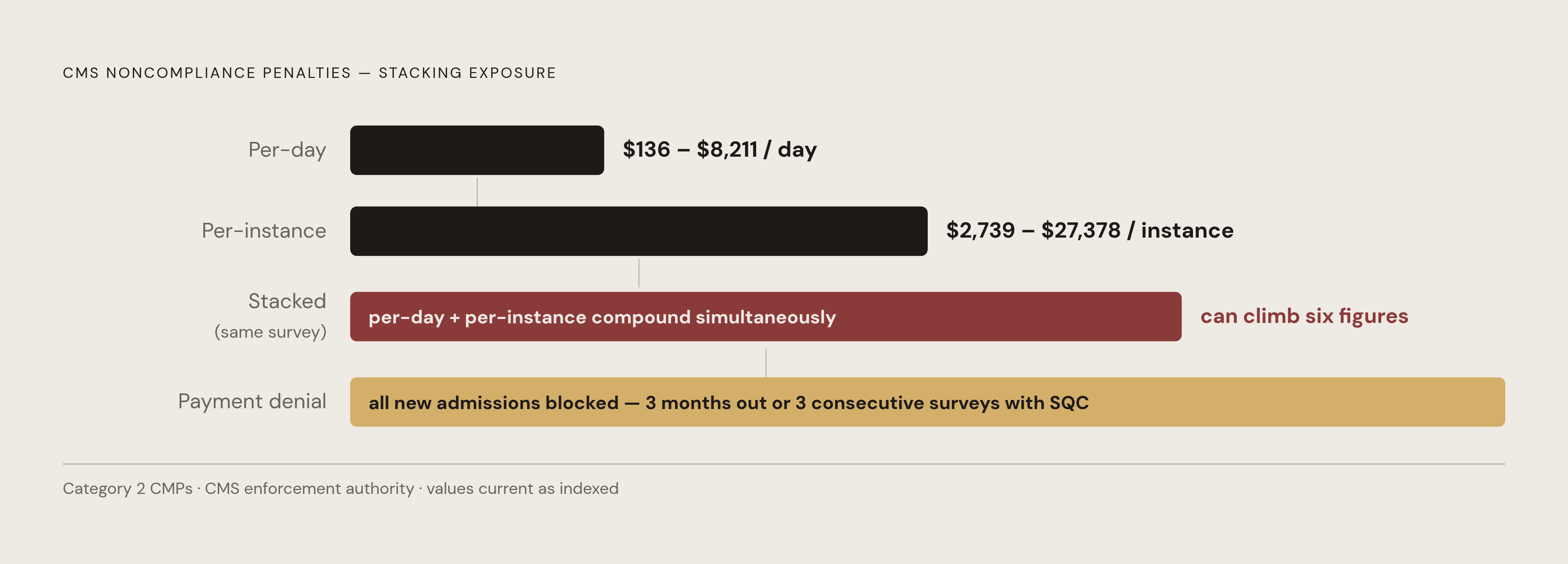
The financial exposure for getting this wrong is severe, and there's no discretion built into it. If a facility remains out of compliance three months after the survey that flagged the problem, CMS or the state must deny payment for all new admissions. The same mandatory denial applies to any facility cited for substandard quality of care across its last three consecutive standard surveys. Under the January 2026 CMP adjustment, Category 2 per-day penalties range from $136 to $8,211 per day of noncompliance, and Category 2 per-instance penalties range from $2,739 to $27,378 per instance. CMS can stack per-day and per-instance penalties from the same survey across separate citations, and a widespread immediate jeopardy finding that takes weeks to resolve can climb into six figures fast.
The POC itself joins the permanent record surveyors read on the next visit. A thin, vague POC filed after one survey has a way of drawing sharper scrutiny on the survey that follows it, which is reason enough to treat the ten-day window as worth the effort it demands.
Incident documentation, falls especially, as the most common gap and the highest-stakes one
Falls are the center of long-term care risk for a reason that has nothing to do with compliance and everything to do with the people involved. Falls are the leading cause of injury and injury death for adults over 65, and the associated costs run into the tens of billions annually nationwide. Every fall triggers a documentation chain with several distinct, separately required pieces: the initial incident report, an updated risk assessment, a revised care plan, records of physician and family notification, and follow-up monitoring notes. Each one stands as its own obligation under the federal rules governing long-term care operations, not an optional add-on tacked onto a single incident report.
The OIG's finding that 43% of falls with major injury and hospitalization go unreported in Medicare data points to something worse than an occasional oversight. A gap that size across the entire Medicare-enrolled population means the failure is systematic, built into how incidents get logged, or don't, rather than a handful of missed entries at a handful of buildings. CMS can spot that gap without setting foot in the building at all, simply by cross-referencing hospitalization claims against what facilities reported internally.
After a fall, F689 exposure doesn't come only from the fall itself. It comes from whatever documentation follows, or fails to follow, showing the facility caught the risk, assessed it, and acted. Retrospective paperwork written days later to patch a hole doesn't hold up the way a contemporaneous note does. Surveyors know the difference on sight, and a note written after the fact carries less weight than one written in the moment. Documentation demands peak exactly when nursing staff have the least bandwidth for it, in the minutes and hours after an acute event, which is precisely when manual processes are most likely to fall short.
EHR-embedded analytics and AI tools changing how SNFs monitor and document resident risk continuously
Electronic health records already hold most of the raw material needed to flag fall risk before it turns into an incident. Research published in PMC (PMC9015781) examined machine learning approaches to fall prediction in long-term care, finding that such models are built to handle the breadth and complexity of interacting risk factors buried in EHR data. The data has been sitting there for years. What changed is the tooling built to read it.
A JAMDA study published in 2024 built a machine learning model using EHR data from 5,642,474 patients across 8,440 skilled nursing facilities, predicting hospitalization or death within seven days using vital signs, diagnoses, lab results, food intake, and clinical notes as inputs. That's population-scale pattern recognition running on the exact kind of resident-level detail a nursing chart already contains.
Manual fall risk assessments have real limits even when staff do them conscientiously. An MDPI study found that routine manual assessments eat up real time even when tracking just a handful of factors, and that AI-derived models can match their accuracy while running far more often than any staff could manage by hand. Frequency matters most here, since risk shifts day to day, not just at the quarterly reassessment.
Vendor tools built on top of this research have started showing measurable results in the field. One EHR-embedded machine learning tool, launched in October 2021, reads resident demographics, active diagnoses, medications, Braden assessments, and fall history to build real-time dashboards organized by floor, wing, or individual resident. A pilot at an operator serving roughly 24,000 patients daily across more than 180 locations focused on residents who'd fallen more than once in a 30-day window, and brought falls in that group down to zero at one facility. The dashboard format helps with the staffing turnover that's only gotten worse since the federal numeric minimum went away: agency and float staff unfamiliar with a unit can check a resident's risk profile at the start of a shift instead of leaning on institutional memory that simply isn't there for them.
A separate tool, built for long-term and post-acute care interdisciplinary teams, uses predictive models trained through machine learning to flag at-risk residents and shape care plans around their actual risk profile. Residents with worsening cognitive difficulty get routed into activity groups that match their real capacity, and residents with elevated fall risk get personalized pain management plans tied to that risk instead of a generic protocol.
The common thread across these tools is that they read documentation already sitting in the record, unstructured clinical notes included, and surface risk signals, compliance gaps, and trend alerts without asking staff to enter anything twice or learn a new workflow. That matters for compliance specifically because it leaves a documented, time-stamped trail of when a risk was flagged and how the care team responded, which is exactly the evidence F689 and F656 citations turn on.
Continuous documentation readiness as an operational practice
QAPI is a standing obligation. CMS expects facilities to run systematic self-assessment year-round: spotting vulnerabilities, running internal reviews that actually mean something, and putting in corrections built to survive surveyor scrutiny whenever it shows up.
Cross-referencing has to become routine, not something that only happens after a citation forces it. MDS coding needs regular checking against the clinical notes it's supposed to summarize. Care plans need to track a resident's current status, not last quarter's. Incident logs need to line up with what Medicare claims data will eventually show, because internal inconsistency between those records is the single most common trigger that turns a routine citation into a deeper investigation.
The discipline that makes a Plan of Correction defensible, specific, backed by evidence, built to hold, is the same discipline that makes everyday documentation defensible during a live survey. It's one muscle, exercised continuously instead of crammed into a 10-day deadline.
The RBS eligibility criteria make the payoff concrete. Facilities with strong quality ratings, accurate data reporting, and a clean survey history make up the roughly 12% eligible for the faster, lighter survey process, and documentation quality isn't separate from that track record, it's the visible proof of it. With the federal numeric minimum staffing rule gone, PBJ data and the clinical record together now stand in for that fixed headcount requirement: what staff did, what they assessed, what interventions they documented, and when they documented it. That combination is what surveyors lean on now in place of a single federal number.
Survey readiness comes down to the condition of the documentation at any given moment, because complaint surveys don't wait for a 15-month cycle to run out. They can arrive on a Tuesday morning with no warning at all, and the record has to be ready before the knock on the door, not scrambled together after it.
Sources
- Development of a Predictive Hospitalization Model for Skilled Nursing Facility Patients - Journal of the American Medical Directors Association
- QSO-26-03-NH Revised State Operations Manual Chapter 5 and 7 20260331
- aapacn.org
- fedlaws.org
- Predicting Falls in Long-term Care Facilities: Machine Learning Study - PMC
- mdpi.com
- wellsky.com