Mandatory Reporting Triggers for Falls in Ontario Long-Term Care Homes
Homes must report falls only when they cause fractures, hospitalizations, or death.
A fall in an Ontario long-term care home doesn't automatically trigger a report to the Ministry. Whether it does depends on outcome, not incident, and that distinction sits at the center of Ontario's entire compliance regime for falls. Falls remain the leading cause of injury among LTC residents, driving chronic pain, lost mobility, hospitalization, and death. Provincial data from 2024-2025 puts fall prevalence at roughly 17% of residents in the 30 days before assessment, well above the historical RAI-MDS benchmark of 9% that Ontario has been measured against for years. Nursing facility residents nationally fall at rates two to three times higher than community-dwelling seniors, with estimates ranging from 50% to 75% annually, so the paperwork this piece walks through tracks real harm to real people, not administrative housekeeping.
The legislative framework Ontario LTC homes operate under for fall reporting
The Fixing Long-Term Care Act, 2021 (FLTCA), together with Ontario Regulation 246/22, governs LTC operations now. Both replaced the Long-Term Care Homes Act, 2007, following consultations involving the public, the health care sector, the Long-Term Care COVID-19 Commission, and the Auditor General, and the rules that emerged were tightened.
O. Reg. 246/22 names falls prevention and management as its own regulatory domain, alongside medication management and skin and wound care, as a distinct compliance area homes get assessed against on its own terms. Falls get assessed as their own compliance area. A home can be doing fine on medication management and still fail on falls specifically. The regulation requires that every resident's care plan identify fall risk by name and attach specific interventions to it, and that requirement appears twice: once in the 24-hour admission care plan, and again in the ongoing plan of care that follows. A home that documents fall risk once at admission and never revisits it has already missed what the regulation asks for, no matter how thorough that first entry was.
What triggers mandatory reporting: the critical incident threshold for falls
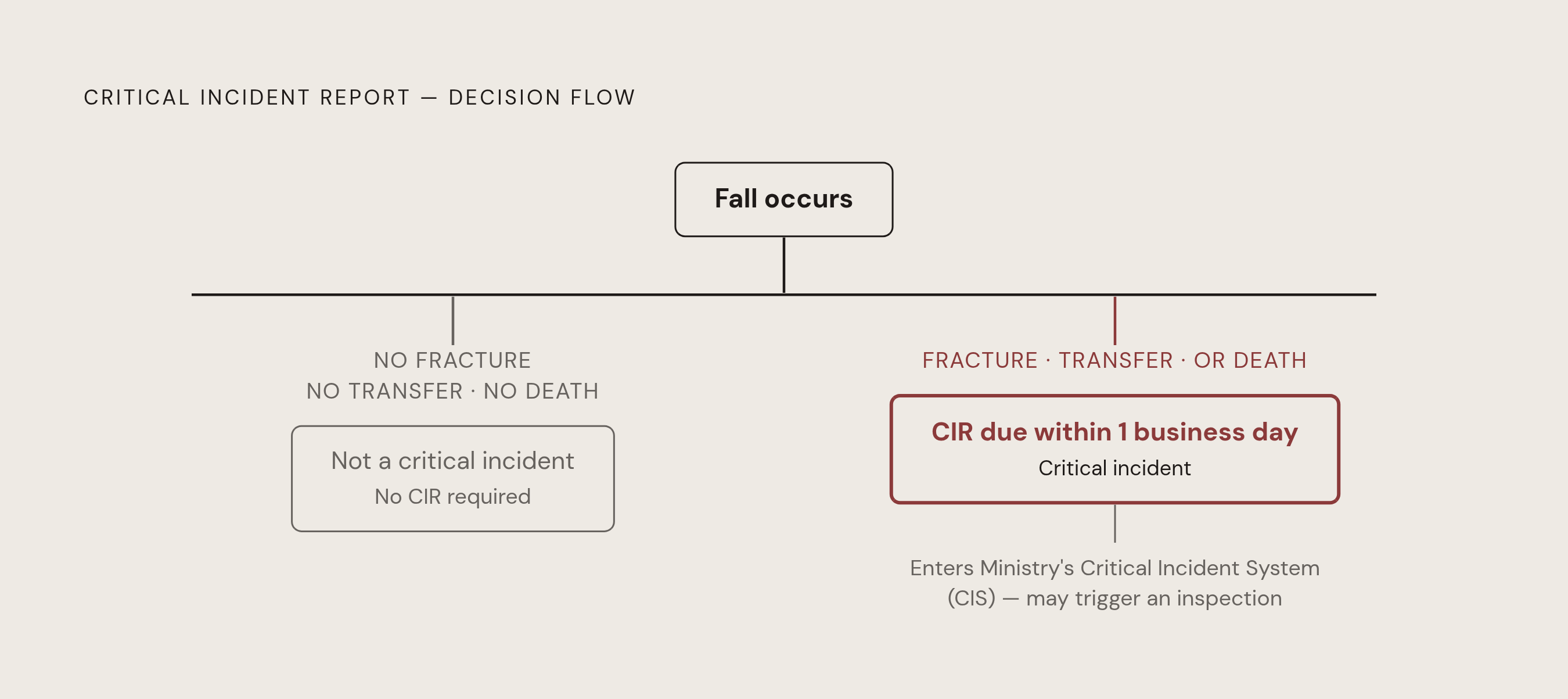
Section 115 of O. Reg. 246/22 governs "Reports re Critical Incidents," and it's the clause that decides when a fall becomes reportable. A fall isn't, by itself, a critical incident. It becomes one when it produces a serious outcome, and the regulation defines that outcome narrowly: a fracture, a hospital transfer, or death. Nothing else on that list counts, and homes that report more broadly than that aren't being careful, they're misreading the statute.
That threshold is the whole ballgame. A resident who slips, lands on the floor, and gets up with a bruise hasn't generated a reportable event under Section 115, however alarming the fall looked to staff on the unit. A resident who fractures a hip in an identical fall has, and the clock starts immediately: homes must notify the Director using the "Report in 1 Business Day" procedure, and that timeline doesn't flex based on how short-staffed the floor was that shift.
The report itself isn't one form. It requires a Critical Incident Report (CIR) submitted to the Ministry, along with supporting clinical documentation showing what interventions followed. If that documentation package is incomplete, the report reads the same to an inspector as a late one.
Where the report goes and how inspectors use it
The Director at the Ministry of Long-Term Care is the primary recipient, and the CIR enters the Ministry's Critical Incident System (CIS). That platform sits apart from CARES, the system Long-Term Care Inspection Branch inspectors use day to day, though the two are being modernized in parallel. The Ministry's 2024-2025 annual report committed to Phase 3 of the Compliance Assistance and Regulatory Enforcement System, with a go-live date in early 2025, touching both the LTCHomes.net platform and the CIS homes submit through. Facilities should confirm they're actually working inside the updated interface rather than assuming last year's login screen still applies, since a submission routed through the wrong portal can sit unprocessed.
Other channels come into play depending on the outcome. A fall resulting in death routes to the Office of the Chief Coroner, and the Geriatric and Long Term Care Review Committee has its own notification role. None of that is optional cc'ing. Each channel exists because a different body holds jurisdiction over a different consequence of the same event, and skipping one because the CIR already went to the Ministry misunderstands what each body is actually checking for.
The Ministry runs several inspection types, complaint, critical incident, follow-up, comprehensive, and a CIR for a fall can open a critical incident inspection on its own. Filing the report is frequently the start of a new obligation, not the close of the one already underway.
What compliance data reveals about where Ontario homes are falling short
The inspection numbers are easy to misread at a glance. Findings climbed from 9.9 per inspected home in 2023 to 13.0 by 2025, and inspections per home rose from roughly 2.9 to 5.6 over that stretch. Reading that as homes getting worse at care would be wrong: more scrutiny produces more findings almost by definition, because increased inspection frequency surfaces problems that were already there in the home's records, not what creates them.
Of the 25,198 total findings recorded since April 2022, about 10% carry compliance orders with mandatory remediation deadlines attached. The rest resolve as written notifications or get corrected on the spot during inspection, so most non-compliance isn't catastrophic. But the tenth that isn't minor is serious enough that the Ministry sets a deadline and expects proof of correction.
The distribution across homes is the number that actually matters here. Homes with 16 or more findings in 2025 made up 29% of the province's facilities, yet accounted for roughly 65% of all findings that year. Non-compliance in Ontario LTC doesn't spread evenly across the sector: it clusters hard in a minority of homes. St. Joseph's at Fleming, a not-for-profit, 200-bed home in Peterborough, recorded 132 non-compliance findings in 2025 alone, close to ten times the annual average of 14 findings per home. A gap that wide doesn't happen by chance. It points to a documentation and workflow failure compounding across every inspection cycle.
How resident risk assessment tools connect to fall reporting readiness
Ontario's standard resident assessment instrument, RAI-MDS 2.0, captures fall data through structured assessments that homes complete on a regular basis. How a home documents and categorizes a fall in that instrument carries operational weight, because the records it generates are what inspectors review when determining whether an event was properly recognized and responded to, before anyone even reaches the question of whether it clears the critical incident threshold.
That instrument is on its way out. RAI-MDS 2.0 and the Continuing Care Reporting System (CCRS) have to be replaced across every Ontario LTC home by the interRAI Long-Term Care Facilities (LTCF) Assessment Instrument and the Integrated interRAI Reporting System (IRRS), with a hard deadline of April 1, 2026. Homes assess residents on a regular cadence, so fall risk profiles refresh periodically, and care plans are supposed to move in step with each update rather than trail behind it by a month or two.
North American LTC facilities lean on a handful of validated tools to turn that quarterly data into a usable risk score, including the Morse Fall Scale, STRATIFY, interRAI's own Clinical Assessment Protocols (CAPs), the Scott Fall Risk Tool, and the Johns Hopkins Fall Risk Tool. Which tool a home picks matters far less than whether the output actually reaches the care plan and stays current with it. A risk score sitting in an assessment file that never makes it into the plan of care fails as a safeguard, no matter how validated the tool behind it is. It's a paper trail an inspector will notice doesn't connect to anything, and that disconnect turns a routine inspection into a finding.
Building a reporting posture that stays ahead of the survey cycle
Fall reporting compliance can't be assembled after a fall happens. It has to already exist as an ongoing alignment between risk assessment results, care plan content, and incident documentation, with each piece feeding the next continuously rather than getting reconciled once a year right before survey.
A few checks follow directly from the regulatory text above. Every resident's care plan, including the 24-hour admission plan, should name fall risk and the specific interventions tied to it." Care plans need updating after each interRAI assessment and reviewed after falls, since a near-miss today can be part of the pattern behind a fracture next month. The critical incident threshold itself has to be applied without hedging: when a serious outcome such as a fracture, hospital transfer, or death occurs, a CIR is due to the Ministry within one business day, and uncertainty about how serious the outcome looked isn't a defense an inspector will accept.
Post-fall interdisciplinary assessments need to land in the clinical record in a form that actually matches the care plan, because that correspondence is precisely what inspectors check line by line. Homes should confirm they're working inside the updated CIS interface as CARES Phase 3 rolls out, and the April 1, 2026 deadline for the interRAI LTCF and IRRS transition belongs on every home's calendar now, not next winter when the deadline is already close.
None of this happens in a staffing vacuum. Nursing managers carry direct care responsibilities alongside an inspection cycle that's grown more active year over year, and proactive inspections reached at least half of Ontario's homes by March 2024, with every CIR opening its own inspection pathway into a home's broader documentation practice. Given that, any system able to surface fall risk from documentation already on file, without demanding a second round of duplicate entry, cuts real time off a burden that's already heavy. A quiet inspection year is something a home earns, one accurate report at a time. It's something a home earns, one accurate report at a time.