Ontario Long-Term Care Homes Act 2007 Documentation Requirements Explained
Homes must document care compliance across multiple legal domains or face inspection citations.
Ontario's Long-Term Care Homes Act, 2007 built documentation into the legal foundation of resident care as the actual evidence of compliance. Every plan of care, incident report, staffing log, and complaint file exists because the statute and its regulation, O. Reg. 79/10, made record-keeping a legal duty with enforcement teeth. Understanding how that structure worked, and how it carried into the Fixing Long-Term Care Act, 2021, is what separates a home that survives an inspection from one that gets an order.
Under the Long-Term Care Homes Act, 2007 and O. Reg. 79/10, every long-term care home in Ontario carried legal duties to document across multiple distinct domains: plans of care based on individual resident assessments, incident and complaint records, investigation reports, restraint logs, staffing and qualification records, criminal reference checks, training and orientation logs, consent, continuous quality improvement records, and infection prevention and control programs, among others. Each domain stood on its own, so a gap in one area, whether a missing reassessment or an incomplete complaint file, could be cited without any offsetting strength elsewhere. When the Fixing Long-Term Care Act, 2021 came into force on April 11, 2022, it repealed the LTCHA and revoked O. Reg. 79/10, but it preserved the documentation logic those instruments had established rather than replacing it, layering in changes to staffing minimums, enforcement powers, and licensing. Homes operating today answer to the FLTCA, but the audit trails and compliance records inspectors examine still trace directly back to the architecture of the earlier legislation.
The LTCHA came into force on July 1, 2010, replacing three older statutes at once, the Nursing Homes Act, the Charitable Institutions Act, and the Homes for the Aged and Rest Homes Act. All three were repealed the same day. The stated goal was to raise quality of life for residents by tightening enforcement, improving care standards, and increasing accountability across the sector. The Act laid out the framework; O. Reg. 79/10 filled in the operational detail, including nearly every documentation obligation a home would ever have to meet.
That framework didn't disappear when the FLTCA took over on April 11, 2022. The newer act repealed the LTCHA and revoked O. Reg. 79/10, but it explicitly preserved the status quo the LTCHA had established, layering in changes to staffing, accountability, enforcement, and licensing rather than rewriting the documentation logic from scratch. So homes operating today answer to the FLTCA, but the audit trails, historical compliance records, and even the habits of front-line staff still trace back to the architecture of the earlier legislation it replaced. Surveyors reference it. Operators reference it. Treating "repealed" as "irrelevant" is a mistake because it becomes visible fast during an inspection.
How the Act structured documentation obligations across resident care
Part II of the LTCHA didn't treat resident care as one undifferentiated obligation. It broke care into distinct domains, each with its own documentation duty: nursing and personal support, restorative care, recreational and social activities, dietary services and hydration, medical services, information and referral assistance, religious and spiritual practices, and accommodation services (ss. 8 to 16). Section 8 of O. Reg. 79/10 then set the baseline: the home had to meet the staffing and care standards the Regulation specified wherever the Act or Regulation called for a plan, policy, protocol, procedure, strategy, or system, and documentation was the proof that it had.
This is the part readers tend to miss. Documentation under the LTCHA wasn't a single checklist a home could complete once and file away. It was a network of obligations spread across multiple Parts of the Act, and each part carried its own record-keeping expectations. Part V, covering the operation of homes, required documentation on the Administrator, the Director of Nursing and Personal Care, the Medical Director, criminal reference checks, continuous quality improvement records, and infection prevention and control programs. Part VI required accounts and records tied to funding under section 92.
Some obligations sat apart as their own discrete category. Restraint records were a requirement inspectors check on their own terms, separate from general incident logs. The Act required documentation alongside the forwarding of complaints, and separate provisions demanded investigation reports in a specified manner. A gap in any single domain, whether it's dietary records, restraint logs, or a mishandled complaint file, can stand alone as a citation. Nothing about the structure allows a home to average out a weak spot against strength elsewhere.
What did the plan of care requirement demand, and what counted as compliance?
Section 6 of the LTCHA, paired with the plan of care provisions of O. Reg. 79/10, governed the plan of care for every resident except those in short-stay respite care. The statute laid out a full sequence. Every resident needed a plan of care, based on an actual assessment of that resident, covering all aspects of care, with assessments and care integrated rather than siloed. The resident and family had to be involved in developing it (6(5)), the initial plan had to come together promptly after admission (6(6)), and the licensee carried a duty to actually comply with what the plan said (6(7)).
Staff had to be kept aware of the plan (6(8)), documentation obligations attached directly to it (6(9)), and reassessment and revision were mandatory whenever a resident's circumstances changed (6(10) and (11)). The plan then had to be explained to the resident or their substitute decision-maker (6(12)), with limits on disclosure and access rounding out the section (6(13) and (14)). Assessment domains followed the Resident Assessment Instrument Minimum Data Set 2.0, RAI-MDS 2.0, a standard now in the middle of a transition covered later in this piece.
The regulation never required the plan of care to live in a single document, and it didn't even have to carry that name. It could span care plans, kardex records, and goal statements. It could include Medication Administration Records and Treatment Administration Records, physician order sheets, medical directive sheets, bath lists, physiotherapy or activation plans, recreational activity plans, snack lists, and diet books. In practice, the plan of care is a legal construct built from whatever documentation exists across the home. What they check is whether the totality of the paperwork, however it's organized, satisfies the statutory criteria.
Consent runs alongside all of this. Section 7 of the LTCHA tied assessment and the provision of care or services to actual consent. Documenting that consent is itself part of the compliance picture, not a separate courtesy. And the single most commonly cited failure point in this entire section is reassessment: when a resident's condition changes and section 6(10) requires a new look at the plan, homes often fail to document that the reassessment happened.
Incident recording, complaints, and mandatory reporting obligations
Section 21 required every licensee to maintain a complaints procedure, full stop. Section 22 required that complaints get forwarded, and section 23 laid out investigation duties in three parts: the licensee had to investigate, respond, and act (23(1)), then produce reports of that investigation in a specified format. Certain matters had to go further, up to the Director, under section 24, and the statute treated false information or suppression of a report as its own offence.
The designate handling complaints had to keep a detailed record of each one. Not a summary. A detailed record, because a summary doesn't hold up under scrutiny the way a full account does. Survey readiness in this area means complete incident reports for falls, medication errors, and resident complaints alike, each one paired with documented follow-up action.
One misunderstanding trips up more homes than it should: if a non-compliance gets fixed before an inspection wraps up, it might not result in a written citation, but the finding itself and the corrective action taken still need to be on paper. Skipping that step leaves a home exposed the next time an inspector comes through and finds no trail.
Restraint records sit in their own lane, checked separately from general incident documentation. Sections 19 and 20 impose a duty to protect residents alongside a zero-tolerance policy on abuse and neglect. The policy's existence and its communication to staff are themselves documentable obligations. A home that has the right policy but never wrote down that staff were trained on it has still failed the requirement.
Surveyors tend to start with incident and complaint records because they show whether a home's paperwork reflects real-time awareness of what happened on the floor or was reconstructed after the fact to look tidy.
Staffing and operational records the regulation required facilities to maintain
Part V required documentation on the Administrator (s. 70), the Director of Nursing and Personal Care (s. 71), and the Medical Director (s. 72), plus staff qualifications (s. 73), screening measures including criminal reference checks (s. 75), training logs (s. 76), and orientation records for volunteers (s. 77). Section 74 limited how much a home could lean on temporary, casual, or agency staff for continuity of care, and documenting the actual staffing mix is what proves a home is staying within that limit.
Survey readiness here means schedules, training logs, and certification updates that inspectors can cross-check against resident care records, confirming that the care documented in a resident's file was actually delivered by someone qualified to deliver it. The LTCHA, carried forward into the FLTCA, required an interdisciplinary quality improvement committee with documented CQI records, and the newer act adds a requirement to publish a CQI report each fiscal year on the home's website.
Infection prevention and control, under section 86, required a documented IPAC program, a category that moved from routine to closely watched during pandemic-era inspections and has stayed scrutinized since. Section 87 required a documented emergency plan, and the emphasis there is specific: it's not enough for the plan to exist, the documentation has to show it exists and is actively maintained.
As of March 31, 2025, Ontario mandated under the FLTCA that homes provide an average of four hours of direct care per resident per day, with allied health professionals contributing 36 minutes per resident per day on top of that. Neither threshold means anything to an inspector without staffing records that prove the hours were actually delivered.
How the inspection regime converts documentation into evidence of compliance
The Inspections Branch runs on software called CARES, the Compliance Assistance and Regulatory Enforcement System, when it examines homes against legislative and regulatory requirements. Across 2024 and 2025, the ministry rolled out five releases carrying more than 350 enhancements to the system, and Phase 3 of that modernization is underway now, with phased implementation starting in summer 2025 that touches LTCHomes.net and the Critical Incident System homes use for reporting. Facilities that don't track these changes risk finding their submission formats out of step with what the system expects.
The inspection push itself has scaled up fast. As of April 24, 2025, 546 homes, 89 percent of every long-term care home in Ontario, had received a proactive compliance inspection, part of a government commitment to reach full coverage by the end of 2025. The consequences for failing those inspections have grown sharper too. The FLTCA allows administrative monetary penalties up to $250,000 for homes that don't comply with an order, and as of March 31, 2023, 58 AMPs had already been served, totalling $206,800. The act also doubles the fines for offences compared to the old LTCHA and doubles the funding that can be withheld for non-compliance.
None of this is theoretical pressure. The government set a target to bring homes found non-compliant with a follow-up order down to 5.5 percent of all homes, a benchmark that reflects how directly the inspection regime tracks documentation gaps. The system is producing measurable movement, and the mechanism behind it is direct: a gap in documentation is a gap in evidence, and penalties flow from what can't be proven on paper as much as from what actually went wrong in care.
What the interRAI LTCF transition changes about assessment documentation
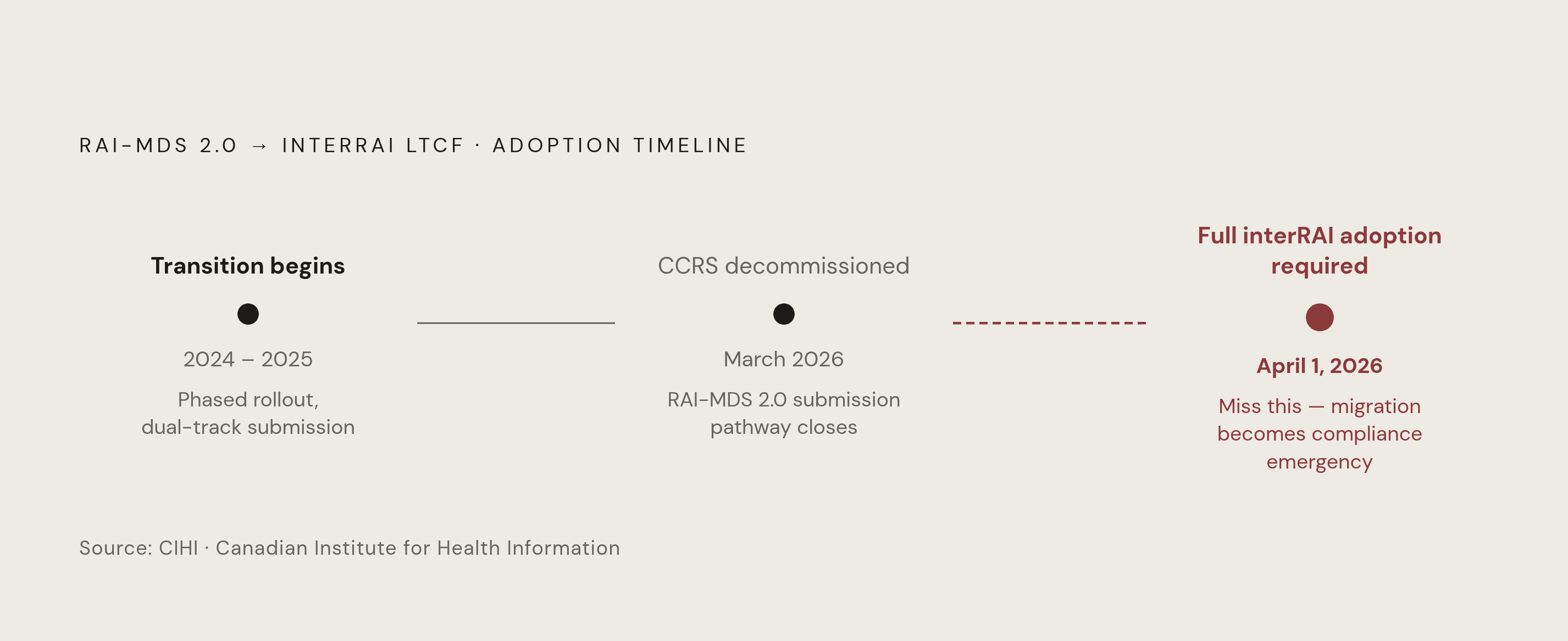
RAI-MDS 2.0 has governed assessment domains under the LTCHA and O. Reg. 79/10 for well over a decade. RAI-MDS 2.0's role as the governing standard is ending. Starting in 2024 and 2025, the Ontario Ministry began a phased transition of every long-term care home to the interRAI Long-Term Care Facility instrument, Canadian Edition, with a hard deadline of April 1, 2026 for full adoption. CIHI will decommission CCRS, the reporting system that RAI-MDS 2.0 depends on, by March 2026. The old standard won't just be outdated; it will have no supported reporting pathway left.
The interRAI LTCF evaluates the needs, strengths, and preferences of people in chronic care settings, measuring function, mental and physical health, social support, and service use. The assessment clock is specific: homes have seven days from the Date Stay Began, the first admission date, to complete an initial assessment, with quarterly reassessments after that. Clinical Assessment Protocols, or CAPs, now sit inside the care planning trigger structure, and while a home decides who actually carries out the resulting goals and interventions, the trigger and the response to it both have to be documented.
The ministry expects the new standard to improve assessment quality and cut administrative burden over time. Fair enough, but the transition period itself is where the risk sits. Any home still running RAI-MDS 2.0 workflows after March 2026 will find its assessment documentation simply can't be submitted anywhere, which turns a software migration into a compliance emergency for anyone who waits too long to make the switch.
What drives documentation gaps despite clear legal requirements
None of this happens in a vacuum free of pressure. Long-term care homes across Ontario, and across the sector generally, face staffing shortages alongside administrative burden that eats into time better spent on residents, family communication, and consent management. Manual documentation processes are a large part of why.
Research consistently shows that nurses report electronic health record systems as a significant source of dissatisfaction, with documentation demands consuming significant time each shift rather than direct care. Broader sector research points the same direction, with burned-out nurses frequently naming their EHR as a major contributor to that burnout, and a meaningful share of that group say they're likely to leave the profession within two years. Documentation burden, in other words, is pushing experienced staff out the door in addition to slowing things down. It's pushing experienced staff out the door.
Part of the problem is where policy attention has gone. Legislation and research in this space have focused overwhelmingly on physician experience with electronic records, leaving the specific documentation burden nurses carry, the ones actually filling out plans of care, incident reports, and reassessments, without the same scrutiny or the same fixes. The legal requirements are clear enough on paper. What's missing is a serious accounting of what it actually costs the people filling out the forms to keep the paper trail intact.