Building a Continuous Internal Audit Cycle for LTC Nursing Documentation
Daily chart reviews and weekly resident audits catch documentation gaps before surveyors do.

A continuous internal audit cycle for LTC nursing documentation makes chart review part of each day’s work as well as the work done before a survey. The cycle turns charting into a compliance asset by linking clinical observations, coding, care plans, and corrective action. Its value depends on a repeating structure that detects gaps while staff can still respond, assigns responsibility, and records what changed.
Why documentation-as-compliance is now the operating premise for LTC facilities
The quality of documentation now helps determine how much a survey involves, whether a facility qualifies for reimbursement, and its risk of deficiencies as new data comes in. CMS QSO-25-14-NH, revised March 10, 2025 and effective April 28, 2025, updated Appendix PP survey guidance with greater emphasis on assessment accuracy, real-time care planning, and documentation quality. Surveyors began applying that guidance April 28, 2025. The record must stay aligned with the resident’s condition as care decisions change.
CMS began piloting the Risk-Based Survey process in 2023 in more than 100 facilities, and nationwide implementation began September 8, 2026. Facilities with strong documentation records face fewer surveyors and less onsite time, while those with gaps face the full traditional process. A facility’s record is not simply evidence presented during a survey but part of the basis for how that survey proceeds.
The OIG found that nursing homes failed to report a large share of falls involving major injury and hospitalization on required MDS assessments. Falls data now directly affects Special Focus Facility selection, while MDS underreporting distorts Care Compare quality measures. CMS has not yet implemented proposed changes to incorporate claims data into the falls quality measure calculation. When documentation is evaluated continuously, audit readiness cannot remain seasonal.
What regulators actually scrutinize: the incident categories that drive deficiency citations
Surveyors concentrate on a predictable cluster of incidents rather than examining documentation as an undifferentiated task. Falls, skin and wound changes, medication use, transfers, and care planning provide the central audit map. Hydration, behavioral changes, and infection indicators also appear consistently in the Critical Element Pathways used by surveyors. Audits examine whether the record shows recognition, assessment, a care decision, and an appropriate update as the resident’s needs evolve.
Highland Pines (CR6922) illustrates the consequences of a break in that sequence. The facility failed to accurately document the spread of gangrene already identified during a foot care visit, delaying recognition and response to the worsening condition. An ALJ upheld a civil money penalty, with contemporaneous records central to whether care was delivered. The decision in Generations Oakton Pavilion (CR6834) also upheld a civil money penalty and denial of payment for new Medicare/Medicaid admissions. The record is evidence of care.
CMS’s November 2024 revised LTC Surveyor Guidance introduced F627 for inappropriate transfers and discharges and F628 for the transfer and discharge process. Surveyors also focus on nonpharmacological interventions, as-needed medication use, and trauma-informed care documentation at admission. These requirements broaden what a defensible resident narrative must contain. Across incident categories, the medical record must explain how decisions align with the resident’s condition, goals, and evolving needs. Every change in condition or medication must be reflected in that account.
Why pre-survey scrambles fail and what a continuous cycle replaces them with
Reactive preparation is an operational design failure because gaps accumulate between reviews and cannot be reliably reconstructed under time pressure. Surveys are unannounced, and Risk-Based Survey eligibility is re-evaluated quarterly. A facility that begins correcting its documentation when a surveyor arrives is already working with a record that has been evaluated. More effort at that point cannot recover every missed connection between an observation and the response it required.
Reconstruction also consumes nursing manager time that would otherwise support direct care and operational oversight. When review is episodic, discrepancies between a resident’s actual condition and the written record can grow without being noticed. By the time a survey exposes them, the opportunity for timely correction has passed. The resulting deficiency reflects the accumulated gap.
Continuous quality improvement offers a different operating model. It identifies gaps, generates data, implements action plans, evaluates performance, and adjusts the process based on what the results show. Staff investigate what went wrong in the system when compliance fails, going beyond a list of individual mistakes. A robust QAPI program engages frontline staff, tracks trends, and uses root cause analysis to drive clinical and operational changes. Internal audits and mock surveys serve that process.
The four-phase structure of a continuous internal audit cycle
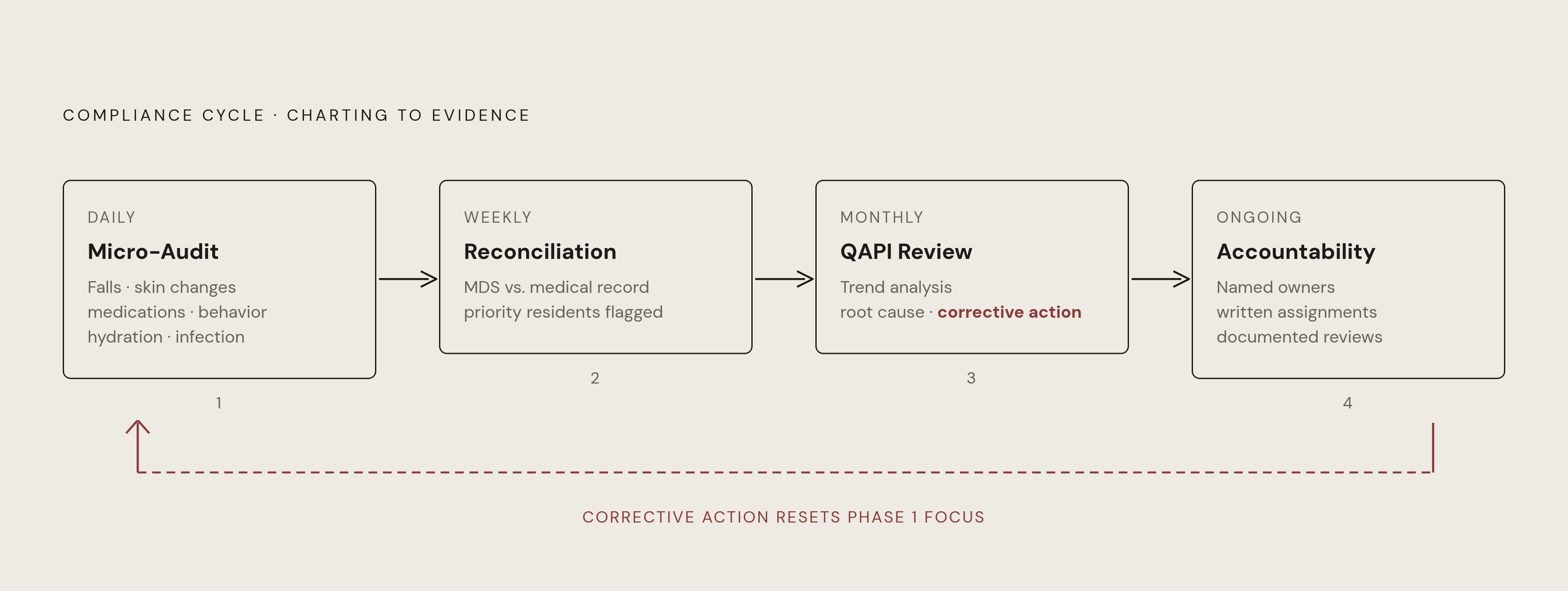
Phase 1 is daily micro-auditing built into the charge nurse’s existing end-of-shift documentation review. To make this consistent, facilities should review falls, skin changes, medication changes, behavioral shifts, hydration, and infection indicators against defined documentation expectations. A fall described in a note should align with MDS coding, and a medication change should be reflected in the care plan. The review need not require dedicated audit staff. Its reliability comes from a common method for identifying discrepancies rather than individual judgment about what deserves a flag.
Phase 2 is resident-level reconciliation, which takes place weekly or biweekly. The reviewer reconciles MDS coding with the medical record and checks that assessments, care plans, and delivered care agree. Priority residents include those with recent falls, progressing wounds, behavioral changes, antipsychotic prescriptions, or an upcoming discharge or transfer. Here, the resident’s story becomes the test. A reviewer reading only the chart should understand why each care decision was made, what changed, and what followed. This resident-level method provides evidence of actual practice that a policy alone cannot supply.
Phase 3 is monthly QAPI review, which turns individual discrepancies into trend data. The review should find categories and residents that keep getting flagged, along with documentation patterns found in the work of more than one staff member. Root cause analysis then distinguishes a workflow problem from a knowledge gap. A form that is difficult to complete at the point of care requires a different response from uncertainty about MDS coding for a fall type. CMS’s revised guidance also includes investigating health equity concerns when examining medical errors and adverse events, so the review should reflect that scope. Corrective action feeds back into daily monitoring by changing what staff examine or how they document it.
Phase 4 is the ongoing accountability structure. Each phase, renewal date, and corrective action needs a named owner, whether a dedicated compliance nurse anchors the cycle or the DON and charge nurses share the work. Those assignments must be explicit in writing. This phase also produces evidence that reviews occurred, findings were addressed, and corrective actions followed. Without that record, the facility has a harder time showing that QAPI work is ongoing. Together, the phases create a connected rhythm in which a missed review or unresolved action exposes where the process has broken down.
How unstructured clinical notes undermine audit reliability — and what to do about it
Some of the most consequential gaps begin with observations that staff did document. The information exists but never reaches the structured record. Despite near-universal EHR adoption, nurses continue to write clinical narratives in free-text fields outside the structured data used for MDS coding, quality measures, and many audit tools. A progress note may describe a change in skin condition without prompting an updated care plan or corrected MDS item. The chart then contains two accounts of the same resident, and the discrepancy becomes visible during reconciliation or survey review.
This is a documentation architecture problem. Phase 2 takes much more work when reviewers must check narrative notes by hand against structured fields in each resident’s record. Under time pressure, they can miss clinically significant details. The operational response is to use tools that read unstructured notes from existing EHRs and surface gaps without requiring duplicate documentation. That model makes information already recorded available to the audit process without adding a new charting workflow.
A study across 94 skilled nursing communities found statistically greater improvements across quality measures with an AI-enabled EHR that helped staff monitor and respond to resident assessment protocol triggers in real time than with an EHR that lacked the AI component. Those improvements included a 9% greater reduction in major falls and a greater reduction in residents needing help with activities of daily living. The finding supports the value of timely recognition and response. It does not establish that every extraction tool will produce the same results. For audit design, the relevant capability is making existing clinical information visible soon enough to reconcile the record and support resident care.
Risk stratification as the audit cycle's clinical intelligence layer
Detecting a documentation gap after an event is useful, but the same information can also guide attention before further deterioration. Risk stratification uses patterns in residents’ records to rank them by the risk they face in the future. AI-supported monitoring and predictive analytics are moving into SNF operations for pressure ulcers, infections, and falls, the same categories that drive deficiency exposure. The clinical and compliance purposes therefore overlap. A risk signal can identify both a resident needing closer monitoring and a record requiring priority reconciliation.
The JAMDA study found that SNF patients at highest short-term risk of hospitalization or death could be identified from existing EHR data without requiring additional staff time. This supports targeted monitoring before clinical deterioration becomes a survey event. For nursing managers, the practical value is prioritization. Limited review time can be directed toward residents whose documentation and clinical trajectories indicate the greatest exposure, rather than charts selected in rotation regardless of urgency. Risk ranking thus gives the daily audit signals a clearer route into Phase 2.
To connect that ranking to the established cycle, facilities should map their internal methodology against the F-tag pathways surveyors use. When a resident is flagged for gaps in fall-risk documentation, checking that the care plan and MDS coding agree should take priority. Signals that keep appearing then go to monthly QAPI review, where the facility can check whether the pattern calls for a wider change. CMS quality measures are benchmarked against rolling national data periods and feed Five-Star ratings, which affect Risk-Based Survey eligibility.
Building the accountability and policy infrastructure that keeps the cycle running
Written assignments of who is responsible need policies that staff can use during a nursing manager’s normal workday. Policies need enough detail to guide what staff do and enough room for them to use sound clinical judgment. When policy language is vague, staff are unsure what to do, while rigid language leaves gaps when a resident’s care needs fall outside what the policy covers. Policies need review throughout the year as well as at the annual review. CMS updates its State Operations Manual without a fixed schedule, so a policy aligned with the last survey may no longer match current Appendix PP guidance.
CMS F842 (§483.70(i)) requires clinical records to be complete, accurately documented, readily accessible, and systematically organized. That standard should shape routine documentation review. The compliance nurse reviews records under F842, tracks when licenses and certifications need renewal, conducts internal audits, and is the main contact for CMS or state health department surveys. In smaller facilities, those duties must be explicitly distributed and documented. Clear assignments make the cycle workable when the DON and charge nurses are balancing compliance with clinical responsibilities.
CMS F726 requires demonstrated competency. Incident-triggered retraining should therefore connect an audit finding to a change in staff performance, while subsequent reviews evaluate whether the gap persists. The cycle’s written history must show that it ran, what it found, and what corrective action followed. With aligned policies, assigned roles, and that history in place, the facility is not reconstructing its response when the surveyor arrives. The surveyor’s questions are already answered in the record.