Death Reporting Obligations in Long-Term Care — Coroner and Regulatory Channels
Facilities must navigate two separate legal channels for reporting resident deaths.

A resident dies in a nursing home, and the facility's obligations split immediately into two separate legal tracks: coroner or medical examiner notification, and regulatory reporting to a state oversight body or attorney general. These are not two names for the same requirement. They have different triggers, different timelines, and different recipients, and treating one as a substitute for the other is where facilities get into trouble.
The confusion is not theoretical. In Ohio, a death at Forest Hills Healthcare Center on September 1, 2025 was initially classified as natural causes and never flagged for coroner review. It took the resident's family pressing repeatedly against dismissals from nursing home, hospice, and funeral home staff before the death was reclassified as homicide following exhumation, with the Hamilton County Coroner ultimately changing the cause of death classification. Nobody in that chain treated the regulatory paperwork as a stand-in for a forensic question, but the case shows what happens when the coroner channel never gets triggered. The rest of this piece maps both channels: what activates each one, what a facility must do procedurally once activated, and where the seams between them create exposure that neither channel alone would catch.
Coroner notification triggers and facility requirements
Coroner notification does not hinge on the fact that someone died. It hinges on whether the circumstances surrounding that death point toward violence, accident, negligence, an unexpected timeline, or a cause nobody can pin down. A death from a progressive illness that follows its expected course generally doesn't trigger anything. A death that arrives too fast, too strangely, or without a clear explanation does.
Injury history matters here, but not in the blunt way staff sometimes assume. Under the Victorian Institute of Forensic Medicine's guidelines, a fractured neck of femur that directly or indirectly contributed to death is reportable, while a fracture from years earlier with no causal link to the death isn't. The same logic governs falls specifically: a fall doesn't make a death reportable on its own, there has to be a significant injury from that fall that caused or contributed to the death. Staff who assume "resident fell last month, resident died this month, better report it" are applying the wrong test, and staff who assume the opposite, that a fall without immediate consequence closes the question permanently, are just as wrong.
There's a stricter line around cause-of-death certification. "Unknown" "Unknown" is an entry that gets kicked to the coroner whenever the attending physician cannot state a cause, regardless of how routine the death looked clinically. This is a hard rule, not a judgment call, and it functions as a backstop for every ambiguous case that doesn't cleanly fit the violence-or-accident categories.
Ontario offers the clearest procedural example of what the coroner channel demands operationally. Under Section 11 of the province's Coroner's Act, nobody with reason to believe a death falls within reportable circumstances may interfere with or alter the body in any way until the coroner issues a warrant directing otherwise. In practice, that means notification has to happen before the body is moved and before a funeral home is contacted, full stop. Ontario also runs a structured institutional model on top of that constraint: long-term care homes submit an Institutional Patient Death Record to the Office of the Chief Coroner for every death, which functions as a screening tool for identifying which cases need investigation, with direct notification required in some circumstances on top of that. Even hospital transfers get a defined process rather than case-by-case guesswork, every tenth transferred case is designated an index case requiring investigation, and the clinical manager has to contact the sending facility to sort out reportability.
None of this is uniform across jurisdictions, and a facility operating in Texas or Pennsylvania shouldn't assume Ontario's screening architecture applies to it. Once the coroner is notified, the facility can be compelled to produce the full record, and that principle holds consistently across jurisdictions. Pennsylvania's proposed legislation, for instance, would require facilities to hand over all medical records, incident reports, and any trauma history involving the deceased once the coroner opens a file. The paperwork isn't optional once that door opens, and facilities that treat the coroner call as the end of their obligation rather than the beginning of a records request are setting themselves up for a bad surprise.
The regulatory reporting channel, illustrated by Texas's model
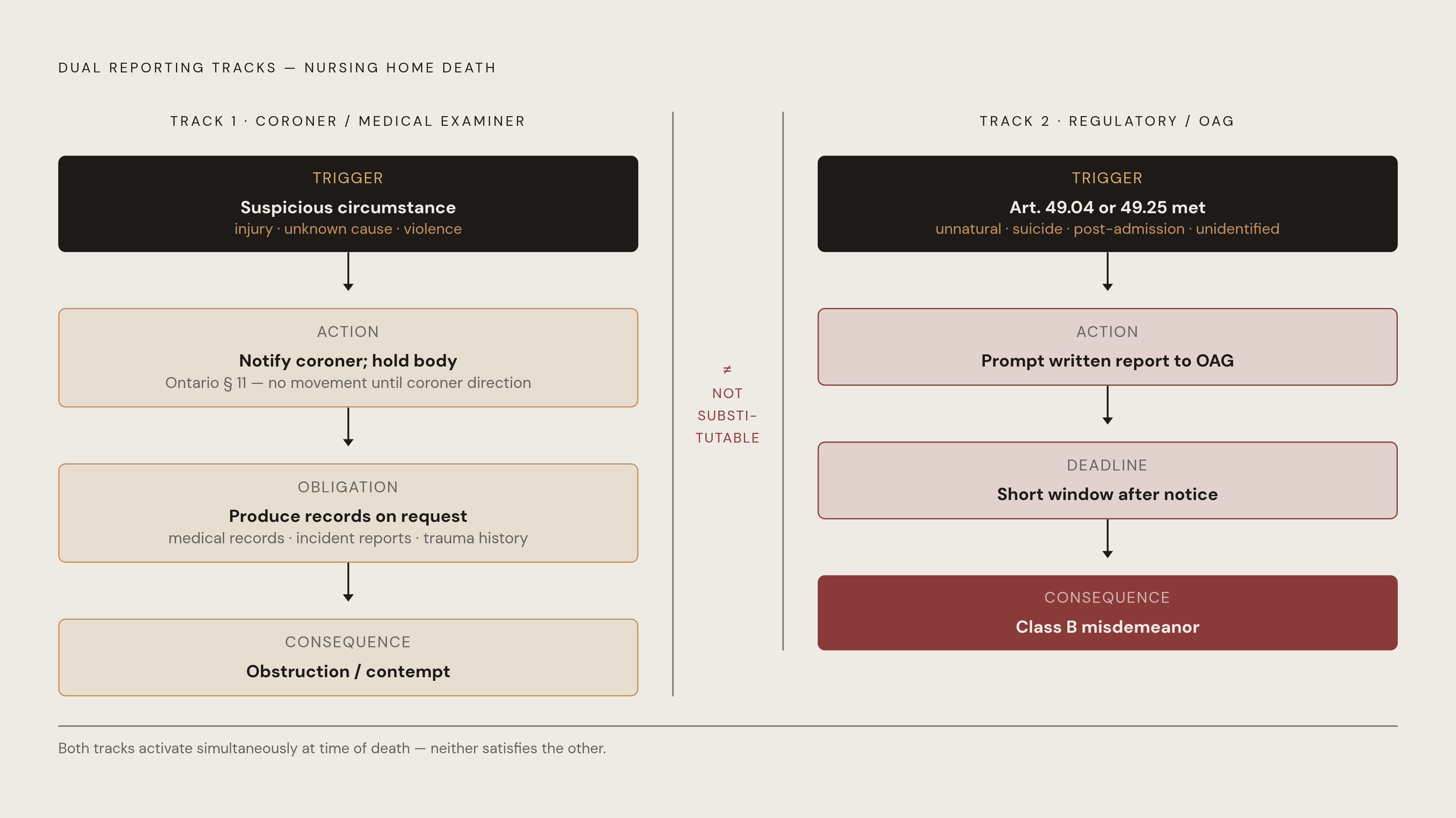
Regulatory reporting runs on its own legal track entirely, with its own trigger, its own timeline, its own recipient, and its own criminal penalty for getting it wrong. Reporting to a state oversight body does not fulfill a coroner-notification duty, and notifying the coroner does not fulfill a regulatory-reporting duty. They're parallel obligations, not sequential ones.
The trigger is narrower than most administrators assume. A facility owes the OAG a report only when it's already required to report that death to a justice of the peace under Article 49.04, or to a medical examiner under Article 49.25. This is not a report-every-death statute. Article 49.04's list covers unnatural death, death under circumstances suggesting unlawful means, suicide or suspected suicide, the death of a child under six requiring a Chapter 264 inquest, and death where a physician can't certify the cause. Article 49.25, which applies in medical examiner counties, adds death shortly after hospital or institutional admission, death by killing or unnatural cause, circumstances suggesting unlawful means, and unidentified decedents. A physician's ability to certify a cause of death knocks out only the certification trigger, it does nothing to the other triggers if they independently apply.
Failing to notify, failing to submit the report, or leaving out material facts is a Class B misdemeanor. That's a criminal exposure sitting on top of whatever civil or survey consequences follow separately.
Florida illustrates a different shape entirely, one where regulatory reporting fans out across multiple agencies rather than funneling to one. A reportable death there can draw simultaneous attention from the Department of Health, the Agency for Health Care Administration, and local law enforcement. Texas's model illustrates how one state built the mechanics. Covered institutions under SB 1469 include nursing and long-term care facilities, intermediate care facilities for individuals with an intellectual disability (ICF/IID), and assisted living facilities, with hospitals explicitly excluded from OAG reporting, though they retain separate duties to notify a justice of the peace or medical examiner. Under the reporting timeline, covered institutions must notify the OAG promptly upon a reportable death and submit the written report within a short window thereafter.
The structural gap created by discretionary coroner-reporting models
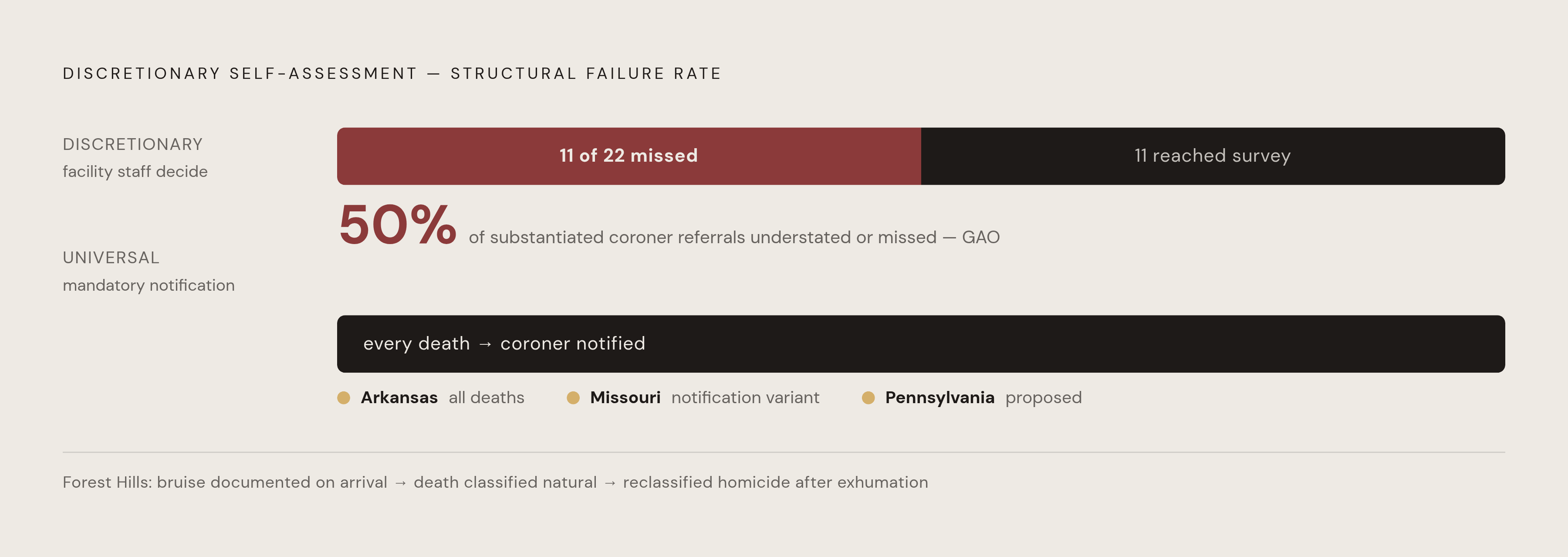
Here is where the two channels stop being merely distinct and start being genuinely mismatched. Most U.S. facilities operate under a discretionary coroner-reporting model, meaning staff contact the coroner only when a death looks suspicious to them, on their own read of the situation. That judgment call, made by facility employees about the facility's own care, is the structural gap. It can conceal preventable deaths, and it leaves facilities exposed to liability that becomes visible only once someone outside the building starts asking questions after the fact.
The lawmakers behind Pennsylvania's House Bills 1713 and 1714 said facilities currently contact the coroner for deaths that look like homicide or accident, not for deaths that may have come from natural causes or a progressive disease. That's a strong claim, but GAO's findings back the underlying worry. Half the sample, understated or missed entirely, on cases a coroner had already flagged as serious enough to substantiate.
Forest Hills Healthcare Center shows what that gap looks like on the ground. Robert Meyer arrived at the facility shortly after discharge from Mercy Health Anderson Hospital, which had documented no injuries to his neck on the way out. Within hours of his arrival, a nurse documented a bruise on his neck. His death was still classified as natural causes, and it took his daughter's sustained pressure against dismissals from nursing home, hospice, and funeral home staff before the Hamilton County Coroner exhumed the body and reclassified the death as homicide. The facility now faces a wrongful death suit.
Some states have already moved to close the gap by removing the discretion. Arkansas requires coroner notification for every resident death, with the coroner deciding afterward whether an investigation is warranted, Missouri runs a notification-only variant of the same idea, and Pennsylvania has proposed similar universal reporting. The logic is straightforward: take the initial judgment call away from the facility whose own care is potentially at issue, and hand it to an independent party instead.
Industry pushback deserves a fair hearing here. That's a legitimate point about singling out one setting when death occurs across many. As long as the initial reportability judgment sits with the facility being investigated, the incentive structure runs in one direction, and GAO's numbers suggest that direction has already produced missed findings. Industry pushback, represented by Pennsylvania Health Care Association president and CEO Michael Jacobs (formerly Zach Shamberg), frames universal reporting as assuming the worst of providers and calls for parity across the care continuum (home health, hospitals, hospice) as a condition of any equitable requirement.
The documentation the facility must have in place before, during, and after a reportable death
None of the above works as guidance rather than description unless it's tied to what a facility's charting actually needs to contain, at each stage of a death that turns out to be reportable. What follows is operational orientation, not legal advice, and facilities should confirm specifics against their own state's requirements.
Incident reports for falls, injuries, and changes in condition need accurate timestamps, because gaps in that record are the first thing an investigator pulls when a death raises questions. Physician documentation has to be sufficient to actually certify a cause of death, since an attending physician who can't certify triggers the coroner channel regardless of how expected the death seemed clinically, and "unknown" simply isn't an available answer. Care plans and observation notes need to track the resident's actual clinical trajectory, particularly for conditions like skin wounds, hydration status, or medication management that can progress toward a fatal outcome if unaddressed.
At the moment of death and through the notification window, the body itself becomes a constraint: where Ontario's Coroner's Act Section 11 applies, no alteration or movement happens until coroner direction arrives. In Texas, that window is procedural rather than physical, prompt notification to the OAG upon a reportable death, followed by a written report within the defined short window that follows. And in either jurisdiction, the full record needs to stay intact and accessible: medical records, incident reports, and any trauma history, since Pennsylvania's proposed legislation would require production of exactly that set on coroner request, consistent with how investigations already tend to proceed.
After the report goes out, the documentation obligation doesn't end, it often multiplies. Florida facilities can face review from the Department of Health, the Agency for Health Care Administration, and local law enforcement simultaneously, and each agency can independently request its own set of records. In Ontario, families have the right to request written death investigation results from the Regional Supervising Coroner's office, and the facility's clinical record becomes part of what shapes that investigation's findings. Some cases escalate further still: a coroner can call an inquest where a public hearing on the circumstances would serve a purpose, and inquests can produce jury recommendations; England and Wales run a parallel mechanism, a Prevention of Future Deaths report issued under the Coroners and Justice Act 2009 and the Coroners (Investigations) Regulations 2013, which obligates the relevant authority to respond formally. The throughline across every one of these mechanisms is the same: whatever the facility documented, or failed to document, becomes the material the entire downstream process runs on.
CMS's current survey and audit environment and the stakes on death-related documentation
CMS's current survey framework has changed how much weight death-related records carry during a routine survey, not just during a coroner-triggered investigation. That shift matters because it means the documentation discussed above is no longer purely a defensive measure against an external inquiry, it now directly shapes ordinary survey outcomes.
CMS memo QSO-26-03-NH, issued January 30, 2026 and effective March 30, 2026, updated Chapters 5 and 7 of the State Operations Manual, tightening how surveyors run investigations and how facilities have to respond to deficiencies once cited. CMS describes this as aligning survey instructions with current policy and making oversight more thorough and consistent. Part of that update is a revised closed record review process that helps survey teams select which residents' records to pull for the required review areas: discharge, hospitalization, and death. Death-related records are now subject to a structured selection process during routine surveys, not something surveyors stumble into only when a coroner has already flagged a case.
The federal government is also auditing the auditors. CMS Admin Info 26-06-NH describes Federal Monitoring Surveys that check whether state survey agencies are properly identifying, citing, documenting, and following through on findings. In other words, the quality of state-level death investigations is itself now a subject of federal review, which is precisely the gap GAO's data pointed to: the finding that 11 of 22 substantiated coroner referrals were understated or missed at the state survey level is the exact pattern this federal monitoring layer is built to catch. Facilities should read that as a signal that scrutiny around death-related findings is increasing.
Two more mechanisms sharpen the stakes further. The Risk-Based Survey process, set for nationwide rollout starting September 8, 2026, gives high-performing facilities a lighter, more focused recertification survey, but qualifying depends on meeting strict criteria, and a death that was misclassified, unreported, or thinly documented can knock a facility out of that favorable track. Separately, CMS's structured data validation audits in 2026 pull a portion of skilled nursing facilities for MDS assessment review against the underlying medical record, and where the clinical documentation doesn't line up with the MDS coding, reimbursement is at risk, with death-related assessments included among what gets reviewed. Both mechanisms turn documentation quality into something with a direct dollar and standing consequence, well before any coroner or plaintiff's attorney ever gets involved.
Unstructured clinical notes and the breakdown of death-relevant documentation
Every failure traced through this piece, the misclassified death, the survey finding cited below its actual severity, the family fighting dismissals for weeks before a coroner reopens a case, traces back to the same weak point: the gap between what actually happened to a resident and what got written down about it in a form anyone can retrieve later. Structured fields, vital signs, medication administration records, incident report checkboxes, tend to survive scrutiny reasonably well, because they're discrete and searchable. Free-text nursing notes are where the narrative detail lives, and narrative detail is what a coroner, a surveyor, or a plaintiff's attorney needs when the question isn't "what were the vitals" but "what did staff actually observe, and when."
A bruise noted in a nurse's free-text entry, a change in breathing pattern mentioned in passing, and a family member's question about a resident's alertness logged almost as an aside do not appear in a structured field, and none of it triggers an automated flag the way an abnormal lab value might. It sits in prose, buried among hundreds of other entries, until someone goes looking for it specifically, usually after the fact, usually because a death has already raised a question that should have been asked earlier. A bruise was documented, in a note, within hours of a resident's arrival, and it took months and an exhumation before that detail connected to the outcome it foreshadowed, which is the actual mechanism behind the Forest Hills case.
The fix is not complicated in principle, even if it's demanding in practice: treat clinical narrative with the same retrieval discipline applied to structured data, so that a change in condition described in prose is as easy to surface, during a death review, as an abnormal vital sign would be. Facilities that can't quickly reconstruct the narrative arc of a resident's final days, not just the numbers but what staff actually saw and wrote, are the facilities most likely to discover, the way Forest Hills did, that the coroner channel should have opened long before it did.
Sources
- State bill requires nursing homes to report every death to local coroner - McKnight's Long-Term Care News
- Resident Death Reporting | Office of the Attorney General
- Guidelines for reporting deaths to the Coroner
- ontario.ca/coroner Page 1 of 2 Deaths in Long-Term Care Homes
- Florida Rules for Reporting Nursing Home Deaths
- Page 1 of 3 DEPARTMENT OF HEALTH & HUMAN SERVICES
- GAO-05-78, Nursing Home Deaths: Arkansas Coroner Referrals Confirm Weaknesses in State and Federal Oversight of Quality of Care
- DEPARTMENT OF HEALTH & HUMAN SERVICES Centers for Medicare & Medicaid Services