Pressure Injury Stage Progression as a Reportable Event in Ontario LTC
A pressure injury that moves from Stage 2 to Stage 3 in an Ontario long-term care home is not just a clinical setback. It is an event that touches multiple provincial obligations, triggers a mandatory dietitian assessment under a rule barely two years old, and, depending on how it happened, may or may not engage the home's critical incident reporting obligations. Getting that determination right, and documenting the reasoning behind it, separates a defensible file from a finding that follows a home through its next several inspections.
Pressure injury stage progression in an Ontario LTC context
A pressure injury, in the language Ontario regulation now uses, is damage to the skin or the tissue underneath it, usually over a bony prominence like the sacrum, heel, or hip, caused by sustained pressure or by friction and shear against a surface. The term itself is newer than the condition. In 2016, a national pressure injury advisory body moved away from "pressure ulcer" in favor of "pressure injury," a change meant to reflect the fact that tissue damage can exist well before the skin actually breaks open. Ontario Regulation 246/22 adopted that updated language, so this article uses "pressure injury" throughout, though older clinical charts, textbooks, and even some inspection reports still use "pressure ulcer" interchangeably.
Staging is the classification system that gives clinicians and regulators a shared vocabulary for severity. It runs from Stage 1 (intact skin with non-blanchable redness) through Stage 4 (full-thickness loss exposing muscle, tendon, or bone), with two additional categories, unstageable injuries and deep tissue injury, for wounds that can't be cleanly slotted into the four-stage scale. A validated staging tool is meant to classify a wound at a point in time, not to track whether it's healing. A wound can be correctly staged as a 3 on Monday and still be improving, because staging describes tissue depth, not trajectory.
Stage progression is the term for what happens when a resident's injury is classified at a higher stage between two assessments than it was at the one before. That single clinical event, a documented move from one stage to a worse one, is what the rest of this piece is built around.
The legislative architecture that governs reporting in Ontario LTC homes
Ontario regulates long-term care through two layers, and licensees are on the hook for both. The Fixing Long-Term Care Act, 2021 (FLTCA) sits at the statute level and sets out the broad legal obligations of a licensee. Ontario Regulation 246/22 does the operational work, spelling out what a home has to do, and by when, to meet those obligations.
Section 28(1) of the FLTCA lists the categories of critical incidents that demand immediate reporting. These include improper or incompetent treatment or care of a resident, abuse or neglect of a resident, unlawful conduct on the premises, misuse of a resident's money, and several other enumerated events. Section 115(3) of O.Reg 246/22 is the provision that actually operationalizes this: it requires homes to follow the "Report in 1 Business Day" procedure for specified incidents. Anyone building a compliance process around this section should read its full text directly rather than relying on a summary, since the regulation's exact wording determines which incidents are captured.
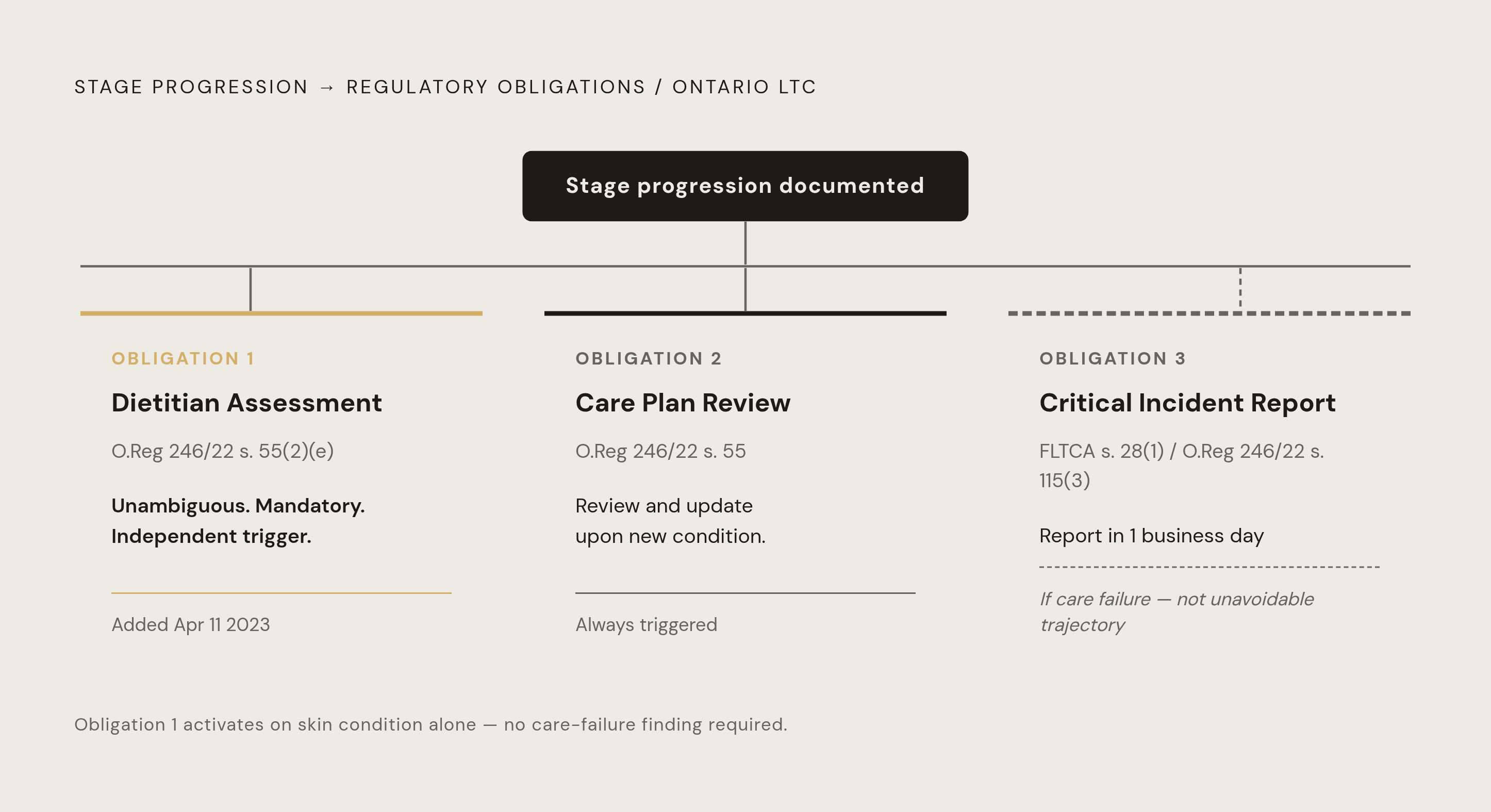
The regulation changed meaningfully on April 11, 2023. That amendment brought O.Reg 246/22's terminology in line with current clinical language (hence "pressure injury" rather than "pressure ulcer" in the regulatory text), and it added clause 55(2)(e), a new requirement that a registered dietitian assess a resident whenever that resident shows a skin condition likely to require or respond to a nutrition-based intervention. Pressure injuries are named explicitly among the conditions that trigger this clause. That's a concrete, unambiguous obligation, and it exists independent of whatever gets decided about critical incident reporting.
How stage progression fits the critical incident definition
The regulatory picture gets less tidy here. Neglect and improper care of a resident are both named categories under the FLTCA's critical incident provisions. So a pressure injury that progresses to a worse stage because of a care failure, a missed repositioning schedule, an ignored risk assessment, a delayed referral, could plausibly fall under "improper care," even though "pressure injury stage progression" doesn't appear anywhere in the statute as its own named trigger.
The distinction that does the work here is causal. A pressure injury that worsens because of an unavoidable trajectory, end-stage illness, a resident who consistently and competently refuses repositioning, is a fundamentally different event than one that worsens because a home's prevention protocol wasn't followed. Same clinical outcome, same stage change on paper, but the reporting obligation likely turns entirely on which of those two stories the documentation supports.
This is a point where a home needs to look at the regulation directly rather than take anyone's word for it. Reviewed sources did not turn up a clause that names "stage progression" itself as an enumerated reportable event, distinct from "improper care." That gap should be treated as a prompt to check the full text of O.Reg 246/22 s. Homes should check the full text of O.Reg 246/22 s. 115 rather than assume the obligation doesn't exist.
What is unambiguous: stage progression is understood to trigger the dietitian assessment under clause 55(2)(e), given that the 2023 amendment added a requirement for dietitian assessment when a resident shows a skin condition likely to require or respond to a nutrition-based intervention. It also triggers an obligation to review and update the resident's care plan. And if the progression traces back to a care failure, it opens the "improper care" reporting pathway under the FLTCA, whether or not "stage progression" appears by name anywhere in the text.
How the Critical Incident System's reporting timeline works
Once a home determines that an incident is reportable, the clock is short. The "Report in 1 Business Day" procedure under O.Reg 246/22 s. 115(3), read together with FLTCA s. 28(1), gives homes one business day to file. That's the operative deadline, and it doesn't flex for a busy unit or an unavailable director of care.
Reports go through the Critical Incident System, the Ministry's platform for intake. Phase 3 of CARES, the initiative that updated this system, has been underway, and homes should confirm they're actually operating inside that updated environment rather than an older interface or workflow that predates the change.
The regulation specifies what a compliant report has to contain. The regulation specifies what a compliant report must contain, and Section 115 spells this out directly. It should be read in full rather than relying on a home's existing template, especially if that template predates the 2023 amendments.
Filing a report is not the end of the story. Critical incident reports trigger critical-incident inspections, and inspection intensity data from ReportONCare shows a rise in inspection activity between 2023 and 2025. A home that reports more critical incidents is also a home that gets inspected more. That's a reason to make sure every report is airtight before it's filed. It is a reason to make sure every report is airtight before it's filed.
The compliance exposure that follows a pressure injury finding
The FLTCA gives the regulatory authority the power to impose administrative monetary penalties (AMPs) for non-compliance with an order. As of March 31, 2023, 58 AMPs had actually been served, totalling $206,800. That's a small aggregate figure relative to the ceiling, but the ceiling itself signals where the Ministry's authority can go if it chooses to use it more aggressively.
Compliance orders, which set a hard deadline for a home to fix an identified problem, account for roughly 10% of the 25,198 findings recorded since April 2022. The remainder are either written notifications or issues the home remedied on the spot, during the inspection itself. The government set a follow-up compliance target, aiming to reduce the share of homes found non-compliant on a follow-up inspection to 5.5% of all LTC homes provincewide. In 2023, the actual figure came in at 5.0%, meeting the target. That's a signal that the regulatory authority is following through on outstanding orders rather than letting them lapse.
The exposure isn't evenly distributed. In 2025, the 29% of homes with 16 or more findings accounted for roughly 65% of all findings recorded across the sector. Homes that have already accumulated wound-care deficiencies are the ones carrying disproportionate regulatory risk going forward, and a pressure injury stage progression event landing in that kind of home is a very different proposition than the same event landing in a home with a clean inspection history.
Documentation at the point of care and the compliance case
Wound care documentation is not paperwork that trails behind the actual clinical work. It functions as part of the care itself: it's what lets one shift communicate to the next what's been tried, what's working, and what needs to happen next, and it's what stands between a nurse and a finding of neglect when an inspector or a lawyer starts asking questions months later.
For a pressure injury event specifically, documentation needs to capture the wound's stage at each assessment, what changed between assessments, the interventions actually applied, whether the repositioning schedule was followed, whether a dietitian referral happened and what came of it, and whether the care plan was updated to reflect the new reality. Every one of those is a discrete data point an inspector can pull and cross-reference.
Ontario's mandatory assessment tool for long-term care is RAI-MDS 2.0, and a national health information body calculates its "Worsened Pressure Ulcer" indicator directly from that data. The same clinical notes feeding that national indicator are available to an inspector who wants to line them up against whatever the home filed in the Critical Incident System. If the two don't match, that discrepancy becomes the finding.
Across wound-care compliance findings, the failure mode inspectors are trained to look for is not a single missed note, but a pattern of gaps that suggests the prevention protocol existed on paper and nowhere else.
Risk stratification before stage progression: what early detection requires
The Braden Scale is a widely used tool for pressure injury risk assessment, scoring residents across multiple clinical domains. The interRAI Pressure Ulcer Risk Scale (PURS), developed from Ontario MDS data and the broader clinical literature, is embedded directly in the RAI-MDS workflow homes already use.
Neither tool is infallible. No risk stratification tool is infallible, and clinical literature has raised questions about the precision of threshold-based scores across different care settings. That's a meaningful limitation for any tool this central to a prevention framework: the threshold for catching residents who will develop a pressure injury may not translate uniformly across contexts.
A nursing association's best practice guidelines respond to that gap with adjunct tools rather than a wholesale replacement. Recommendation 1.0 suggests thermography alongside routine skin assessment; Recommendation 1.1 suggests subepidermal moisture detection. Both are framed explicitly as supplements to skin assessment, not substitutes for it.
On the prevention side, the same guidelines are specific and actionable. Recommendation 2.0 calls for repositioning at-risk residents every two to four hours. Further recommendations address prophylactic dressing strategies at body locations known to bear the most pressure. These are the concrete, evidence-based actions a home needs to be able to show it actually deployed, consistently, before a stage progression happened, if it wants any real defense against an "improper care" finding down the line.
Turning continuous documentation into continuous compliance readiness
The shift homes need to make is from reactive reporting to proactive monitoring. Reactive reporting means documenting a stage progression after it happens and filing the critical incident report on deadline. Proactive monitoring means using the clinical documentation a home is already generating to catch a trajectory change before the wound reaches the next stage.
"Continuous" "Continuous" is a specific claim. Every nursing note describing wound appearance, every repositioning entry, every recorded meal intake, every skin check, is a data point in a trend line. The real question for any home is that the trend must be visible to a nursing manager before it shows up in a national dataset or in a surveyor's file.
CIHI's "Worsened Pressure Ulcer in Long-Term Care" indicator draws on full provincial RAI-MDS 2.0 coverage. It gives homes an Ontario-wide benchmark and a facility-level comparison. A home performing below the national average on that indicator is carrying regulatory exposure already, independent of whether a single critical incident report has ever been filed against it.
Nurses are not, generally speaking, failing to document. The information exists. What's inconsistent is whether anyone is extracting the pattern buried inside those notes and reviewing it before it becomes a finding. That's the specific problem that clinical decision support tools working from existing EHR documentation, without requiring staff to enter anything new, are built to solve, and it's the category of tool the province's $70 million ITS investment in medication safety and clinical decision support is aimed at supporting. The documentation was always going to get written. Someone must read the trend before an inspector does.