How MOHLTC Inspectors Triage Resident Records on Arrival
Inspectors use a two-stage algorithm to focus audits on high-risk resident records.

By the time a Ministry of Long-Term Care inspector walks through the front doors of a home, the decision about what to read, and how closely, has already been made. Under the Fixing Long-Term Care Act, 2021 and its associated regulation, the Ministry can inspect any home at any reasonable time without advance notice, subject to limited exceptions. What matters just as much as that authority is the type of inspection it triggers, because the type shapes everything that follows once the inspector is inside. Before any visit happens, a dedicated Triage Inspector reviews the complaints the Ministry has received about that home, sometimes contacts the person who filed the complaint to ask follow-up questions, and assigns a risk level to what has come in. A higher risk rating sends a full inspection team to the home. A lower risk rating produces a narrower inquiry instead, and that single classification decision sets the depth of every record review that follows. This also accounts for a pattern in the Ministry's own numbers: comprehensive proactive inspections, which look at the whole home, find roughly twice the non-compliances that complaint or critical incident inspections do, because they are built to look everywhere.
Stage One: the 40-resident sample
The first thing that happens once inspectors are on-site is the construction of a sample, and how that sample gets used determines which parts of the home's documentation get pulled first. In Stage One of a comprehensive inspection, inspectors randomly select 40 residents and then run three activities across that group at once: reviewing health records, interviewing residents directly, and observing the care being delivered on the floor. The record review at this stage is a structured scan rather than a line-by-line chart audit of all 40 files, built to surface indicators across a set of mandatory protocol categories that every comprehensive inspection must cover no matter what else turns up. Those five categories are medication, infection prevention and control, residents' council interview, family council interview, and dining observation. Inspectors examine all five as the floor of every inspection.
A good deal of what makes that scan move quickly across 40 residents is the interRAI Long-Term Care Facilities Assessment Instrument, which has become a central document inspectors rely on. Ontario required every long-term care home to move off the older Continuing Care Reporting System and onto the interRAI LTCF instrument and the Integrated interRAI Reporting System by April 1, 2026. That gives inspectors a standardized, structured record for each resident covering cognition, function, mood, and quality indicators such as falls, pressure ulcers, and pain, all captured in comparable fields. That structure is what lets Stage One function as a scan. Comparable fields across 40 different residents let an inspector see a baseline fast, and a baseline is what the whole triage approach depends on.
Stage Two: the algorithm that converts Stage One signals into targeted protocols
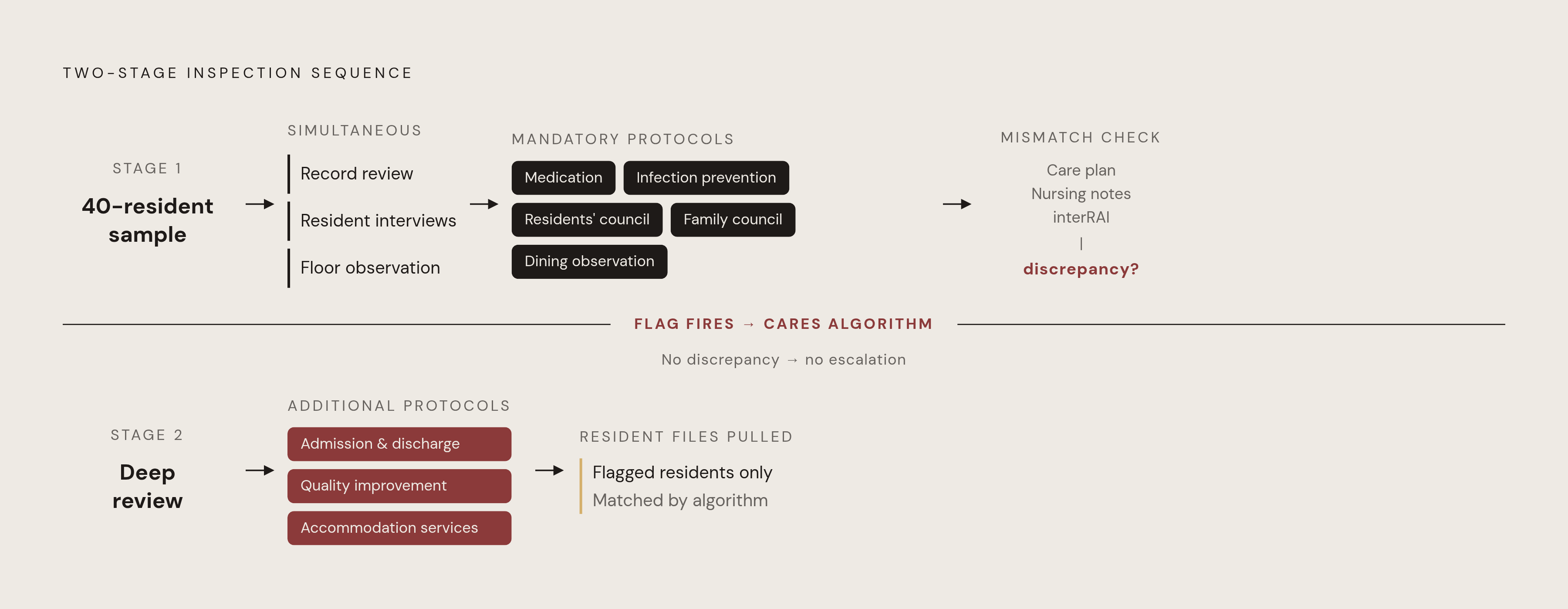
Stage Two is where a broad scan turns into a targeted audit of specific records. An algorithm takes whatever Stage One surfaced and uses it to decide which additional protocols get triggered and which resident files get pulled for deep review. Inspectors apply this algorithm to the information gathered in Stage One to identify the areas that call for closer inspection, then work through standardized protocols to carry out and document that closer look. None of this runs as a black box. The algorithm works by matching specific signals from Stage One to a fixed list of additional protocol categories, so a given flag leads to a known, defined response. Protocols such as admission and discharge, quality improvement, and accommodation services only come into play when Stage One actually raises a flag in that area. They sit outside the mandatory floor, and they only enter the inspection when the data calls them in.
The tool inspectors use to run this process on-site is the Ministry's CARES software platform, which structures the record review, keeps track of findings as they accumulate, and produces the inspection report handed to the home at the close of the visit. Reports generated this way are built to cut down the total time an inspection takes and to keep the process consistent from one home to the next across the sector.
What actually drives a Stage Two escalation is a mismatch. The review is hunting for places where a care plan says one thing, the nursing notes say another, and the interRAI assessment says a third. A care plan that fails to reflect a risk the interRAI assessment has already identified is exactly the kind of gap that Stage One catches and that pulls a Stage Two protocol in behind it. An incident log that records a fall with no matching update in that resident's care plan reads as the same kind of flag. This is what makes the whole structure workable within the time a team actually has: a comprehensive inspection typically runs three or four inspectors over eight days, and that timeline only holds because Stage One does the work of pointing Stage Two at the records that actually need deep review, rather than asking the team to read everything at the same depth.
Incident categories that draw the most inspection scrutiny
Not every category of incident gets the same degree of attention once a record lands in front of an inspector. The categories that draw the sharpest scrutiny are the ones already tracked by a standardized measurement tool and a public benchmark, because those two things together let an inspector compare a home's own numbers against a known reference point before ever opening a chart. The Canadian Institute for Health Information publishes, for every long-term care home, the share of residents who have gone through specific undesirable care events, and inspectors check those published indicators against what they find in the Stage One record pulls. The CIHI indicators that matter most here are recent falls, worsening pressure ulcers, antipsychotic use without a diagnosis of psychosis, and worsened pain. A home's public CIHI profile gives an inspector a sense, before arrival, of where the Stage One scan is likely to confirm a problem or contradict one.
Falls draw a particular degree of weight in this system. The interRAI Falls Clinical Assessment Protocol has shown higher predictive accuracy than other tools tested against it, and interRAI's broader indicators, including the Cognitive Performance Scale, CHESS, and the ADL Hierarchy, feed predictive models used for falls, emergency department transfers, and transitions near end of life. Analysis of Ontario inspection records found that, of all the CIHI indicators, a home's fall rate is the only one with a consistent relationship to how often that home gets written up. Every other indicator, pressure ulcers, antipsychotic use, pain, showed almost no such relationship. Alongside falls, medication administration and infection prevention and control sit in every comprehensive inspection as an unconditional floor. Those two categories get examined whether or not Stage One raises anything, so medication records and infection logs stay in scope for every home, including ones with no complaint history. None of this works, though, without complete underlying data: interRAI functions as a predictive engine rather than a mere form, and its accuracy depends entirely on how completely and consistently that data gets entered at the bedside. Sparse or inconsistent charting weakens both the care planning interRAI is meant to support and the picture an inspector ends up seeing.
The structural blind spot: where the triage logic misses homes that are performing poorly
The triage system described above only does its work once a home is actually selected for inspection, and that selection depends far more on who reports a problem than on how a home is actually performing. Reporting on Ontario's 2025 inspection data found that only 39 percent of long-term care homes received a proactive inspection from the Ministry that year, well short of what regulatory targets call for. Most inspections instead start from a complaint or a critical incident report. If nobody tells the Ministry something has gone wrong, the entire algorithm described in the previous two sections never gets the chance to activate, no matter how sharp its logic is once it starts running.
That gap appears starkly in the data itself. Analysis of thousands of Ontario inspection reports found almost no relationship between a home's CIHI performance metrics and how often that home gets written up, with falls standing as the lone partial exception already noted above. Homes performing worse on pressure ulcers, inappropriate antipsychotic use, or worsening pain are not inspected or cited more often as a result. The algorithm is precise once triggered, but the trigger itself runs on complaint volume, and that is a structural weakness built into the system. Staff inside long-term care homes have also described managers alerting floor staff once an inspector is known to be in the building, giving staff time to fix visible problems before the inspector reaches that part of the home, a practice that sits entirely outside anything the algorithm is designed to detect.
Specific cases from the 2025 Ontario data make the pattern concrete. Tendercare Living Centre in Scarborough, which recorded one of the highest death rates of any home in the province during a major public health crisis, accumulated dozens of non-compliances and received no proactive inspections that year. Kensington Gardens, a 350-resident non-profit home in downtown Toronto, received 68 non-compliance notices in 2025 after 37 the year before. Across the province in 2025, hundreds of homes were inspected across thousands of inspections, producing thousands of non-compliance findings, hundreds of compliance orders, and hundreds of thousands of dollars in fines. All of it demonstrates a system that works with real precision inside any inspection it actually runs, while leaving its reach dependent on who happens to complain.
Documentation conditions nurses work under and the records inspectors read
The structured fields inspectors can triage fastest, interRAI quarterly assessments, incident logs, medication records, are only as good as the documentation conditions that produced them, and those conditions are under real strain across most Ontario long-term care homes. The 2025 Future Ready Healthcare Survey Report found that 62 percent of healthcare leaders see generative AI as likely to help with EHR management, alongside majorities naming prior authorizations, cybersecurity preparedness, and telehealth programs as areas where the same help is needed. That finding points to something true well beyond any one technology: electronic record systems in long-term care remain a persistent source of friction for the people filling them out.
A home that reviews its own documentation before an inspector arrives, checking whether assessments are complete, whether care plans are individualized and measurable, and whether daily notes actually reflect the interventions delivered, will usually find the same gaps a Stage One scan would find. The same structured EHR fields that trip up an inspector's review are generating incomplete interRAI submissions and missing incident triggers well before any inspection ever starts. The largest gap in this picture sits in unstructured clinical notes. Structured EHR fields are what inspectors can scan quickly, but the fuller clinical picture often lives in narrative nursing notes that no standardized inspection tool reaches in any systematic way. Research into long-term care exposure documentation found that History and Physical notes identified a large majority of relevant patients, while structured EHR admission source fields missed a substantial share of the same group, meaning narrative clinical notes outperformed structured fields by a wide margin for capturing clinically important information. A gap documented only in a nursing note, with nothing surfaced in the structured field, can stay invisible to the inspection triage algorithm. It can stay just as invisible to the home's own internal compliance monitoring, because both systems are built to read the structured fields first.
Reading your records the way a regulator does: what the triage sequence implies for continuous compliance
Every stage described above follows a predictable sequence: pre-visit classification, a 40-resident Stage One sample, algorithm-triggered Stage Two protocols, and mandatory medication and infection reviews that apply no matter what else happens. A facility that understands that sequence can hold its records to it continuously, rather than scrambling to assemble documentation once inspectors are already in the building.
The first implication follows directly from the mandatory floor. Medication, infection prevention and control, residents' council interviews, family council interviews, and dining observation are in scope for every comprehensive inspection, with no complaint and no trigger required, so documentation in those five areas should stay inspection-ready at all times rather than only around a scheduled or anticipated visit.
The second implication follows from what Stage One is actually hunting for: mismatches among care plans, nursing notes, and interRAI assessments. A facility should directly ask whether those three documentation streams tell the same story for every resident in any sample an inspector might draw. A care plan that doesn't reflect a risk interRAI has already flagged will appear almost immediately in a Stage One scan. An incident log entry with no matching care plan update reads as the identical kind of flag, regardless of which resident or which incident produced it.
The third implication comes from the public side of the data. CIHI's quality indicators, falls, pressure ulcers, antipsychotic use, pain, are the figures an inspector can check before ever stepping on-site. A home that already knows where it stands on those measures relative to the provincial average has a real sense, ahead of any visit, of where scrutiny is most likely to land.
Sources
- Long-Term-Care Home Quality Inspection Program
- Long-term-care Home Quality Inspection Program Chapter 3 Section 3.09
- 3.04 Long-Term-Care Home Quality Inspection Program
- Ministry of Long-Term Care (MLTC) Long-Term Care Inspection Branch (LTCIB)
- Published plans and annual reports 2025–2026: Ministry of Long-Term Care