Patterns in Ontario MOHLTC Non-Compliance Orders by Incident Category
Infections, care plans, and abuse drive most serious enforcement actions in Ontario long-term care.

Ontario's long-term care system does not treat every inspection finding the same way. Compliance orders, the most serious outcome an inspector can issue short of referring a home to the Director, cluster in a small number of predictable incident categories, and that clustering tells facilities exactly where their regulatory exposure is sharpest.
Translating a finding into a compliance order
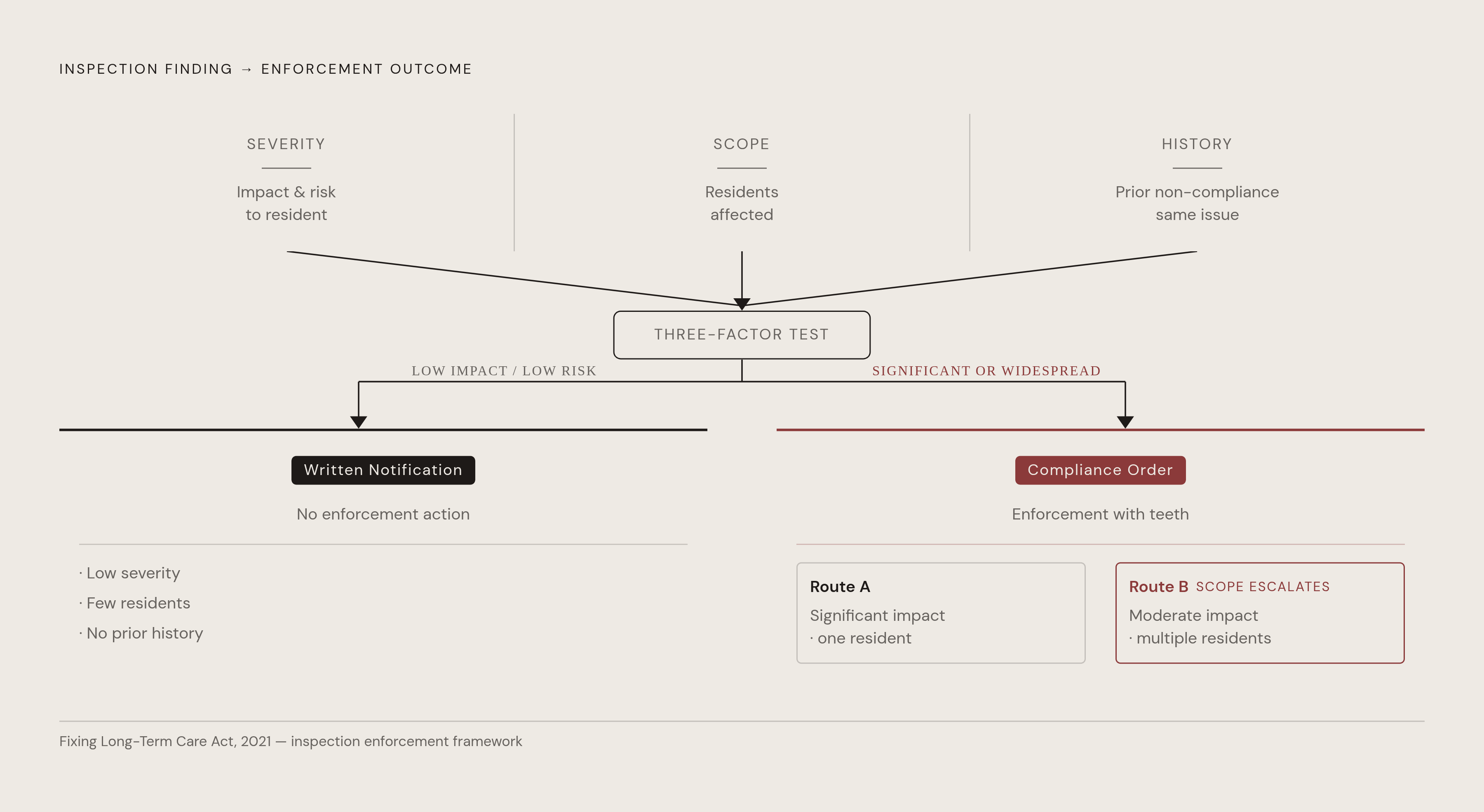
When inspectors find a home out of compliance, they have to apply a specific test that the Fixing Long-Term Care Act, 2021 sets out. They weigh three factors: severity, the impact and risk to the resident involved; scope, how many residents the non-compliance touches; and compliance history, whether the home has been found non-compliant on the same point before. These three factors together decide which of two paths a finding takes. A written notification happens if the non-compliance is low impact or low risk to a resident. A compliance order results when the impact or risk is significant to one resident, or moderate but spread across multiple residents.
The practical effect of this test is that the same underlying incident can land on either side of the line depending on its context. If a single resident goes without adequate fluids for part of a shift, that might draw a written notification, a paper record with no further enforcement teeth. But if the same hydration failure repeats across a unit, or ties to a home's prior history of the same gap, it crosses into order territory, because scope and compliance history can move the needle even when severity alone would not. Understanding this three-part test matters because it is the lens through which every category discussed in this piece needs to be read. A category's frequency in inspection reports is one thing. A category's findings can be severe or widespread enough to cross the order threshold, and it is that second question that determines real regulatory exposure.
Compliance Orders in the Aggregate Record
Across Ontario's roughly 630 long-term care homes, compliance orders make up only a small share of all findings issued. Most non-compliances resolve as written notifications, which is the lower tier kept for low-impact, low-risk gaps. That baseline matters for how to read everything that follows. If compliance orders were common and spread evenly across every type of non-compliance a home might commit, their appearance in a handful of categories would just mean those categories are common in general. Because orders are rare, their repeated concentration in a specific set of categories is a signal. It means that those categories are not just where inspectors find problems most often. They are where the problems inspectors find most often happen to be severe or widespread enough to clear the order threshold. That distinction, between frequency of findings and frequency of orders, is the one this piece holds onto throughout.
The five incident categories that persistently generate the most findings
The Ministry's Inspections Branch has named five incident categories as the most frequently recurring non-compliances across Ontario's long-term care homes: infection prevention and control (IPAC), Plan of Care, Duty to Protect, Skin and Wound, and Transferring and Positioning. This pattern has been described as long-standing, not a recent shift in enforcement priorities. The Concerned Friends Policy and Advocacy Committee reached a similar conclusion independently in its 2024 Summary Report, identifying abuse by staff, neglect by staff, infection control, and safety as central and longstanding concerns for resident health and safety. The overlap between the Ministry's own list and an independent advocacy group's assessment is not a coincidence of wording. It reflects the same underlying risk landscape, just from two different vantage points.
What ties these five categories together is that each one carries a structural tendency toward exactly the scope or severity that the compliance order threshold is built to catch. IPAC failures are inherently multi-resident by nature: an infection control breakdown in a shared living environment, a shared dining room, a shared bathing schedule, can expose an entire unit at once, clearing the bar for moderate impact to multiple residents without needing any single resident to be severely harmed. Plan of Care failures work similarly through sheer breadth. Every resident in a home has an individualized care plan, so a systemic gap in how those plans are developed or followed is rarely an isolated event involving one person. It tends to be a pattern that touches many residents simultaneously, which is scope in the plainest sense the regulation describes. Skin and Wound and Transferring and Positioning findings reach that same threshold a different way. They do not need to be widespread to be serious, because they carry direct severity risk on their own. A missed wound assessment or an unsafe transfer from bed to wheelchair causes measurable physical harm to one person, and that harm alone can be enough to justify an order if it is significant.
The sources behind this pattern do not publish a ranked list of orders by category with precise counts attached to each one. What they establish is that these five categories are the ones the Inspections Branch itself describes as most frequently occurring, and the scope-and-severity logic built into the three-factor test explains why these particular categories cross from notification into order more often than others.
Why Duty to Protect findings escalate and go under-enforced
Among the five recurring categories, Duty to Protect stands apart. It is at the most serious end of the compliance order spectrum because the incidents it covers, abuse, neglect, and assault, are harms to residents in the most direct sense the law recognizes, not administrative shortfalls that happen to be serious. They are acts or omissions that cause residents physical or psychological injury, not gaps in documentation or scheduling, which is precisely the kind of severity the order threshold was built to catch.
The gap between what Duty to Protect findings record and what the underlying conduct actually warrants is where this category becomes troubling. A 2024 study that examined a random sample of Ontario long-term care inspection reports found that among reports where accounts of abuse or neglect appeared, including theft, fraud, and physical and sexual assault, police were notified and dispatched in only 12.5% of those cases. A compliance order issued for a Duty to Protect failure can show that a home broke the rules. If the conduct behind that failure was criminal and police were never brought in, the order by itself does not address the full risk to residents that the incident represented. The regulatory and criminal tracks are supposed to run in parallel when conduct crosses into criminal territory, and the study's finding suggests that in the overwhelming majority of cases, only the regulatory track gets used.
The government has moved to close part of that gap. In January 2024, the government announced a new long-term care Investigations Unit, and its investigators now hold status as Provincial Offences Officers, so they can investigate allegations of offenses. That authority can lead to recommended prosecutions, and it covers failure to protect a resident from abuse or neglect, repeated and ongoing non-compliance, and suppressing or falsifying mandatory reports. The timing and the specific offenses named make clear that this unit exists as a direct response to the pattern the 2024 study documented, not as a general-purpose enforcement upgrade. Golden Plough Lodge's inspection in April 2025 illustrates how this category operates in practice: the visit was triggered in part by Critical Incident System reports alleging staff-to-resident abuse and neglect, the kind of intake that routes directly into a reactive inspection focused on Duty to Protect.
How inspection type determines which categories get detected
The five recurring categories are not simply the five areas where non-compliance happens most. They are, in part, the five areas inspectors are directed to look at most closely, and that distinction complicates any claim that the compliance order record fully captures risk across a home.
A 2025 study in the International Journal of Environmental Research and Public Health offers a clear illustration using a category outside the Ministry's top five: food, nutrition, and hydration. The study found that FNH non-compliance appeared in a small minority of Ontario long-term care homes overall, but in 43.7% of homes where the FNH inspection protocol was specifically used, and the association between protocol use and detection was statistically strong. FNH is not one of the five most-cited categories in Ontario, and this finding suggests that absence from the list may have less to do with homes managing food, nutrition, and hydration well, and more to do with how rarely the specific inspection protocol built to catch those failures gets deployed.
The same logic extends across every category this piece has discussed. Proactive compliance inspections are built to have the inspector observe every part of a home's operation. But reactive inspections start from a complaint or a critical incident report, like the one that opened Golden Plough Lodge's April 2025 visit, so they focus narrowly on the specific intake that brought the inspector through the door. So if a reactive visit is built around an abuse allegation, an entire domain of risk in a home, say its hydration practices or its HVAC maintenance, can go completely unexamined. Proactive inspections typically surface more non-compliances than reactive ones do, simply because they look at more of the home. The compliance order record is real and meaningful, but it is a map of where inspectors have been looking, not a complete map of risk.
Escalation when compliance orders fail to achieve compliance
A compliance order is not the end of the line. If a home fails to meet an order, or repeats a non-compliance against the same legislative reference within 36 months, the inspection system can reach for further tools, and those tools can go as far as ending a home's ability to admit new residents.
The pathway works like this: an inspector who finds repeat non-compliance, or who judges that a home is unable to achieve compliance through an order alone, can refer the home to the Director. From there, the Director can issue a Director's Order, an Order Requiring Management, or a Cease Admissions order, each one a step further from routine regulatory correction and a step closer to direct government control over how the home operates. In 2024, Director referrals produced one Director's Order for skin and wound care, two for management of Responsive Behaviours, and one for cleaning and inspection of HVAC systems. The first two outcomes sit squarely inside the five recurring categories this piece has traced from the start. The categories driving the largest volume of compliance orders are the same ones showing up at the most severe end of the enforcement ladder. The Investigations Unit announced in January 2024 adds a further consequence on top of these administrative escalation tools: it can now lay provincial charges for repeated and ongoing non-compliance. For homes that keep producing orders in the same recurring categories, the result is no longer confined to paperwork and Director oversight. It can become a prosecution.
The legitimate objection to how the inspection system counts citations
The long-term care sector has raised a real concern about how Ontario's inspection system is read and reported, and it deserves to be taken seriously. AdvantAge Ontario has formally submitted that public inspection reports focus exclusively on non-compliance: they don't recognize positive performance, they don't give readers context about how serious a finding actually is, and when they include low-risk, already-resolved findings, that can shape how a home gets perceived. The sector's broader complaint is that compliance activity is at an all-time high, and that near-constant scrutiny is contributing to staff burnout and recruitment difficulty in a sector already short-staffed. That operational cost is genuine.
The argument that inspection volume is mostly citation-generating noise applies with real force only to written notifications, the lower tier reserved for low-impact findings that AdvantAge Ontario is specifically asking to be read in context. Compliance orders are a different instrument. An order requires the inspector to find a non-compliance that rises to significant impact on one resident or moderate impact across multiple residents, and that is the exact threshold the Fixing Long-Term Care Act, 2021 built in to separate meaningful risk from minor paperwork gaps. Collapsing written notifications and compliance orders into a single undifferentiated count of "citations" erases the distinction the law itself draws, and it is that distinction, not inspection volume in general, that should guide how a home reads its own regulatory exposure.
What the Compliance Order Pattern Means for Facility Risk Monitoring
The clustering of compliance orders in IPAC, Plan of Care, Duty to Protect, Skin and Wound, and Transferring and Positioning gives homes a map of where their exposure concentrates, and that map is actionable well before an inspector arrives. A home that waits for a proactive compliance inspection to surface a gap in its care planning, or for a critical incident report to trigger a reactive visit into an abuse allegation, is relying on the same structural limitations this piece has described: proactive inspections are infrequent, and reactive inspections only look where the complaint points. If a home monitors these five categories continuously, instead of reviewing them once a cycle timed to an expected inspection, it stays ahead of the specific failure modes that the record shows are most likely to cross the order threshold.
That means treating infection control practices, individualized care plan adherence, protective reporting on abuse and neglect, wound assessment schedules, and transfer and positioning technique as standing areas of internal audit, not as boxes to check only when a surveyor is in the building. The categories that generate the most compliance orders in Ontario are not a mystery, and they are not evenly distributed across the hundreds of things a long-term care home does every day. They are concentrated, named, and consistent enough across years of Ministry and advocacy reporting that a home choosing to monitor them continuously is working from the same evidence the regulator itself relies on.
Sources
- What Gets Measured Gets Counted: Food, Nutrition, and Hydration Non-Compliance in Ontario Long-Term Care Homes and the Role of Proactive Compliance Inspections, 2024
- Long-term-care Home Quality Inspection Program Chapter 3 Section 3.09
- Duty to Protect? The Troubling Pattern of Legislative Noncompliance and Missed Police Involvement in Ontario’s Long-Term Care Sector - PMC
- What Gets Measured Gets Counted: Food, Nutrition, and Hydration Non-Compliance in Ontario Long-Term Care Homes and the Role of Proactive Compliance Inspections, 2024 - PMC