Critical Incident Reporting Timelines Under Ontario Regulation 79/10
Timelines and reporting channels for Ontario long-term care critical incidents.

Ontario's critical incident reporting rules changed their legal home in 2022, but the operational demands on long-term care homes did not get any lighter. The Fixing Long-Term Care Act, 2021 and its associated regulations now govern what must be reported, and how fast, replacing the Long-Term Care Homes Act, 2007 and O. Reg. 79/10 that had structured this obligation since July 1, 2010. The switch matters less as a legal technicality than as a live compliance trap: any facility still citing O. Reg. 79/10 as current law is working from a repealed rulebook. This piece maps what counts as a critical incident, the exact timelines attached to each category, and why the record of enforcement failures around these rules should change how a home thinks about its own readiness.
Under Ontario's current framework, the Fixing Long-Term Care Act, 2021 and O. Reg. 246/22, critical incidents in long-term care homes include falls, medication errors (including near-misses where no harm actually reached the resident), hydration problems, skin wounds, behavioural changes, abuse, neglect, and disease outbreaks. Neglect covers any failure to provide required treatment or care, including inaction or a pattern of inaction that puts residents at risk, not just active mistakes. Timelines depend on the category: suspected abuse or neglect that may constitute a criminal offence must be reported to police immediately upon discovery; missing or unaccounted-for controlled substances and glucagon use resulting in hospitalization must be reported within one business day through the Critical Incident System; and all other standard critical incidents are reported through CIS during business hours (Monday to Friday, 8:30 a.m. to 4:30 p.m.) or via the Service Ontario After-Hours Line at 1-888-999-6973 outside those hours, with the CIS form to follow the next business day. When a home is uncertain whether an event crosses the reporting threshold, the defensible move is to report it, because under-reporting is the riskier failure mode by a wide margin.
The stakes are not abstract. The original 2010 framework was built to protect the rights of more than 75,000 Ontario residents living in long-term care, and that population, and its vulnerability, is why the reporting regime carries the weight it does.
What counts as a critical incident under Ontario LTC law
Ontario's health system defines a critical incident, in the general sense, as an unintended event tied to treatment that results in death, serious disability, injury, or harm, provided that harm doesn't stem primarily from the resident's own underlying condition or from a risk that's simply inherent to providing care. Long-term care law narrows and sharpens that idea. Under the current regulatory scheme, "critical incidents" explicitly include disease outbreaks, and the Ontario Ombudsman has pointed to COVID-19 as the illustrative case that exposed how seriously this category needs to be taken.
Two definitions inside O. Reg. 246/22 do a lot of quiet work. "Neglect" is defined as a failure to provide a resident with the treatment, care, services, or assistance required for their health, safety, or well-being, and it explicitly captures inaction, or a pattern of inaction, that puts one or more residents at risk. That's a broader net than most staff assume: neglect doesn't require an active mistake, just a gap that goes unaddressed. The second is "medication-related incident," which includes near-misses, events where no harm actually reached the resident but easily could have. This one tends to catch facilities off guard, because the instinct is to report only when something goes wrong, not when something almost did.
In practice, the categories driving regulatory exposure are falls, medication errors, hydration problems, skin wounds, behavioural changes, abuse and neglect, and outbreaks. The common thread across all of them is that the legal definition is written broadly on purpose. When a home is unsure whether an event clears the reporting bar, the defensible move is to report it. Under-reporting is the riskier failure mode, by a wide margin, compared to filing a report that turns out not to have been strictly necessary.
What are the reporting timelines for each critical incident category?
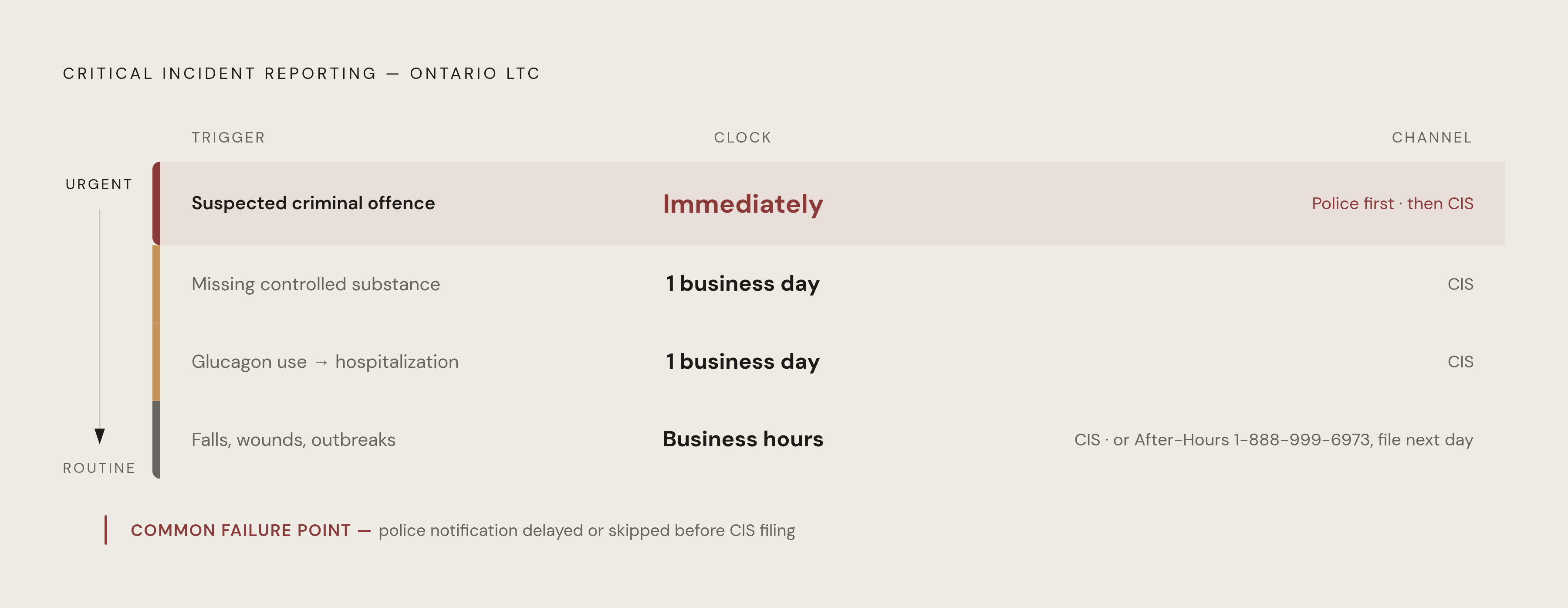
Timelines vary by category, and the differences are not cosmetic.
The most urgent obligation involves police, not the ministry. Under O. Reg. 246/22, s. 105 (carrying forward from FLTCA s. 105), every licensee has to make sure police are notified immediately of any alleged, suspected, or witnessed incident of abuse or neglect that the licensee suspects might amount to a criminal offence, offences under the Criminal Code. "Immediately" "Immediately" is not defined with a clock time anywhere in the regulation. The safest reading, and the one facilities should build policy around, treats "immediately" as upon discovery, before any internal review, fact-finding, or documentation cleanup takes place. Waiting to notify police until an internal picture is clearer defeats the purpose of the obligation.
Standard critical incidents run on a separate track. During regular business hours, Monday to Friday, 8:30 a.m. to 4:30 p.m., reports go through the Critical Incident System (CIS). Outside those hours, on weekends, and on statutory holidays, the home calls the Service Ontario After-Hours Line at 1-888-999-6973, and then completes the Critical Incident form the following business day. Abuse that forms part of a broader critical incident gets reported through this same channel, alongside whatever police notification obligation it triggers separately.
A narrower, elevated category carries its own compressed clock. Under O. Reg. 246/22, s. 115, a missing or unaccounted-for controlled substance, or a case where glucagon is administered and the resident ends up hospitalized as a result, must be reported within one business day. That's the "Report in 1 Business Day" procedure, and it sits in between the immediacy of the police notification rule and the routine cadence of standard CIS filings. A quick reference for staff might look like this:
| Incident Type | Trigger | Timeline | Channel | |---|---|---|---| | Suspected criminal offence (abuse/neglect) | Alleged, suspected, or witnessed | Immediately | Police, then CIS | | Standard critical incident | Falls, wounds, outbreaks, etc. | Per CIS business hours, or next business day after-hours | CIS / After-Hours Line | | Controlled substance missing/unaccounted for | Discovery of discrepancy | 1 business day | CIS | | Glucagon use resulting in hospitalization | Hospital transfer | 1 business day | CIS |
One more thing belongs in this section, because it's easy to treat reporting as a purely administrative act: knowingly submitting false information to the Ministry of Long-Term Care Director is an offence under the FLTCA, 2021. Accuracy in what gets reported is a separate legal obligation running in parallel to the timeline requirement. It's a separate legal obligation running in parallel to it.
The reporting channels and what happens after a report is filed
The Critical Incident System handles the bulk of standard reporting during business hours, and the after-hours line, 1-888-999-6973, catches everything outside that window, with the CIS form to follow the next business day. Those two channels cover the facility's own reporting obligation.
There's a third channel that operates independently of anything the home does. Families and visitors can reach the Ministry of Long-Term Care's Family Support and Action Line at 1-866-434-0144, seven days a week, from 8:30 a.m. to 7:00 p.m., and callers can stay anonymous. This line matters because it can trigger an inspection regardless of whether the facility has filed anything. A home that assumes its own CIS filing is the only route by which the ministry learns of a problem is missing half the picture.
Once a report lands, whether through CIS or through a family complaint, it can lead to an inspection, and inspectors respond with one of two instruments: written notifications, which are the milder outcome, or compliance orders, which are directives the home must follow. Analysis of more than 17,500 inspection reports released between 2018 and 2025 gives some sense of how frequently these tools get used across the sector. The Compliance Assistance and Regulatory Enforcement System (CARES) is the ministry's IT backbone for inspection work, underlying all of this. Phase 3 of its modernization touches the LTCHomes.net platform and the CIS interface homes use directly, so facilities should expect the reporting interface itself to keep shifting even as the underlying legal timelines stay fixed.
None of this removes the burden of internal recordkeeping. Whatever channel a report goes through, the home needs its own record of what was filed, when, and what it said. If an inspector later questions whether, or when, a report was made, that internal documentation is what settles the question, not memory.
Where compliance has broken down historically
The pre-pandemic track record is not flattering. The Ontario Ombudsman found that before COVID-19, the Ministry rarely acted on critical incident reports concerning disease outbreaks. When the pandemic arrived, many homes facing active outbreaks simply didn't report them as required, and the Inspections Branch largely let that failure slide, doing little even in cases where homes did file. The Auditor General's findings, cited by the Ombudsman, point to the same underlying dysfunction: the Ministry was sitting on a large backlog of complaints and critical incidents that needed inspection. Filing a report was, for a period, not much of a safeguard on its own.
The pattern isn't confined to outbreaks, either. A 2024 study drawing on a 20% random sample of Ontario LTC homes, 457 inspection reports retrieved from Ministry records, found documented instances where licensees failed to immediately notify police as required. Each of those failures becomes part of the home's public record, and can trigger compliance orders, follow-up inspections, or administrative monetary penalties.
Read that history carefully, because it's easy to draw the wrong lesson from it. A facility might look at a weak enforcement record and conclude that reporting gaps tend to go unnoticed. That's backwards: the FLTCA's tighter framework and the expanded inspection program that followed exist specifically because the earlier enforcement record was this weak. The FLTCA's tighter framework and the expanded inspection program that followed exist specifically because the earlier enforcement record was this weak. The regulatory apparatus got stricter as a direct response to the gaps the pandemic exposed, not looser.
How intensively Ontario is now inspecting LTC homes
The government committed to completing a proactive compliance inspection (PCI) in every Ontario LTC home by the end of 2025, running alongside the separate track of critical incident and complaint-driven inspections. Progress toward that goal has been uneven. As of April 24, 2025, 546 homes had received a PCI, 89% of all homes in the province, and the ministry had already hit an earlier interim target of 50% coverage by March 2024.
Then the numbers moved the wrong direction. Concerned Friends, in a review of all LTC Ministry Inspection Reports, found that fewer than 50% of Ontario homes received a PCI during 2025, a steep drop from the prior year and well short of the ministry's stated 100% goal. The areas of central concern flagged in that review, abuse by staff, neglect by staff, infection control, and safety, are among the core concerns the critical incident reporting regime is designed to address.
What should a home take from that gap in coverage? Not comfort. A facility that hasn't received a PCI is not shielded from scrutiny, because critical incident complaints trigger inspections on a completely separate track. A filed complaint, or a call to the Family Support and Action Line, can prompt ministry attention regardless of where a home sits in the proactive inspection cycle. The ministry had set a target of reducing homes found non-compliant with a follow-up order to 5.5% of all LTC homes, and met that target in 2023. It's a useful reference point for what "improved compliance" actually looks like measured at the scale of the whole sector, even as PCI coverage itself has slipped since.
How unstructured clinical documentation creates reporting risk
Critical incidents rarely appear labeled as such in the record. They appear as patterns buried inside routine clinical notes, a fall description here, a medication note there, a wound observation, a behavioural notation, entered into electronic health record systems throughout the day but rarely reviewed systematically in real time. That gap between documentation and awareness is where reporting timelines quietly start slipping.
Think about what the 1-business-day rule actually assumes. It assumes the home already knows an incident happened. But if the relevant detail is sitting in an unstructured nurse's note that no one surfaces to a nursing manager until the next morning's rounds, the reporting clock has arguably already been running for hours before anyone with authority to act even knows there's a clock.
Ontario's move toward interRAI adds a layer of standardization here, though not a complete fix. The government has moved to require LTC homes to transition to interRAI reporting, with structured assessment timelines tied to admission and ongoing care. Structured interRAI data helps, but it doesn't eliminate the narrative notes where incident details get written down first, in the nurse's own words, before anything gets coded into a structured field.
Concerned Friends has pushed for a registered nurse role in every home dedicated to daily rounding and status monitoring, a recommendation built on the same underlying logic: incidents get missed because no one connected what was written down to a reporting threshold in time. Effective internal practice treats clinical documentation as something to review continuously against the categories that trigger mandatory reporting, with escalation protocols that connect a nurse's note to management awareness well before an external deadline expires. Under this model, charting becomes a real-time compliance signal because it is reviewed continuously rather than treated as a recordkeeping exercise after the fact.
Clinical intelligence platforms are built for exactly this gap: they read unstructured EHR notes and surface incidents and patterns directly to nursing managers, without asking nursing staff to enter any new data. A tool that adds a new data-entry burden on top of an already stretched nursing staff tends not to get used consistently. One that works from documentation staff are already producing has a real chance of closing the gap between when something is written and when someone in authority actually sees it.
Building a continuous compliance posture rather than a reactive reporting scramble
Most reporting failures follow the same script. An incident happens, a note gets entered into the chart, and nobody connects that documentation to a reportable-incident threshold until a surveyor asks about it, a complaint lands, or a follow-up inspection shows up unannounced. By the time anyone notices, the relevant deadline, whether it was immediate, one business day, or the standard CIS window, has often already passed.
Continuous compliance means something specific in this context. Every category a nurse might document, falls, medication events, skin wounds, behavioural changes, hydration issues, abuse, outbreaks, gets checked against reporting thresholds as it's written, not weeks later during a chart audit. Timelines get tracked from the moment of documentation itself, not from whenever a manager happens to notice. And the police notification obligation, immediate, upon reasonable suspicion of a criminal offence, sits inside a defined escalation protocol rather than being left to whatever judgment an individual staff member can muster under pressure at 2 a.m.
Coverage numbers make the case for this on their own. Concerned Friends reported that proactive inspections hit 89% of homes in 2024 and then fell under 50% in 2025, and complaint-triggered inspections run on a completely separate schedule that no facility can predict. There is no reliable way to know when an inspector will show up. The only posture that holds up under that uncertainty is one built to survive scrutiny at any moment, not one scrambled together after a complaint lands.
A short set of questions gets at whether a home is actually there. Does every shift, including nights and weekends, know the CIS procedure cold? Is the 1-business-day process for controlled substance discrepancies and glucagon-related hospitalizations written into policy, not just understood informally? Is the immediate police notification duty built into the on-call escalation chain, rather than resting on individual judgment? Is the after-hours number, 1-888-999-6973, actually posted where the charge nurse can find it at 3 a.m. on a Sunday? And are clinical notes getting reviewed against reportable categories before the relevant deadline runs out, not after?
The information a home needs to answer those questions is, in nearly every case, already sitting in the chart. Ontario LTC homes generate a heavy volume of clinical documentation every single day. The compliance challenge was a shortage of attention to data that already existed, not a shortage of data itself. It's making what's already been written visible and actionable before the clock runs out, not scrambling to reconstruct a timeline after it already has.